

China's First Extracorporeal Magnetically Levitated Ventricular Assist Device Successfully Enrolls First Patient in Clinical Trial

magAssist
Developer of Extracorporeal Artificial Heart Devices
Suzhou, August 202119/PRNewswire/ -- Recently, Suzhou magAssist Medical Technology Co., Ltd. (hereinafter referred to as magAssist) and Professor Dong Nianguo's team from the Department of Cardiovascular Surgery at Union Hospital, Tongji Medical College, Huazhong University of Science and Technology (hereinafter referred to as Wuhan Union) have jointly developed an extracorporeal magnetically levitated artificial heart (MoyoAssist®Extra-VAD )clinical trial officially launched.
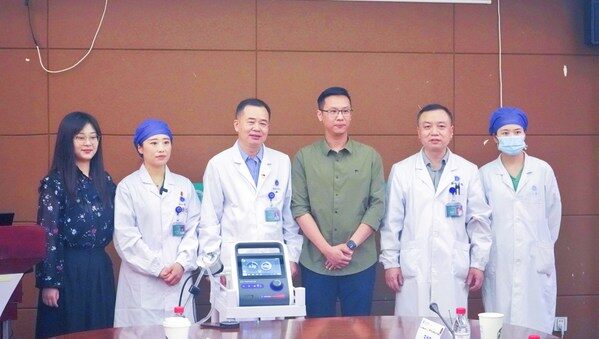
magAssist and Wuhan Union Hospital Officially Launch Clinical Trial for Extracorporeal Ventricular Assist Device
The extracorporeal magnetically levitated artificial heart can be used for patients with cardiogenic shock resulting from heart failure, or for patients whose hearts have lost pumping function due to external factors such as influenza or car accidents. Currently, only Abbott in the United States has a comparable product globally, and it has not yet been introduced to China.
MoyoAssist®in ChinaThe first oneThe world's first clinical trial of the independently developed, domestically produced extracorporeal magnetically levitated artificial heart, which is alsoChina's firstMulticenter clinical trial of an extracorporeal artificial heart. This study, led by Wuhan Union Hospital in collaboration with multiple renowned cardiac centers in China, is of great significance.
Case Presentation
The patient is a 31-year-old female with blood type O. In June 2020, she underwent bioprosthetic mitral valve replacement and atrial septal defect repair at an outside hospital due to infective endocarditis. Postoperatively, she experienced recurrent chest tightness and dyspnea, with symptoms worsening over the past two months and showing poor response to medical therapy. Upon admission, the patient continued to experience recurrent chest tightness and chest pain. Her condition was severe, necessitating prolonged bed rest. Symptomatic and supportive treatments were administered but yielded suboptimal results. The patient presented with severe heart failure symptoms, hypotension, and hemodynamic instability.
Due to the patient's blood type O and the prolonged waiting time for heart transplantation, conventional medical management was unsustainable. Following discussion, a decision was made to proceed with minimally invasive Extra-VAD implantation. Via an intercostal incision, a 28 Fr venous cannula was inserted through the right upper pulmonary vein, with its drainage port advanced into the left atrium; via the axillary artery, an 8 mm prosthetic vascular graft was placed and connected externally to the drainage circuit.
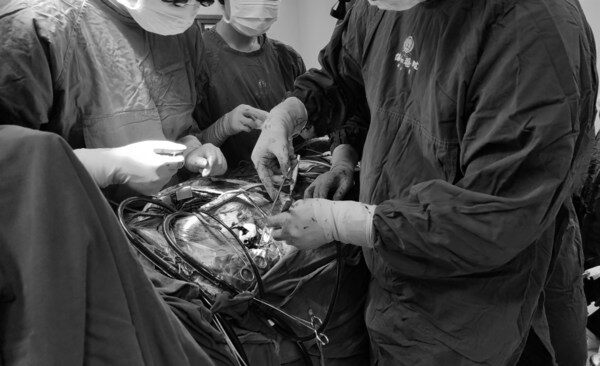
During Minimally Invasive Extra-VAD Implantation Surgery
The patient was extubated 10 hours postoperatively. On postoperative day 1, oxygen saturation increased to 75.2%, and blood lactate levels decreased from a preoperative value of 3.5 mmol/L to 1.5 mmol/L. Urine was clear with no evidence of hemolysis. By postoperative day 3, the patient was able to sit up and eat independently, and by day 5, could get out of bed and stand for mobilization. Throughout this period, the intervention was minimally invasive with rapid recovery, and the assist device functioned stably, maintaining normal and stable respiratory and hemodynamic parameters. Mechanical circulatory support served as a bridge to transplantation, securing crucial time while awaiting a donor heart. Twelve days later, the patient successfully underwent heart transplantation. Currently, the patient exhibits stable hemodynamics, a steady heart rate, and a favorable overall recovery status.

The patient is recovering well.
Professor Dong Nianguo from Wuhan Union Hospital stated: The extracorporeal magnetically levitated artificial heart not only involves minimal surgical trauma and provides significant circulatory support with fewer side effects, but also enables rapid patient recovery.
Currently, only one foreign company possesses extracorporeal artificial heart (Extra-VAD) technology, which is a fully magnetically levitated blood pump designed for short-term extracorporeal ventricular support. This product has obtained FDA and CE approvals but has not yet entered the Chinese market. Meanwhile, this product, jointly developed by Wuhan Union Hospital and magAssist, belongs toFirst in China, is an innovative product with independent intellectual property rights.
Professor Li Ping of Wuhan Union Hospital stated: The preoperative status of patients significantly influences postoperative outcomes following heart transplantation. Currently, preoperative management primarily relies on ECMO. When used as a bridge to heart transplantation, it is generally associated with high complication rates, frequent blood transfusions, increased graft rejection, and elevated patient mortality. In contrast, mid- to short-term use of Extra-VAD results in fewer complications. As a bridge to heart transplantation, Extra-VAD may offer advantages over VA-ECMO. It represents a promising bridging therapy for the future, and its distinctive features may be particularly well-suited to the Chinese healthcare system.
Specialized mechanical support strategies are crucial for optimizing transplant patient outcomes. magAssist's MoyoAssist®The patented magnetic levitation technology applied in the Extra-VAD delivers exceptional stability, ensuring the impeller remains unaffected by handling and vibration. This enables patients to mobilize out of bed, thereby shortening the recovery period. During long-distance emergency transport, its magnetic levitation stability and extended battery life offer distinct advantages.
Extracorporeal Magnetically Levitated Artificial Heart MoyoAssist®Ready for Launch
magAssist Extracorporeal Magnetically Levitated Artificial Heart (Extra-VAD), utilizingAdvancedComputational fluid dynamics technology and fully magnetic levitation technology deliver performance that meets the international gold standard for hemocompatibility. The technology originates fromGlobally LeadingArtificial Heart Research Institute. The hemodynamic design optimizes hemocompatibility, provides up to 30 days of support, reliably supports the potential clinical duration for Bridge to Recovery (BTR), Bridge to Transplant (BTT), and Bridge to Other Therapies (BTD), and ensures reduced surgical invasiveness and side effects.
The magnetically levitated motor device features an IPX4 waterproof rating, making it suitable for complex environments such as outdoor settings, operating rooms, and emergency departments. Equipped with a patented detachable and multi-angle fixation structure, it seamlessly adapts to complex ICU and ER environments, enabling medical staff to flexibly configure tubing circuits. The fully magnetically levitated impeller rotor delivers exceptional shock and torsional stability, meeting the requirements for patient transfers, inter-hospital movements, and cross-provincial long-distance transport. Its advanced front-end UI design ensures an intuitive human-machine interface, facilitating rapid deployment and exceptional portability during transport.
The advancement of this multi-center clinical trial will further validate the efficacy of MoyoAssist®, which is expected to deliver advanced technologies and improved treatment regimens to critically ill patients in need of urgent care.