

Korui Bio Advances TCR-Based Therapies to Break Through Solid Tumor Barriers with Two Clinical-Stage Products

CorreGene
Developer of Tumor Immunotherapy and Gene Therapy Technologies
textIn recent years, with the advancement of cell engineering technology and the accumulation of clinical experience, the efficacy and safety of CAR-T therapy have been significantly improved. Clinical trial results demonstrate that CAR-T products exhibit remarkable therapeutic effects against refractory and relapsed hematologic malignancies, with objective response rates (ORR) generally exceeding 70%–80%, and approaching nearly 100% for certain products. As follow-up durations extend, patients' overall survival (OS) is highly likely to continue surpassing 20 months, with some patients expected to achieve a clinical cure. Following the sequential market approval of five CAR-T cell therapy products in the United States and one in China, cellular immunotherapy has garnered widespread public attention.
Compared to the remarkable achievements of CAR-T in hematological malignancies, its therapeutic performance in solid tumors has been lackluster. In contrast, the sibling technology to CAR-T—TCR-T—holds greater advantages in the field of solid tumor treatment. Although, due to a combination of contingent and inevitable factors, the R&D progress of contemporaneous TCR-T innovative drugs has lagged behind that of CAR-T therapeutics.However, multiple clinical trials utilizing TCR-T therapy for solid tumors have demonstrated its promising prospects: results from several trials indicate that the objective response rate (ORR) approaches or exceeds 50%, and the therapeutic benefits can be durably maintained in the majority of patients who achieve a clinical response.
Focusing on the broad prospects of TCR-T innovative drugs and the technical barriers in their R&D, Beijing Kerui Biological Technology Co., Ltd. (hereinafter referred to as "Kerui Bio"), under the leadership of its professional R&D and management teams, has established a comprehensive TCR R&D platform. The platform encompasses TCR antigen epitope identification, single-cell and library-based TCR cloning strategies, and a proprietary SMART-TCR affinity optimization platform. Leveraging revolutionary T cell receptor (TCR) affinity optimization technology, it significantly enhances TCR screening efficiency and the success rate of affinity optimization, thereby breaking through the development barriers for TCR-T innovative drugs.
Cultivating both methodology and professional expertise internally and externally,
Chang Development Empowers PKU Medical Team to Set Sail
Founded in 2016, Beijing Kerui Biological Technology Co., Ltd. is primarily dedicated to the development of anti-tumor immunotherapy technologies and the exploration of gene therapy for genetic diseases, and was co-founded by several Peking University alumni and returning overseas scholars.In 2017, Beijing Kerui Biological Technology Co., Ltd. established an R&D laboratory and assembled a research team at the Peking University Healthcare Industrial Park. In 2019, Kerui Bio relocated its R&D center to the International Center for Precision Medicine Innovation at Beijing Changping Science Park Technology Development Co., Ltd. (abbreviated as "Changfazhan"), leveraging the laboratory and office spaces, instruments and equipment provided by the center, along with its integrated resources across the genetic testing and cell therapy ecosystem, to accelerate the pace of corporate development.
In October this year, Kerui Bio will relocate to the Changfazhan International Precision Medicine Accelerator Center to conduct GMP pilot production for TCR-T. Located in the Zhongguancun Life Science Park, the center serves as a transitional platform for projects to advance to the next phase after graduating from the International Precision Medicine Innovation Center.
In terms of its core team, the founding members of Kerui Bio are predominantly from Peking University, sharing over a decade of mutual trust and close collaboration. Among them, Dr. Xie Xingwang, CEO of Kerui Bio, has dedicated more than ten years to basic and clinical translational research in tumor immunology and tumor genomics at Peking University. His research group was one of the earliest institutions in China to conduct cellular immunotherapy and initiated China’s first clinical trial of a peptide vaccine for liver cancer treatment. Dr. Xie currently holds several professional affiliations, including Committee Member of the Tumor Multidisciplinary Diagnosis (MDD) Collaboration Group under the Tumor Biomarker Professional Committee of the China Anti-Cancer Association, and Committee Member of the Clinical Application of Pharmaceutical Biotechnology Professional Committee under the Chinese Society of Biomedical Technology.
When asked about Dr. Xie Xingwang's current scope of responsibilities at Kerui Bio, he said: “Based on my previous experience and expertise, I am currently primarily responsible for two areas at Kerui: resource integration and strategic planning.”Our core team covers the top-level design spanning the entire ‘Innovative R&D-Process Development-Quality Control-Clinical Translation’ chain.Besides myself, the other core members are also responsible for their respective areas of expertise.
Dr. Jiang Dong has over 20 years of experience in biomedical research and is currently responsible for technology R&D at Kerui; Dr. Wang Jianghua completed his undergraduate studies at the School of Pharmaceutical Sciences, Peking University, and has extensive research experience in cell biology and virology. His dual background in pharmacy and basic biology has provided him with a deeper understanding of process development and manufacturing for T-cell products, and he currently serves as the Head of Production and Operations at Kerui Biological; Dr. Li Yonghong and Dr. Wang Xueyan are responsible for quality management. The former was a researcher at the National Institutes for Food and Drug Control and participated in the compilation of the *Chinese Pharmacopoeia*, while the latter served as a core member in China’s first clinical trial of a peptide vaccine for the treatment of liver cancer.”
In addition to the strategic establishment of its team, Beijing Kerui Biological Technology Co., Ltd. leverages the conveniences provided by Changping Development regarding the space, capital, and industrial services essential for corporate growth—through its three core business segments of asset management, technology finance, and industrial services, Changping Development delivers tailored solutions including customized industrial spaces, industry-focused investment and financing, and in-depth industrial services.
For example, it integrates a combination of multiple specialized service platforms built around the entire pharmaceutical and healthcare industry chain—such as a shared platform for instruments, equipment, and testing services, third-party clinical testing laboratories, medical device CMOs, and one-stop innovative drug CROs—alongside industrial spaces like industrial parks. It also features programs such as the HIBIO·Innovation Acceleration Camp, which focuses on skill enhancement and course training, thereby covering the entire project lifecycle from incubation and acceleration to commercialization. At the capital level, Kerui Biological can leverage the Changfazhan Mother Fund and its proprietary direct investment fund operations to support its growth.
SMART-TCR Breaks Through the Technological Bottleneck of Affinity Optimization in the TCR Industry
With the joint support of the research team and Chang Development, Kerui Biological has established a comprehensive TCR R&D toolkit to facilitate the research, development, and clinical translation of TCR-based anti-tumor products.The TCR R&D toolkit comprises a T-cell signaling reporter system, a single-HLA cell library, a single-HLA exogenous peptide-presenting cell library, a human whole-genome epitope library, an X-Scan off-target screening system, a TCR single-cell sequencing platform, and an SMAR-TCR affinity optimization platform, enabling high-throughput development of novel TCR therapeutics.
Among them, the SMART-TCR affinity optimization platform employs an intracellular mutagenesis system to construct a high-throughput TCR mutant library. It then screens for optimized TCRs based on TCR-mediated tumor antigen recognition and cytotoxicity. Finally, by assessing the non-specific reactivity of TCRs against non-target antigens, it eliminates candidates that induce off-target killing, thereby yielding TCRs with high specificity and high affinity. The entire system operates as a closed-loop workflow that can be iterated through multiple rounds to achieve high-throughput affinity optimization screening, effectively addressing the industry bottleneck and pain point associated with the difficulty of obtaining high-affinity TCRs.
The SMART-TCR affinity optimization platform enables the development of TCR-T cell therapies and innovative TCR protein therapeutics. Currently, Kerui Biological has successfully identified multiple specific TCRs with nanomolar affinity targeting antigens such as HPV and KRAS G12V, and is conducting in vivo evaluations of TCR-T in animal models. Furthermore, Kerui Biological holds proprietary bispecific TCR protein structures for the development of TCR protein therapeutics.
Additionally, Kerui Bio has established a complete CMC system for TCR-T., including a 1,000-square-meter GMP-compliant cell manufacturing facility supporting production needs for TCR-T clinical trials; a TCR-T expansion and culture process to ensure T cells achieve over 200-fold expansion within an 8-day culture period, with a TCR positivity rate of 60-70%; and relevant quality control and quality assurance systems.Through collaboration with leading industry suppliers, Kerui Biologics will also establish a complete lentiviral suspension manufacturing process to fully meet subsequent commercial production requirements.
7 Innovative TCR-Based Drugs in Development, 2 to Begin Clinical Trial Enrollment by Year-End
Based on the aforementioned platforms and systems, Kerui Biologics currently has multiple first-in-class TCR-T cell therapy products and soluble TCR protein therapeutics under development, including the first cell therapy in China targeting KRAS G12 mutations and the world's first TCR protein therapeutic for the treatment of HPV infectious diseases.
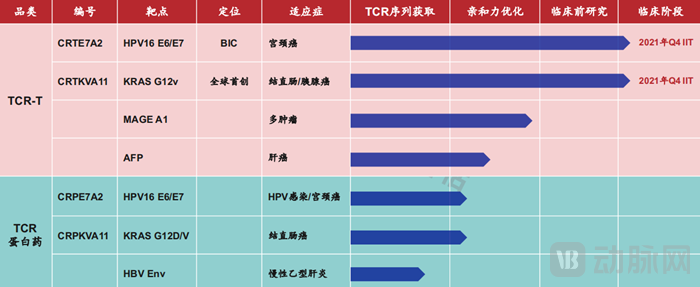
Product Pipeline
The core product, CRTE7A2, is intended for the treatment of HPV-related diseases and is currently in the ethics application stage.The target recognized by this drug is HPV16 E7. Currently, the only TCR-T product developed internationally targeting HPV16 E7 is KITE-439 from Gilead Sciences (USA), with its published exploratory clinical trial data demonstrating remarkable efficacy against HPV-related advanced tumors, whereas no reports exist in China regarding TCR-T products developed against the HPV16 E7 target.CRTE7A2 is ready to initiate clinical trials, with patient enrollment expected to begin in Q4 of this year.
Another core product is CRTKVA11, the world's first cell therapy drug targeting the KRAS G12V mutation, indicated for colorectal and pancreatic cancer. The project is currently in the ethics committee application stage., specifically targeting KRAS G12V. Currently, no drugs targeting the KRAS G12V mutation have entered clinical development worldwide. CRTKV11, developed by Kerui, has demonstrated exceptional pharmacological efficacy and a favorable safety profile in preclinical studies.CRTKV11 is ready to initiate clinical trials, with patient enrollment expected to begin in Q4 of this year.
In addition to the aforementioned pipeline products, Kerui Bio is actively pursuing collaborations with other enterprises and institutions. Currently, Kerui Bio has partnered with Anlong Bio to co-develop gene therapy products and has been deeply involved in the research and development of Anlong Bio's first gene therapy product—an AAV gene therapy drug targeting wet AMD. Furthermore, Kerui Bio has collaborated with institutions such as Beijing Obstetrics and Gynecology Hospital, Beijing Cancer Hospital, the GCP Center of Cancer Hospital, Chinese Academy of Medical Sciences, and The First Affiliated Hospital of Zhengzhou University to conduct non-registrational clinical studies focusing on HPV-associated cervical cancer and cervical intraepithelial neoplasia, KRAS-mutated colorectal and pancreatic cancers, and CRTE7A2 TCR-T therapy for HPV16-associated advanced cervical cancer, thereby accelerating project progression and clinical translation.
Leveraging Chinese-Produced Material Suppliers to Reduce CGT Costs and Advance the Industrial Chain
In addition to the platforms and products introduced above, Kerui Bio has another distinctive feature—its supply chain actively incorporates domestic material suppliers.。When asked why domestic suppliers were chosen, Xie Xingwang stated: “The primary barrier to the widespread adoption of cell therapy products is currently pricing. To effectively control costs and lower prices, the most effective approach is to achieve cost reduction at the source. We are willing to grow alongside emerging domestic CGT suppliers such as Shenyan Biotechnology, and we are pleased to share our manufacturing processes, materials, and equipment with the industry. We call on cell therapy enterprises to establish localized product and supply chains, working together to promote the healthy development of China’s CGT industry.”
When asked about the current development focus, Xie Xingwang stated: "In the short term, Kerui Biotech will prioritize the development of the CRTE7A2 and CRTKV11 programs and rapidly bring them to market. In addition to product R&D, the company is also steadily advancing in team building and collaborations with research institutions and investment firms.At the end of 2019, Beijing Kerui Biological Technology Co., Ltd. secured an angel round investment of RMB 20 million from Anlong Fund, along with equipment and laboratory facility support from Changping Development. Recently, Kerui Bio will close a Pre-A financing round of tens of millions of RMB, with the proceeds to be used for the IND application of its core project and the advancement of other product pipelines.”
Currently, only about a dozen companies worldwide are researching TCR-T therapy technology., Characterized by strong technological innovation and significant development challenges, the bottlenecks are primarily concentrated in target screening, clonal specificity, and affinity optimization. Beijing Kerui Biological Technology Co., Ltd. has established a proprietary TCR discovery and affinity optimization platform, enabling high-throughput affinity optimization screening. This allows for the acquisition of antigen-specific TCRs within two weeks, effectively breaking through the development barriers for innovative TCR-T therapeutics.
In 2023, Beijing Kerui Biological Technology Co., Ltd. plans to establish a commercial manufacturing facility at the Changping Life Valley Industrial Base to support the registration and commercialization of its TCR-T products. Meanwhile, addressing the lack of effective clinical treatments for tumors such as HPV-related advanced cervical cancer, the company is developing a TCR product capable of specifically recognizing the HPV16 E7 antigen and killing antigen-positive cells. This product is also scheduled to obtain Investigational New Drug (IND) approval and enter clinical trials in 2023, aiming to fill the current market gap for effective therapies against advanced cervical cancer.
In the future, Kerui Bio will develop multiple indication programs across three therapeutic areas—oncology, chronic infections, and autoimmune diseases—through two product modalities: cell therapy drugs and soluble TCR protein therapeutics, targeting a trillion-dollar disease market. The company will pursue dual regulatory filings in China and the United States to enter the North American market, and gradually expand into the global market through co-development or licensing partnerships.