

Sanofi Showcases Innovation Achievements at China International Fair for Trade in Services 2021

Sanofi
Pharmaceutical R&D Developer
BEIJING, Sept. 7, 2021 /PRNewswire/ -- Sanofi, a world-leading biopharmaceutical company, showcased multiple innovative achievements at the 2021 China International Fair for Trade in Services (CIFTIS), comprehensively demonstrating Sanofi China's sustained investment in pharmaceutical R&D, vaccine innovation, and primary healthcare services.
“As one of the three major exhibition platforms for China's opening-up to the outside world, the China International Fair for Trade in Services has created tremendous opportunities for the development of foreign-invested enterprises in China, further bolstering our confidence in continuing to invest in the country.”Zhu Hailuan, Head of Government Relations and Market Access at Sanofi China, said,“As one of the first multinational pharmaceutical companies to take root in China,Sanofi will usher in next year40Anniversary. Sanofi maintains a long-term commitment to China. We are not only accelerating the introduction of globally leading innovative medicines to China, but will also fully leverage our global R&D capabilities and local insights to actively participate in China’s innovation ecosystem, and are committed to enhancing healthcare accessibility to benefit the broadest population in China, in support of the 14th Five-Year Plan and2035Contribute to the long-term vision.”
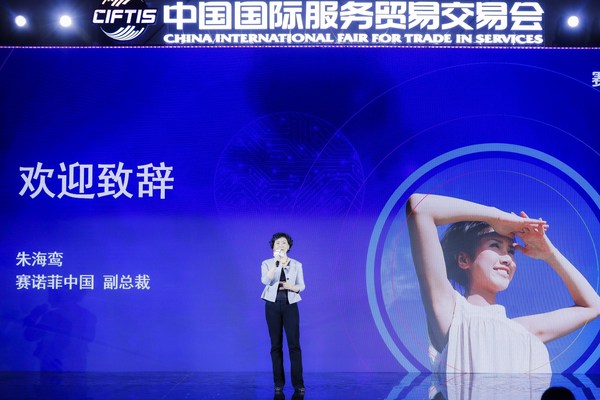
Remarks by Ms. Zhu Hailuan, Vice President, Sanofi China
The China International Fair for Trade in Services (CIFTIS), jointly hosted by the Ministry of Commerce of the People's Republic of China and the Beijing Municipal People's Government, is a comprehensive exhibition aligned with the rapid development of global trade in services. It has become a vital platform for sharing business opportunities and fostering common development in the international trade in services sector. At this CIFTIS, Sanofi China, under the theme "Accelerating Innovation, Bringing Health to Every Chinese," will centrally showcase its achievements in accelerating basic research and drug R&D, advancing vaccine innovation to expand vaccine accessibility, and its five-year dedicated initiative focused on building county- and city-level chest pain centers and enhancing interventional diagnostic and treatment capabilities. These efforts comprehensively demonstrate Sanofi China's integrated solutions for disease and health management. Over its nearly 40 years in China, Sanofi has actively pursued innovation and deeply cultivated both urban and county markets, introducing more than 40 high-quality innovative drugs and vaccines to deliver diverse innovative health services to the Chinese people.
To better serve the Chinese public, Sanofi's first global research institute in China was officially completed and inaugurated this year in the Suzhou Industrial Park. This institute is the fourth global research institute established by Sanofi, and alsoSanofi's first in ChinaThe Global Research Institute will enhance Sanofi’s early-stage research capabilities in oncology, immunology, and inflammation, address the pressing unmet medical needs in these fields by accelerating basic research and drug development, actively integrate into China’s biopharmaceutical R&D ecosystem, forge China’s innovation engine through zero-to-one local innovation, and accelerate the translation of R&D outcomes into therapies that tangibly improve patient health.
As Sanofi’s vaccines division, Sanofi Pasteur has cumulatively invested 1.2 billion RMB since 2007 to construct in ShenzhenChina's first and currently onlyA foreign-invested vaccine facility meeting international standards has achieved localized production of influenza vaccines. Notably, as a significant milestone in Sino-French vaccine cooperation and a major livelihood project jointly developed by the Shenzhen Municipal Government and Sanofi Pasteur, the Greater Bay Area International Vaccine Innovation Center is scheduled to be completed and become operational in the second half of this year. As China’s first international vaccine innovation center, it will be dedicated to uniting stakeholders across government, industry, and the public; creating a comprehensive innovation hub that integrates public education, perspectives showcase, academic exchange, industry forums, and innovation incubation; and championing the advancement of public health, the end-to-end innovation and upgrading of the vaccine industry, and the bridging of gaps in public understanding—all initiatives conducive to "shifting perceptions and driving innovation."”action.
County-level hospitals in China serve a population of over 900 million, accounting for more than 64% of China's total population, with a substantial demand for standardized diagnosis and treatment as well as disease management. However, compared to this massive patient population, the primary healthcare system faces unmet needs in hospital management, the clinical proficiency of medical personnel, and patient disease management, a disparity that is becoming increasingly pronounced. As Sanofi China,First batchOne of the multinational pharmaceutical companies that established an independent business unit in China to support primary healthcare development has been deeply engaged in the grassroots sector over the past decade, launching multiple initiatives. A typical example is the "County and City-Level Chest Pain Center Construction and Interventional Diagnosis and Treatment Capacity Enhancement Project," a flagship initiative honed over five years of dedicated effort. Focusing on standardized treatment training and chest pain center construction training for cardiovascular physicians at the county and city levels, the project aims to, through standardized guidance, enhance the diagnostic and differential diagnosis capabilities of primary healthcare professionals for acute myocardial infarction (AMI) patients, while assisting county and city hospitals in establishing standardized chest pain centers and obtaining official Chest Pain Center certification. To date, over 2,400 county-level hospitals have joined the chest pain center construction initiative, including 1,018 that have already achieved certification. The program spans 25 provinces, 308 cities, and 1,554 county-level regions across China, benefiting more than 2 million patients in these areas.