

Boston Scientific Bolsters Urology Franchise Amid Billion-Dollar Revenue Growth

Boston Scientific
Medical Device Manufacturer
A soccer match brought John Abele and Pete Nicholas together. Shortly thereafter, the two co-founded a company. Full of ambition and confidence, they pledged to develop the company into an industry leader.
More than forty years later, this commitment became a reality. In the 2020 World Top 100 Medical Device Companies list published by Greenlight, Boston Scientific (NYSE: BSX) ranked 15th with nearly $9.9 billion in revenue.
Today, Boston Scientific is further expanding its strategic presence across multiple medical fields. In September this year, the company announced the acquisition of Lumenis Ltd.'s global surgical business from an affiliate of Baring Private Equity Asia (BPEA), which includes laser systems, fibers, and accessories for urological and otolaryngological (ENT) procedures.
Boston Scientific Senior Vice President and President of the Urology and Pelvic Health Division Meghan Scanlon stated: “MOSES laser technology, combined with Boston Scientific’s LithoVue single-use digital flexible ureteroscope and comprehensive kidney stone management portfolio, will enable the execution of our stone management business strategy.”
Boston Scientific’s business in the urology field dates back to its early years, with catheters for bladder stone surgery included among its first commercially launched products; in the 1980s, the acquisition of Van-Tec, which specialized in ureteral stents, significantly advanced its urology business; and in subsequent years, it has continuously strengthened its position in urology through a series of strategic acquisitions.
This article focuses on Boston Scientific's urology-related business, aiming to trace the growth trajectory of its urological segment.
A Winding Road to Growth: Acquisitions Are a Double-Edged Sword
Boston Scientific is a medical device giant renowned for minimally invasive interventional surgical devices and consumables. Founded in 1979, it is headquartered in Marlborough, Massachusetts, USA.
After more than 40 years of development, Boston Scientific now has 38,000 employees globally, with its 17,000 products sold in over 120 countries and regions worldwide.
The company's business encompasses three major segments: MedSurg, Rhythm Management, and Cardiovascular, covering Interventional Cardiology, Electrophysiology, Cardiac Rhythm Management, Neuromodulation, Peripheral and Oncology Interventions, Endoscopic Interventions, Urology, and Pelvic Floor Health, among others.Main products are as follows:
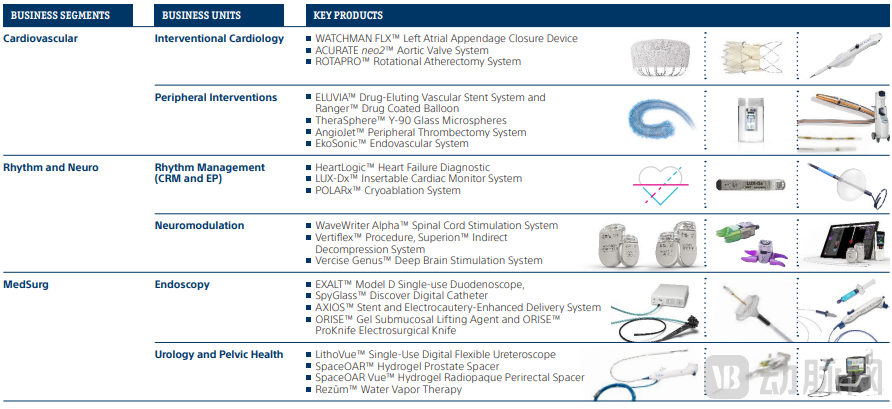
Source: Boston Scientific Official Website
Tracing back to its origins, it was a soccer match that brought together the two founders of Boston Scientific—John Abele and Pete Nicholas. At the time, John Abele was seeking investment for Medi-Tech, a medical device company, while Pete Nicholas intended to establish a new venture. The two quickly hit it off and decided to join forces.
Drawing on Medi-Tech's expertise in interventional technologies, Boston Scientific initially focused its business on catheters and other interventional devices and instruments. This marked the beginning of the company's rapid growth. During the 1980s, it acquired a series of companies, expanding its product portfolio to span multiple clinical specialties, including cardiology, pulmonology, gastroenterology, and urology, while simultaneously establishing its international operations.
In May 1992, Boston Scientific was listed on the New York Stock Exchange. Between 1994 and 1997, the company undertook a series of intensive acquisitions. Among them, the acquisition of Scimed, a coronary catheter manufacturer, doubled the company's size and solidified its leadership in interventional therapies; while the acquisition of Target Therapeutics enabled the company to rapidly establish a competitive advantage in neurointervention.
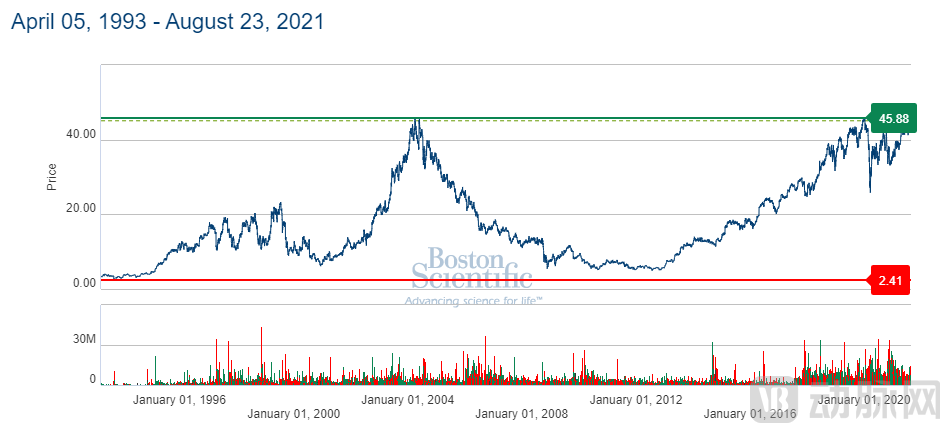
Acquisitions are one of Boston Scientific's strategic expansion approaches. On the one hand, they enhance the competitiveness of the company's core business; on the other hand, they diversify its business portfolio, spread operational risks, and increase flexibility in product development. As Boston Scientific's business continues to advance, its stock price has begun to climb.
Source: Boston Scientific Official Website
However, looking at Boston Scientific’s stock price chart, the share price plummeted between 1999 and 2000. In fact, as early as 1997, the company’s development encountered numerous challenges, including sales declines, product recalls, and delays in bringing products to market on schedule.
It was not until 2004, when Boston Scientific launched the Taxus coronary drug-eluting stent, that the product's market debut drove its stock price to a peak.
In 2005, Boston Scientific decided to expand its product portfolio once again through acquisition, but this move resulted in a severe setback. The acquisition of Guidant not only required Boston Scientific to pay a staggering $27 billion, but also exacted a heavy toll due to product quality issues. Even by 2015, the shadow of this acquisition had not fully dissipated; to resolve litigation stemming from the deal, the company paid Johnson & Johnson $600 million.
This acquisition appeared to be a turning point, after which Boston Scientific encountered a series of product development setbacks. In 2011, its stock price plummeted to a new low.
In the same year, the new CEO—Michael Mahoney—took office and implemented corporate reforms.As part of its strategic restructuring, Boston Scientific successively acquired a series of companies between 2010 and 2018 to strengthen its peripheral intervention, urology, and other business segments, while simultaneously increasing investments in emerging markets. Starting in 2014, the company returned to profitability.
Over the years, it has become evident that acquisitions have consistently remained a core strategy for Boston Scientific. While acquisitions have historically brought the company diversified and rapidly growing business segments, it has also been plunged into a severe crisis due to its "relentless acquisitions".Following a period of setback, Boston Scientific's acquisition strategy has become more disciplined, prioritizing earlier-stage startups and focusing on its core therapeutic areas.
Urology and Pelvic Floor Health Business Becomes New Growth Driver
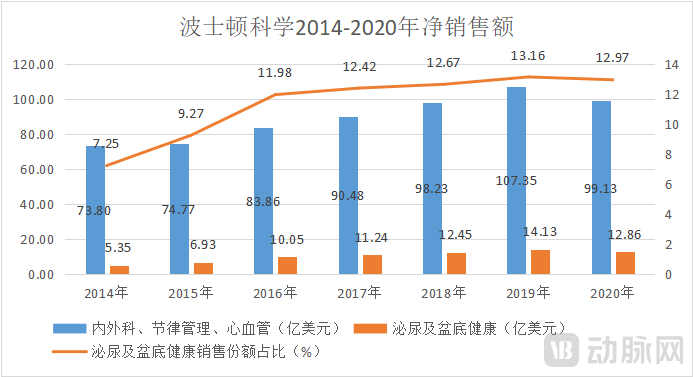
Impacted by the pandemic, Boston Scientific's revenue declined in 2020; however, it had already delivered six years of strong performance prior to that. According to its annual report data, from 2014 to 2019, its net product sales demonstrated a sustained growth trend, with the business growth rate consistently maintained at or above 8%.
Data Source: Boston Scientific Official Website - Annual Report
Based on the revenue data for the Urology and Pelvic Health business, sales had already surpassed $1 billion starting in 2016, reaching $1.413 billion in 2019.
In 2020, net sales for this business were $1.286 billion, a decrease of $127 million compared to 2019, primarily due to the negative impact of the pandemic and related business changes offsetting growth. Despite the decline, inFrom 2014 to 2019, the net sales of this business also exhibited an upward trend, and its growth rate exceeded the company's average.
6 Major Series, Extensive Product Portfolio
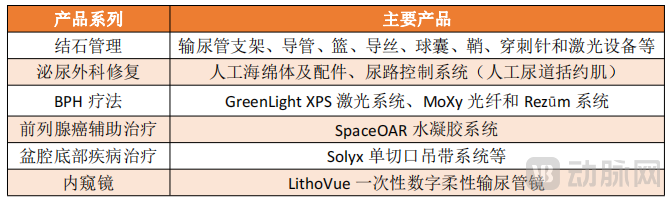
Boston Scientific’s Urology and Pelvic Health business primarily develops medical devices for the treatment of various urological and pelvic conditions, including kidney stones, BPH, prostate cancer, erectile dysfunction, incontinence, and pelvic floor disorders. Currently, the business offers products across six major product lines.
Source: Boston Scientific official website
Among them, the key featured products include the LithoVue single-use digital ureteroscope, Rezūm water vapor therapy, AccuTrac, Flexiva single-use fiber, and SpaceOAR hydrogel.
Stone and prostate health products are key growth drivers.
Overall, stone and prostate health products are the primary growth drivers for the urology and pelvic floor health business.
In stone management, Boston Scientific not only offers a comprehensive product portfolio but also remains committed to innovation. Its stone management devices include instruments for access creation, lithotripsy and stone extraction, drainage, dilation, and percutaneous nephrostomy. Notably, the LithoVue Empower stone extraction device launched by Boston Scientific has been honored with the Medical Design Excellence Award (MDEA).
Studies have shown that during ureteroscopy, kidney stone retrieval is one of the most time-consuming steps and requires a high degree of coordination from the urologist throughout the procedure. When used in conjunction with the LithoVue single-use digital flexible ureteroscope, LithoVue Empower enables a single surgeon to directly control the stone retrieval basket during flexible ureteroscopy without the need for an assistant.
In prostate health management, the primary focus is on BPH and prostate cancer, with representative products being the Rezūm system and SpaceOAR hydrogel, respectively.
The Rezūm system is a minimally invasive treatment option powered by convective water vapor energy, delivering the thermal energy stored in water vapor in a targeted and controlled manner directly to the prostate region to ablate tissue. Over time, the ablated tissue is naturally reabsorbed by the body, thereby reducing tissue volume to treat benign prostatic hyperplasia (BPH). This procedure can be performed in an outpatient setting, and patients typically experience symptom improvement within two weeks.
SpaceOAR Hydrogel is a therapy designed to reduce rectal radiation injury associated with prostate cancer radiotherapy. By injecting a biodegradable hydrogel between the prostate and the rectum, it minimizes radiation exposure to surrounding periprostatic organs and tissues throughout the course of radiation treatment. Currently, this therapy is expanding into the European market.
Leveraging Acquisitions to Strengthen Business
The aforementioned Rezūm system and SpaceOAR hydrogel originated from Boston Scientific's acquisitions of Nxthera and Augmenix in 2018. Strengthening its business through acquisitions is a standard practice for Boston Scientific.
In its annual report, Boston Scientific stated that mergers and acquisitions remain its top priority.Its commercial strategy is to strengthen the market-leading position of its core products and expand into high-growth markets. The company integrates internally developed products with products and technologies acquired externally through strategic acquisitions, alliances, and other investments to reinforce its global expansion and pursue diversification opportunities.
This article provides a non-exhaustive list of its acquisitions in the urology and pelvic health sector, as shown in the table below:
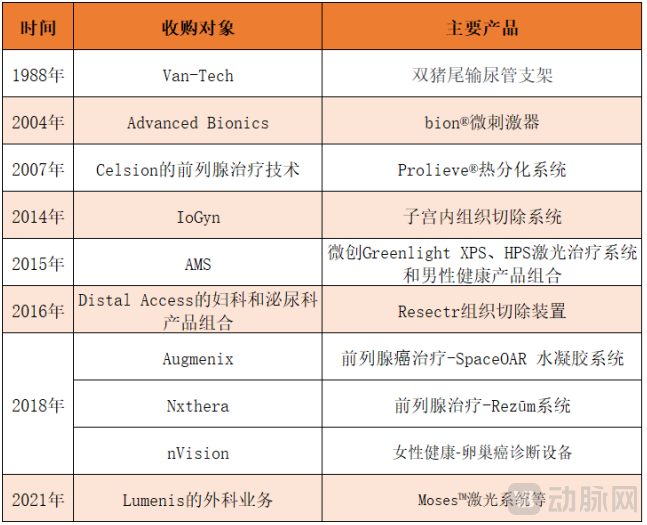
Urology and Pelvic Health Business-Related Acquisitions (Incomplete Statistics) Source: Boston Scientific Official Website, Huaan Securities Coronary Stent Report
In March 2021, Boston Scientific announced the acquisition of Lumenis's global surgical business for $1.07 billion. The acquisition was completed in September, marking the company's second major acquisition of 2021 and its fourth strategic expansion in the urology and pelvic health business in recent years.
Prior to the acquisition, Boston Scientific and Lumenis had collaborated for over 20 years, giving Boston Scientific a thorough understanding of the strengths of Lumenis's products. This acquisition will add a formidable asset to Boston Scientific's stone management portfolio: Lumenis's flagship Moses laser system. Launched in 2017, the system utilizes unique pulse modulation to optimize energy delivery, effectively enhancing stone fragmentation efficiency and reducing procedure times.
The urology sector, marked by frequent strategic moves, is clearly a key focus for Boston Scientific in recent years.Meghan Scanlon stated at the Cowen Virtual Healthcare Conference that, compared to 5 or 6 years ago, Boston Scientific's Urology and Pelvic Health business through“Organic Growth + Acquisitions”approach has already expanded threefold. In the Q2 2021 financial report released by Boston Scientific, operating sales for the Urology & Pelvic Health business increased by 70.4% year-on-year.
`Boston Scientific in China`
International operations are a long-term development strategy for Boston Scientific. In 2020 and 2019, international net sales accounted for 42% of total sales, compared to 44% in 2018.
In its international operations, Boston Scientific has steadily increased its investment in emerging markets. In 2020, net sales from its 20 designated emerging markets accounted for 11% of total net sales, compared to 12% in 2019.
China is considered one of the emerging markets of strategic significance to its future development. Boston Scientific entered China in 1997 and has expanded its operations here for over 20 years. Its China headquarters is located in Shanghai, with branch offices and R&D centers also established in Beijing, Guangzhou, Chengdu, and other cities.
In 2020, Boston Scientific invested $1 billion in product research and development. The company prioritizes product innovation and continues to increase its investment in China. Since 2013, Boston Scientific has established innovation training academies and innovation centers in cities such as Shanghai, Beijing, and Chengdu to accelerate the commercialization of innovative technologies and integrate into the local healthcare ecosystem.
In 2014, Boston Scientific launched its first corporate strategic plan in China—the "Innovation Shockwave"—to support effective innovation in China's healthcare sector. In August 2018, it jointly established the T3 (Technology, Transformation, Think Tank) Innovation Hub with the Technology Transfer Institute of Tsinghua University, aiming to attract outstanding talent and resources from the global healthcare ecosystem to China.
Art Butcher, President of Boston Scientific Asia Pacific, and Ms. Zhang Jun, President of Boston Scientific Greater China, have both stated that the Chinese market is an extremely important market within Boston Scientific's global strategy.
According to the *Medical Device Blue Book: China Medical Device Industry Development Report (2019)*, jointly published by the Chinese Society for Drug Regulation and the Social Sciences Academic Press, China has become the world's second-largest medical device market, with its market size projected to exceed RMB 900 billion in 2022.
The Chinese market holds tremendous opportunities. Taking nephrolithiasis (kidney stones), a urological disease, as an example, it is one of the most common diseases of the adult urinary system. A 2017 nationwide cross-sectional epidemiological study on adult kidney stones revealed that the prevalence among Chinese adults is 5.8%, indicating that nearly one in every 17 individuals suffers from the condition.
As a device-intensive department, urology is seeing market expectations for the emergence of more innovative medical devices to deliver more efficient and safer treatment experiences for patients.
Already a global giant in cardiovascular intervention, Boston Scientific has been significantly expanding its urology business in recent years. Let us explore how it is leading innovation in urological medical devices and making waves in both the Chinese and global markets.
References:
[1] Boston Scientific. Annual Report.
[2] Huaan Securities. Drawing on International Development Experience: Report on the Competitive Breakthrough of Domestic Coronary Stents. 2021.07.30
[3]MedTrend. Why Is Lumenis Being Sold Again? What Did Boston Scientific Acquire for $1.1 Billion?. 2021.03.05