

Medtronic's Pipeline™ Flow Diverter Receives Further Clinical Validation in Landmark PEDESTRIAN Study

Medtronic
Chronic Disease Medical Device and Therapy Developer
Shanghai, September 202130Date /PRNewswire/ -- In September 2021, the journal 《Neurosurgery》 newly published PEDESTRIAN1study, which had a profound impact on the entire neurointerventional academic community. The PEDESTRIAN study evaluated the PipelineTMFlow-diverting stent technology: the largest real-world study with the longest follow-up period has once again validated the efficacy and safety of this technology. PipelineTMFlow-diverting stent technology has also fundamentally transformed the treatment paradigm for intracranial aneurysms.
Intracranial aneurysm is a saccular outpouching of cerebral arteries resulting from localized structural abnormalities, and it is one of the most common cerebrovascular diseases. Its prevalence is approximately 4.05%. Prone to rupture and hemorrhage, it constitutes the most common cause of spontaneous subarachnoid hemorrhage. Upon rupture, approximately 8%–30% of patients die before hospital admission. If rebleeding occurs, the mortality rate can reach as high as 70%. Early and accurate diagnosis and treatment are of critical importance in reducing the rates of aneurysm rupture, disability, and mortality.2。
Clinical treatment of aneurysms is predominantly surgical, with specific treatment options mainly including endovascular embolization and surgical clipping via craniotomy.2. Since 2002, the former has gradually become the preferred option.
Over time, endovascular treatment technologies for intracranial aneurysms have undergone continuous upgrades and iterations. In 2011, the U.S. FDA approved a new technology, the first-generation PipelineTMFlow diverter stent technology.
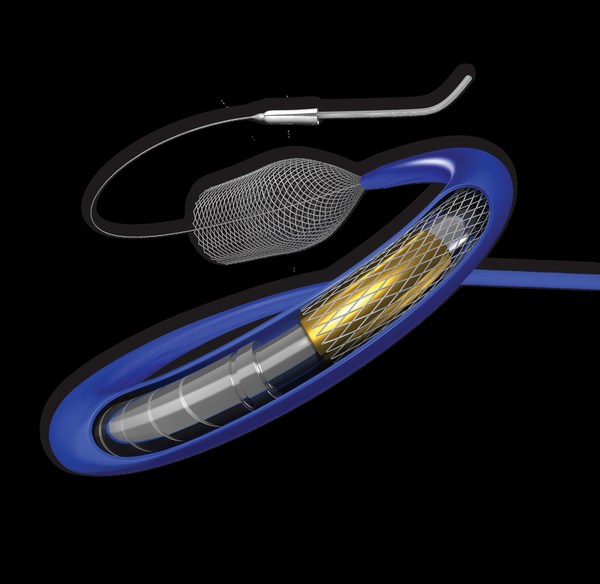
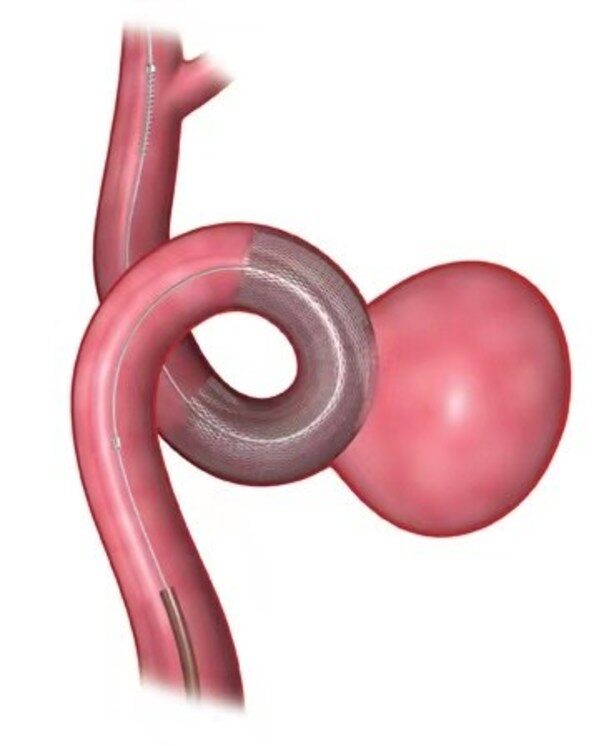
PipelineTMFlow-diverting stents can repair the diseased vascular segments harboring intracranial aneurysms and reconstruct the local arteries. This has fundamentally transformed the treatment paradigm for intracranial aneurysms; in a sense, it represents both a product and a therapeutic strategy. The two primary mechanisms of action of this technology in treating aneurysms are:(1)Disrupts blood flow from the parent artery into the aneurysm, causing blood stasis within the aneurysm, promoting intrasaccular thrombosis, and thereby achieving complete occlusion. (2) Serves as a "scaffold" for vascular endothelial cell migration and proliferation; once covered by endothelial cells, it forms a permanent biological seal at the aneurysm neck.
Traditional endovascular coil embolization strategies have certain limitations, as the ultimate goal of aneurysm treatment is permanent occlusion, which requires sealing the aneurysm neck to block the blood inflow pathway. Traditional endovascular therapy, however, focuses primarily on embolizing the aneurysm sac, akin to filling a road pothole with earth and stones. In contrast, flow-diverting stents function differently; they can reconstruct the parent vessel and completely repair the diseased segment, analogous to entirely repaving a damaged roadway. Consequently, they are one of the preferred methods for achieving a permanent cure for aneurysms.3。
The continuous improvement and indisputable clinical outcomes of flow-diverting stents have led to widespread recognition among clinicians of the clinical value of this technology.3. First, in 2014, the second-generation Pipeline technologyTMThe Flex flow diverter technology received FDA and CE approval; followed closely in 2015 by the third-generation Pipeline technology.TMFlex with Shield TechnologyTMObtained European CE certification.
In the Chinese market, the second-generation Pipeline technology in 2017TMThe Flex flow-diverting stent technology has received approval from China's CFDA (now renamed the NMPA) and has officially launched to serve patients across China.
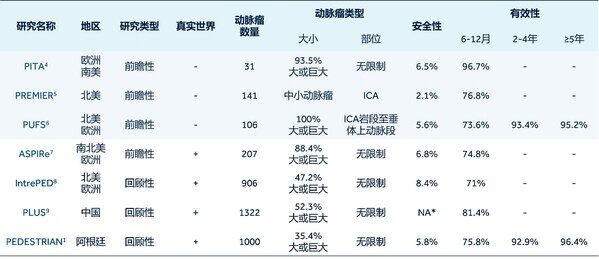
PipelineTMLarge-sample, high-quality clinical studies on flow-diverting stent technology are also continuously advancing, starting from the PITA published in 20114PEDESTRIAN Study: From Initiation Through September 20211Research, the efficacy and safety of this technology have been repeatedly validated by numerous clinical studies.
*Note:
1. PLUS9 The study reported the counts of individual complications but did not calculate the overall complication rate; therefore, this is not specified here.
2. Safety is represented by the incidence rate of major adverse events.
Over the past decade, tens of thousands of domestic and international patients have received treatment with this technology, fromAdvancedPatients benefit from this medical technology, and in the future, more patients will be treated with it, thereby restoring their health and extending their truly high-quality lifespan.
References:
1. Lylyk I, Scrivano E, etc. Pipeline Embolization Devices for the Treatment of Intracranial Aneurysms, Single-Center Registry: Long-Term Angiographic and Clinical Outcomes from 1000 Aneurysms. Neurosurgery. 2021 Jun 7;89(3):443–9. doi: 10.1093/neuros/nyab183. Epub ahead of print. PMID: 34098575; PMCID: PMC8374967
2. Wang Yi. Analysis of Related Risk Factors for Rupture of Intracranial Aneurysms[D]. Jilin University, 2011.
3. Satoshi Tateshima. Basics of the Flow Diverter: Development and Principles. Journal of Neuroendovascular Therapy 2017; 11(3):105–108. DOI: 10.5797/jnet.ra-diver ter.2016-0027
4. Nelson PK, Lylyk P, etc. The pipeline embolization device for the intracranial treatment of aneurysms trial. AJNR Am J Neuroradiol. 2011 Jan;32(1):34-40. doi: 10.3174/ajnr.A2421. Epub 2010 Dec 9. PMID: 21148256; PMCID: PMC7964968.
5. Hanel RA, Kallmes DF, etc. Prospective study on embolization of intracranial aneurysms with the pipeline device: the PREMIER study 1 year results. J Neurointerv Surg. 2020 Jan;12(1):62-66. doi: 10.1136/neurintsurg-2019-015091. Epub 2019 Jul 15. PMID: 31308197; PMCID: PMC6996098.
6. Becske T, Brinjikji W, etc. Long-Term Clinical and Angiographic Outcomes Following Pipeline Embolization Device Treatment of Complex Internal Carotid Artery Aneurysms: Five-Year Results of the Pipeline for Uncoilable or Failed Aneurysms Trial. Neurosurgery. 2017 Jan 1;80(1):40-48. doi: 10.1093/neuros/nyw014. PMID: 28362885.
7. Kallmes DF, Brinjikji W, etc. Aneurysm Study of Pipeline in an Observational Registry (ASPIRe). Interv Neurol. 2016 Jun;5(1-2):89-99. doi: 10.1159/000446503. Epub 2016 May 26. PMID: 27610126; PMCID: PMC4934472.
8. Kallmes DF, Hanel R, etc. International retrospective study of the pipeline embolization device: a multicenter aneurysm treatment study. AJNR Am J Neuroradiol. 2015 Jan;36(1):108-15. doi: 10.3174/ajnr.A4111. Epub 2014 Oct 29. Erratum in: AJNR Am J Neuroradiol. 2015 May;36(5):E39-40. PMID: 25355814; PMCID: PMC7965920.
9. Luo B, Kang H, etc. Pipeline Embolization device for intracranial aneurysms in a large Chinese cohort: factors related to aneurysm occlusion. Ther Adv Neurol Disord. 2020 Nov 2;13:1756286420967828. doi: 10.1177/1756286420967828. PMID: 33224273; PMCID: PMC7649855.
*This article is intended to convey cutting-edge medical information and research advancements for educational or popular science purposes only. It should not be construed as a recommendation or proof of efficacy for the medical products involved. For matters pertaining to disease diagnosis, treatment, or rehabilitation, please visit a professional medical institution and seek professional medical advice.