

Opening the Door to Gene Activation: Ractigen Therapeutics Pioneers a New Era in saRNA-Based Therapeutics

Ractigen Therapeutics
Innovative Drug R&D Developer
RNA activation technology utilizes small activating RNA (saRNA, also known as small activation RNA) to reactivate endogenous gene expression and restore the physiological function of proteins, thereby achieving therapeutic objectives. This technologyOvercoming the limitation of existing targeted therapeutic agents that can only inhibit the expression of target genes and proteins, it provides a novel strategy for treating various diseases caused by functional protein deficiency or low expression.
RNA activation is currently the only disruptive technology capable of achieving endogenous gene activation that has entered clinical validation. In recent years, RNA activation therapy has rapidly gained global traction, with industry leaders such as Ractigen and MiNA Therapeutics accelerating their strategic deployment in this field.
Overseas, the RNA-activating therapeutic developed by MiNA Therapeutics entered clinical trials in 2016, becoming the world’s first RNA activation drug to reach clinical development. The company currently has a pipeline candidate advanced to Phase II clinical trials. Capitalizing on the scarcity of small activating RNA (saRNA) therapeutics and the cutting-edge nature of RNA activation technology, MiNA Therapeutics has established partnerships with major multinational pharmaceutical companies, including Eli Lilly, AstraZeneca, Boehringer Ingelheim, and Servier, to develop novel drugs utilizing RNA activation therapy.
In China, Ractigen, founded by Dr. Longcheng Li, the discoverer of RNA activation, has attracted significant attention.
2In 2006, Li Longcheng first discovered and named the phenomenon of RNA activation globally.In 2017, Li Longcheng founded Ractigen, establishing over 10 new drug development pipelines centered on a next-generation RNA activation (RNAa) technology platform targeting multiple disease areas, including monogenic rare diseases, oncology, and liver diseases.
The core team of Ractigen includes Longcheng Li, Robert Place, and MooRim Kang, all of whom are from the University of California, San Francisco (UCSF), serving asThe pioneering team in RNA activation technology has collaborated seamlessly for years, accumulating profound technical expertise and extensive experience in the field.
Leveraging its unparalleled team strengths, Ractigen attracted significant interest from numerous investors upon its establishment. In February 2021, Ractigen announced the completion of a RMB 120 million Series A financing round, led by GL Ventures, with follow-on investments from Longmen Capital, CCB Healthcare Growth Fund, Boyi Capital, and Huimei Capital.
Wang Haining, Founding Partner of Longmen Capital, stated: “Small nucleic acid drugs are one of Longmen Capital’s key strategic focus areas. We are early-stage investors in multiple small nucleic acid companies. Professor Li Longcheng is the discoverer of the RNA activation mechanism and a highly dedicated and rigorous scientist. Ractigen is one of the few companies in China developing original innovative drugs.”
“saRNA technology has provided preliminary validation of its druggability, and Longmen Capital is optimistic that saRNA will emerge as a major drug development platform in the coming years, with more drug candidates advancing to clinical trials.”
Based on the action of drugs on their targets, drugs can be classified into two categories,One class comprises target inhibitors, while the other comprises drugs with agonistic and supplementary effects on the target.。
The majority of existing large-molecule drugs, antibody-based therapeutics, and targeted therapies exert their effects by inhibiting target gene and protein expression. Agonist therapy, in contrast, encompasses small-molecule and large-molecule agonists, while supplementation therapy involves supplementation at the genetic, mRNA, and protein levels.
Since clinically, most polygenic diseases and almost all monogenic diseases are caused by loss-of-function rather than gain-of-function, therefore,Target-inhibiting drugs have relatively limited clinical applicability, and the actual clinical demand for gene activation and supplementation therapies exceeds that for inhibitory therapies.
However, small-molecule and large-molecule agonists currently used in clinical practice face challenges such as a very limited number of targets, extremely high development difficulty, and low success rates.
Furthermore, existing supplementation therapies require the intracellular introduction of a biological macromolecule (DNA, mRNA, or protein) with a high molecular weight, presenting significant bottlenecks in immunogenicity, stability, delivery vectors, and manufacturing that must be overcome. Moreover, whether at the gene or mRNA level, the size of the genetic fragments that can be supplemented is strictly limited. Protein-level supplementation, in contrast, is confined to secretory proteins, with only approximately 20 types of genes currently amenable to this approach.
RNA activation is the most highly anticipated technology in gene activation and supplementation therapy. RNA activation therapy utilizes small RNA molecules to achieve specific and sustained activation of target genes in vivo, bringing new hope to countless diseases, including numerous conditions that currently lack effective treatments.
“For genes within our cells to be expressed as functional proteins, the first step is transcription into mRNA. This process is regulated by gene promoters. Therefore,”The promoter is the master switch for gene expression.. We canSmall activating RNA can be viewed as a key that can be used to turn on this master switch.” Li Longcheng explained, “Moreover, one key can only unlock a specific gene.Ractigen's vision is to provide a specific key to precisely activate every gene within human cells.”
In recent years, with MiNA Therapeutics successfully advancing RNA activation therapy into clinical development and companies such as Ractigen actively developing RNA activation therapeutics, the prospects of this sector have gained widespread recognition from investors and multinational pharmaceutical companies. Li Longcheng believes: “In the future, more pharmaceutical companies will enter the RNA activation therapy space. As clinical data continue to accumulate and the superiority of RNA activation technology is validated across a broader range of indications, this sector will witness exponential growth.”
According to Li Longcheng, existing RNA activation technologies face challenges in areas such as target design and target activity. Following the establishment of Ractigen, the team spent two years and devoted considerable effort to overcoming the bottlenecks of RNA activation technology, and developedNext-Generation RNA Activation Platform Technology RNAa 2.0。Through bioinformatics analysis, rational design, and chemical modification, this platform enables the discovery and development of RNA activation (RNAa) therapeutics, enhancing RNAa activity while simultaneously reducing off-target effects, toxicity, and immune stimulation.
Leveraging RNAa 2.0, Ractigen has overcome the major technical challenges facing RNA activation technology,The success rate for lead saRNA discovery and validation currently approaches nearly 100%,Achieved effective activation of virtually any gene, significantly enhancing the efficiency of saRNA drug design and new drug discovery, as well as the druggability of candidate compounds.
RNAa 2.0 holds broad application potential across various disease areas. In R&D project selection, to rapidly advance drug pipeline development, Ractigen prioritizes "low-hanging fruit," such as monogenic diseases with well-defined targets and liver targets with established drug delivery solutions. Additionally, the availability of established animal models and biomarkers are key considerations for project selection.
Based on the "low-hanging fruit" concept, Ractigen targetsMonogenic Genetic Diseases, Tumors, Liver Diseasesand other disease areas,Established over 10 drug development pipelines, among which 5 projects have completed in vivo proof of concept and 3 projects are in the preclinical research stage.
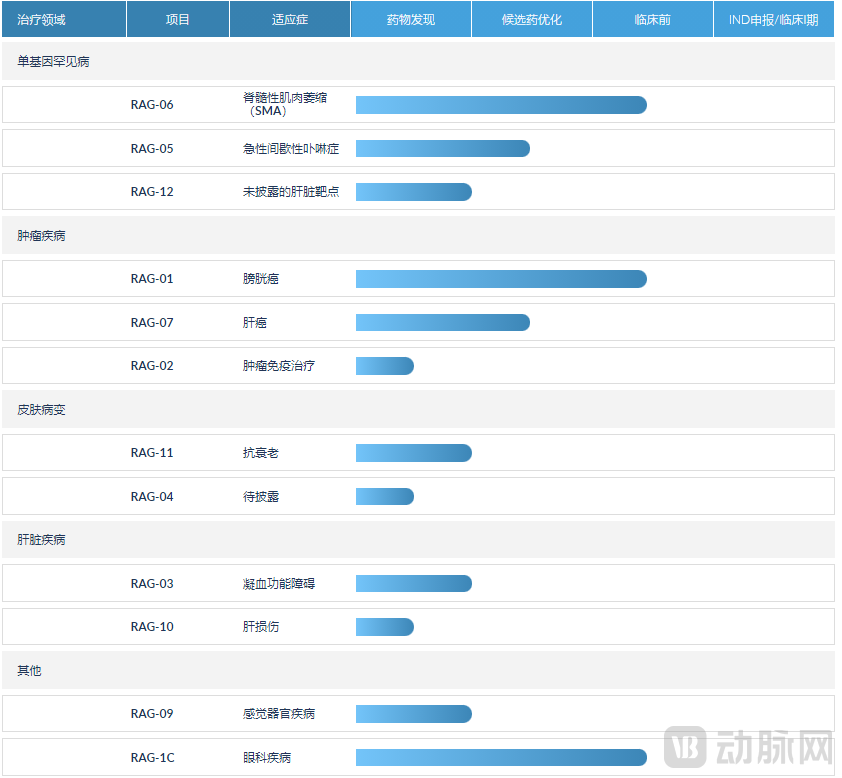
Leveraging the core team's unique strengths in foundational RNA activation technology, Ractigen aims to become a global leader in RNA activation therapeutics.
“Next, Ractigen will rapidly advance its pipeline to the clinical stage to complete human proof-of-concept for its platform technology.”It is anticipated that in approximately one year, at least one project will be ready to enter the IND application stage."Li Longcheng stated, 'As a long-term corporate strategy, Ractigen will remain committed to continuous innovation and internationalization, ultimately achieving a 0-to-1 breakthrough in RNA activation therapy. Building upon its foundational technology, the company will rapidly scale from 1 to N, thereby successfully developing a series of novel small nucleic acid therapeutics.'"