

Innovative Liwen RF™ Radiofrequency Ablation System for Hypertrophic Cardiomyopathy Developed by Nuocheng Medical and Xijing Hospital
HANGZHOU, China, Oct. 12, 2021 /PR Newswire/ --ReferenceInnovative treatment strategies,World's FirstInnovative Treatment Regimen-Jointly developed by NCC Medical and Professor Liu Liwen of Xijing HospitalLiwen RF™`Radiofrequency Ablation System`Bringing hope to patients with hypertrophic cardiomyopathy.
Current Status of Treatment for Hypertrophic Cardiomyopathy
Hypertrophic cardiomyopathy (hereinafter referred to as HCM) is the most common inherited cardiovascular disease. It is fundamentally characterized by myocardial hypertrophy, reduced ventricular cavity size, impaired ventricular filling, and decreased diastolic compliance, with some patients exhibiting outflow tract obstruction. Its clinical manifestations are highly heterogeneous; while some patients remain asymptomatic or present with only mild symptoms, others may early on develop chest tightness, chest pain, dyspnea, syncope, heart failure, or even sudden cardiac death, making it the leading cause of sudden cardiac death in young individuals and athletes. The annual mortality rate for HCM patients is approximately 1.4%–2.2%, with a prevalence of about 1 in 500 to 1 in 200. It is estimated that there are up to 2.6 million patients with HCM in China.
Currently, treatment options for hypertrophic cardiomyopathy (HCM) primarily include pharmacological therapy, alcohol septal ablation, and surgical septal myectomy. Pharmacological therapy, as the traditional approach, is suitable for patients with mild to moderate left ventricular outflow tract (LVOT) obstruction; however, its therapeutic efficacy is limited and it carries certain side effects. Surgical septal myectomy is considered the gold standard for treating obstructive HCM. By resecting the hypertrophied myocardium on the left ventricular surface of the interventricular septum, it relieves outflow tract obstruction and improves clinical symptoms. However, it requires sternotomy, cardiopulmonary bypass, and cardiac arrest, imposing stringent requirements on patients' baseline conditions. It is highly invasive, associated with slow recovery and higher surgical risks, and the low annual procedure volume in China makes it difficult to meet clinical demand. Alcohol septal ablation is an interventional therapy. Its mechanism involves catheter-based injection of absolute alcohol into the coronary artery to occlude the septal perforator branch, thereby inducing myocardial ischemia, necrosis, thinning, and reduced contractility in the supplied hypertrophied septum. This eliminates or mitigates LVOT obstruction, consequently improving clinical symptoms. While its minimally invasive nature is a significant advantage, some patients lack suitable septal perforator vessels, rendering them ineligible for the procedure. Additionally, there are risks of alcohol leakage causing off-target myocardial infarction, as well as a certain risk of bundle branch block.
Medical-Engineering Integration, NCC Medical's Leading Strategic Layout
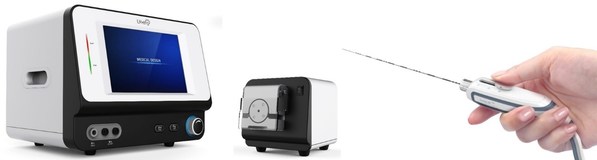
Guided by the vision of leveraging technological innovation to address unmet clinical needs worldwide, NCC Medical, in collaboration with Professor Liu Liwen of Xijing Hospital, assembled a team of clinical experts and engineers to successfully develop the world’s first radiofrequency-based therapeutic device for hypertrophic cardiomyopathy --Liwen RF™Radiofrequency ablation system. The system employs a purely ultrasound-guided, percutaneous, transthoracic puncture approach (Liwenprocedure), radiofrequency ablation is performed on the hypertrophied interventricular septum.Currently inTCT、CSI、CITpresent relevant findings at important international academic conferences, etc.The principle of the system involves percutaneous transapical puncture with a specially designed radiofrequency ablation needle to reach the hypertrophied interventricular septum for thermal ablation. This induces coagulative necrosis of cardiomyocytes and the surrounding septal branches of the coronary arteries, resulting in necrosis, thinning, and reduced contractility of the hypertrophied septal myocardium. Consequently, left ventricular outflow tract obstruction is eliminated or alleviated, thereby improving the clinical symptoms of patients with hypertrophic cardiomyopathy.The ablation needle dynamically adjusts the size of the ablation lesion in real time based on myocardial thickness, enabling ablation of the basal, mid, and near-apical segments of the interventricular septum. This system pioneers an innovative therapeutic pathway beyond surgical septal myectomy and alcohol septal ablation.
Encouraging Clinical Evidence
Liwen RF™ Radiofrequency Ablation System Has Successfully Completed Exploratory Clinical Study for New Technology,It has officially entered the registration clinical trial phase (a prospective, multicenter, single-arm performance goal clinical study evaluating the safety and efficacy of the radiofrequency ablation system and radiofrequency ablation electrode in the treatment of hypertrophic cardiomyopathy). The study is led by Academicians Ge Junbo and Zhang Yun, with Professor Liu Liwen serving as the Principal Investigator, and research advisors include Professor Martin Leon (Chair of TCT), Professor Horst Sievert (Chair of CSI), and Professor Chaim Lotan. Fourteen Grade 3A hospitals in China are participating in the study, meticulously assembling a world-class clinical research team.
To date, the study has successfully enrolled 28 patients. The mean preoperative resting left ventricular outflow tract (LVOT) pressure gradient was 57 mmHg, and the mean stress LVOT pressure gradient was 127 mmHg. Following treatment with the Liwen RF™ radiofrequency ablation system, the mean immediate postoperative LVOT pressure gradient decreased to 19 mmHg. At the 30-day postoperative follow-up, the mean LVOT pressure gradient further decreased to 7.8 mmHg. At this 30-day time point, all enrolled patients demonstrated improvement in their New York Heart Association (NYHA) functional class: 75% of patients improved from preoperative class III to class I, and 25% improved to class II. These follow-up results indicate that ultrasound-guided percutaneous intramyocardial septal radiofrequency ablation using the Liwen RF™ system can sustainably and effectively reduce the LVOT pressure gradient, thereby providing sustained clinical benefits for patients with hypertrophic cardiomyopathy. This clinical study is currently progressing successfully across China, and the product is expected to obtain NMPA registration approval in 2023.
# Investigator's Message
Professor Liu Liwen of Xijing Hospital stated: The Liwen RF™ radiofrequency ablation system features an adjustable ablation needle design that can adjust the ablation lesion size in real time according to myocardial thickness, enabling selective ablation of the basal, mid, and near-apical segments of the interventricular septum, effectivelyGroundIt overcomes the limitations of previous surgical interventions for hypertrophic cardiomyopathy and demonstrates significant advantages in safety and efficacy. The ongoing registration clinical trial is proceeding smoothly, and we eagerly anticipate its results. We are confident that the Liwen RF™ Radiofrequency Ablation System, with its outstanding clinical performance, will become a novel treatment device for hypertrophic cardiomyopathy that captures worldwide attention.