

Hanyu Medical's Hong Kong IPO Application Labeled 'Lapsed' Despite Prior Listing Approval; Company Expects Continued Losses

Hanyu Medical
Structural Heart Disease Interventional Devices and Electrophysiology Product R&D, Manufacturer
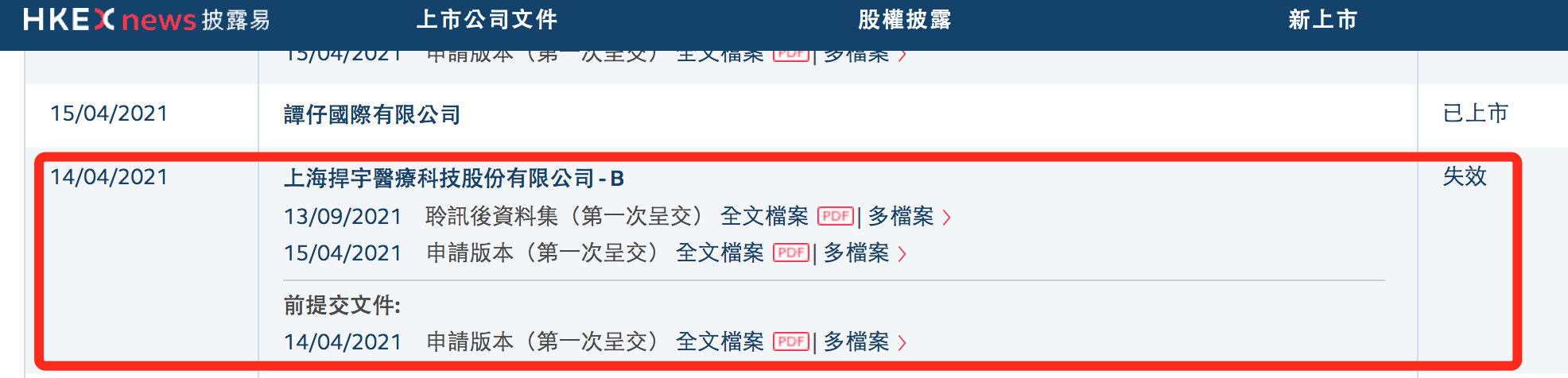
Recently, Hanyu Medical's prospectus, which had already passed the Hong Kong Stock Exchange (HKEX) listing hearing, was marked as "lapsed" by the exchange. This means that Hanyu Medical's plan to list in Hong Kong has already been delayed, and its initial public offering (IPO) may be suspended or postponed.

Under HKEX rules, if a prospective issuer fails to pass the listing hearing and complete its offer and listing within six months of filing its application with the exchange, its application status will automatically "lapse." However, a "lapse" does not constitute a listing failure; the issuer may still advance the listing process by updating its submission materials.
Beduo Finance has learned that, in addition to Hanyu Medical, quite a number of prospective issuers have had their listing applications "lapse" after passing the hearing but without commencing the IPO subscription process. These include Edding Group, BioCardia, and Betta Pharmaceuticals, among others. Among them, BioCardia re-filed its listing application on September 13 this year.
Hanyu Medical Continues to Incur Losses
By contrast, Betta Pharmaceuticals itself is already listed on the ChiNext board of the Shenzhen Stock Exchange, whereas Yiteng Pharmaceutical, Hanyu Medical, Bioheart Biotechnology, and others have yet to be listed on any public market. To date, Yiteng Pharmaceutical has not re-filed its prospectus.
According to the previous prospectus, Eddingpharm's revenues for 2017, 2018, 2019, and 2020 were RMB 1.787 billion, RMB 1.478 billion, RMB 1.874 billion, and RMB 1.768 billion, respectively, with annual profits (net profits) of RMB -38.538 million, RMB -215 million, RMB 173 million, and RMB 86.939 million, respectively.
Based on this, Yiteng Medical's profit margins during the reporting period were -2.2%, -14.6%, 9.2%, and 4.9%, respectively, and it turned a loss into a profit in 2019. However, both its revenue and net profit in 2020 declined to varying degrees compared to 2019, with net profit plunging by approximately 50% year-on-year.
Currently, Eddingpharm has achieved "self-sustaining" operations, generating stable revenue and achieving profitability. In contrast, Hanyu Medical remains in the R&D phase and has not yet commercialized any pipeline products.
According to Hanyu Medical's prospectus, its operating revenues in 2019 and 2020 were RMB 0 and RMB 490,000, respectively, primarily derived from pet treatment and pet healthcare services. During the same period, Hanyu Medical's net losses were RMB 48.133 million and RMB 129 million, respectively.

In the first quarter of 2021, Hanyu Medical's revenue was RMB374,000, compared to RMB53,000 in the same period of 2020; the loss for the period (net loss) was RMB28.404 million, compared to RMB16.619 million in the same period of 2020.
Urgently needs to replenish capital through financing
According to public information, Hanyu Medical is a medical technology company founded in 2016, dedicated to the research, development, and commercialization of innovative medical devices in the field of structural heart disease. According to its introduction, its core product is the mitral valve interventional device Valve Clamp, which is used for minimally invasive interventional treatment of mitral regurgitation.
Hanyu Medical previously pursued plans to list on the A-share market and engaged CICC as its sponsor in December 2020. It underwent a tutoring period in preparation for the proposed A-share listing, which was subsequently terminated in March 2021. Subsequently, Hanyu Medical publicly filed a listing application with the Hong Kong Stock Exchange in April 2021.
In its prospectus, Hanyu Medical cited data from Frost & Sullivan, indicating that its core product, ValveClamp, is expected to become the first TMV device developed in China to achieve commercialization. However, the prospectus also discloses that the patents for both ValveClamp and another product under development, ReAces, were acquired by Hanyu Medical through purchase.
Specifically, Hanyu Medical acquired the relevant patents for ValveClamp from Zhongshan Hospital in December 2018 for a total consideration of RMB 5 million, and acquired the relevant patent applications for ReAces from Zhongshan Hospital in February 2021 for a total consideration of RMB 4.6 million.
Hanyu Medical stated in its prospectus that it expects ValveClamp to complete regulatory registration and be launched in the first quarter of 2023. This means that Hanyu Medical will still require an additional 2 to 3 years before it can potentially achieve initial commercialization of its pipeline products.
It is evident that prior to the sustained commercialization of its pipeline products, Hanyu Medical is likely to incur losses for an extended period. In this regard, when disclosing risks in its prospectus, Hanyu Medical explicitly acknowledged that it expects to continue reporting net losses in the near future.
In terms of R&D expenses alone, Hanyu Medical's R&D costs for 2019, 2020, and the first quarter of 2021 were RMB 29.393 million, RMB 32.069 million, and RMB 15.642 million, respectively. Among these, the R&D expenses incurred for its core product, ValveClamp, accounted for 71.1%, 77.3%, and 46.3% of the total R&D expenses during the corresponding periods.
In addition, Hanyu Medical also needs to cover routine administrative expenses, among others. Previously, Hanyu Medical also stated that the company estimated its cash and cash equivalents as of February 28, 2021, would be sufficient to sustain its operations for approximately 19 months.
In other words, Hanyu Medical urgently needs to secure new financing to replenish its capital. Undoubtedly, pursuing an IPO on the Hong Kong Stock Exchange (HKEX) would be an excellent choice.