

Ancora Heart Submits IPO Prospectus for AccuCinch: World’s First Percutaneous Ventricular Repair System Targeting Heart Failure and Functional Mitral Regurgitation

Ancora Heart
Medical Device R&D Company
Due to its high disability and mortality rates, heart failure has long been a focal point of clinical attention.
Heart failure (HF) refers to a clinical syndrome caused by various structural or functional cardiac disorders that impair ventricular filling and/or ejection function, resulting in cardiac output insufficient to meet the metabolic demands of the body, and clinically characterized by pulmonary and/or systemic congestion and inadequate perfusion of organs and tissues.
Simply put, heart failure refers to a decline in the heart's pumping function, rendering it unable to pump sufficient blood to the body.
Left ventricular dilation in patients with heart failure leads to mitral regurgitation, which exacerbates their condition. According to statistics,Up to 74% of patients with heart failure have functional mitral regurgitation.
The mitral valve is a valve located between the left atrium and the left ventricle, controlling the unidirectional flow of blood from the left atrium to the left ventricle. Mitral regurgitation (MR) is the most common valvular heart disease, characterized by mitral valve insufficiency that causes blood to regurgitate from the left ventricle into the left atrium during cardiac systole, thereby increasing the cardiac workload.
Functional mitral regurgitation (FMR), also known as secondary mitral regurgitation, is primarily mitral regurgitation resulting from structural and functional changes of the left ventricle due to ischemic or non-ischemic etiologies.
For patients with moderate-to-severe mitral regurgitation, conventional open surgery remains the mainstream treatment modality. With the advancement of minimally invasive technologies, transcatheter intervention for mitral regurgitation has become a key focus for both clinical practice and corporate development.
For the management of mitral regurgitation, many companies focus on mitral valve repair and replacement. Transcatheter Edge-to-Edge Repair (TEER) has become a therapy recommended by numerous clinical guidelines, with a representative product being Abbott's MitraClip transcatheter mitral valve clip.
However, one company has taken a distinct approach to treating functional mitral regurgitation by addressing the root cause: improving left ventricular structural abnormalities.Ancora Heart developed AccuCinch, the world's first subcutaneous ventricular repair system, for the treatment of patients with heart failure and functional mitral regurgitation.
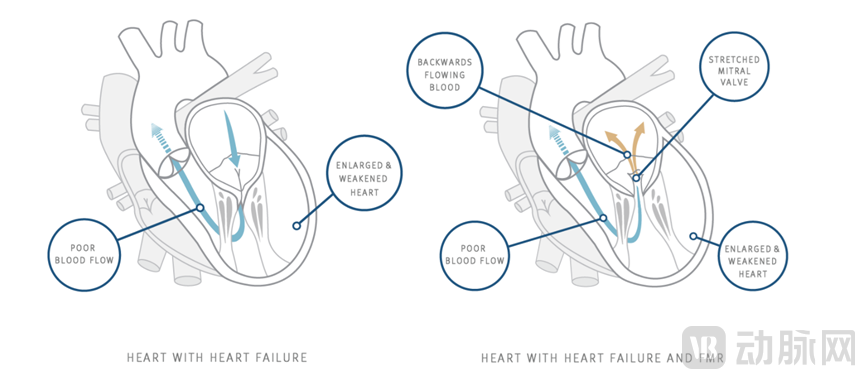
Heart Failure (Left) Heart Failure and Functional Mitral Regurgitation (Right) Source: Ancora Heart Official Website
In 2001, Ancora Heart was founded in California, USA, dedicated to treating heart failure patients and competing for a share of the market alongside formidable multinational corporations such as Abbott and Medtronic.
Over its 20-year history, the company has established a comprehensive talent matrix of technical and management professionals. Jeffrey M. Closs, the company’s CEO and President, co-founded Benu, successfully guided Perclose through its initial public offering (IPO), and previously served in a leadership role at Nellix Endovascular (acquired by Endologix).
Russel Sampson, who holds over 80 patents, serves as the Chief Scientist at Ancora Heart, bringing extensive expertise in CE and PMA certification, commercialization, profitability, and acquisitions, and overseeing the company’s core technologies, intellectual property, and product development.
Over its 20 years of development, the company has completed a total of four financing rounds. In May 2018, the company completed a $17.8 million financing round led by Savitr Capital. The most recent financing round was in July 2021,Ancora Heart announces the completion of an $80 million financing round, backed by leading investment firms Sands Capital, Sio Capital, and an undisclosed strategic investor.
Prior to any product launch, what exactly makes Ancora Heart so appealing to top-tier investors?
The appeal of this small medical device company begins with its new technology.
In the treatment of heart failure patients with mitral regurgitation, Ancora Heart has pioneered an innovative strategy targeting left ventricular structural repair. The company's AccuCinch system will provide a new therapeutic option for heart failure patients who are refractory to pharmacological and pacemaker therapies and do not require left ventricular assist device (LVAD) support, thereby filling a gap in conventional treatment paradigms.
Worldwide, AccuCinch is the first and only percutaneous ventricular restoration system for the treatment of heart failure and functional mitral regurgitation, addressing the root cause of mitral regurgitation.
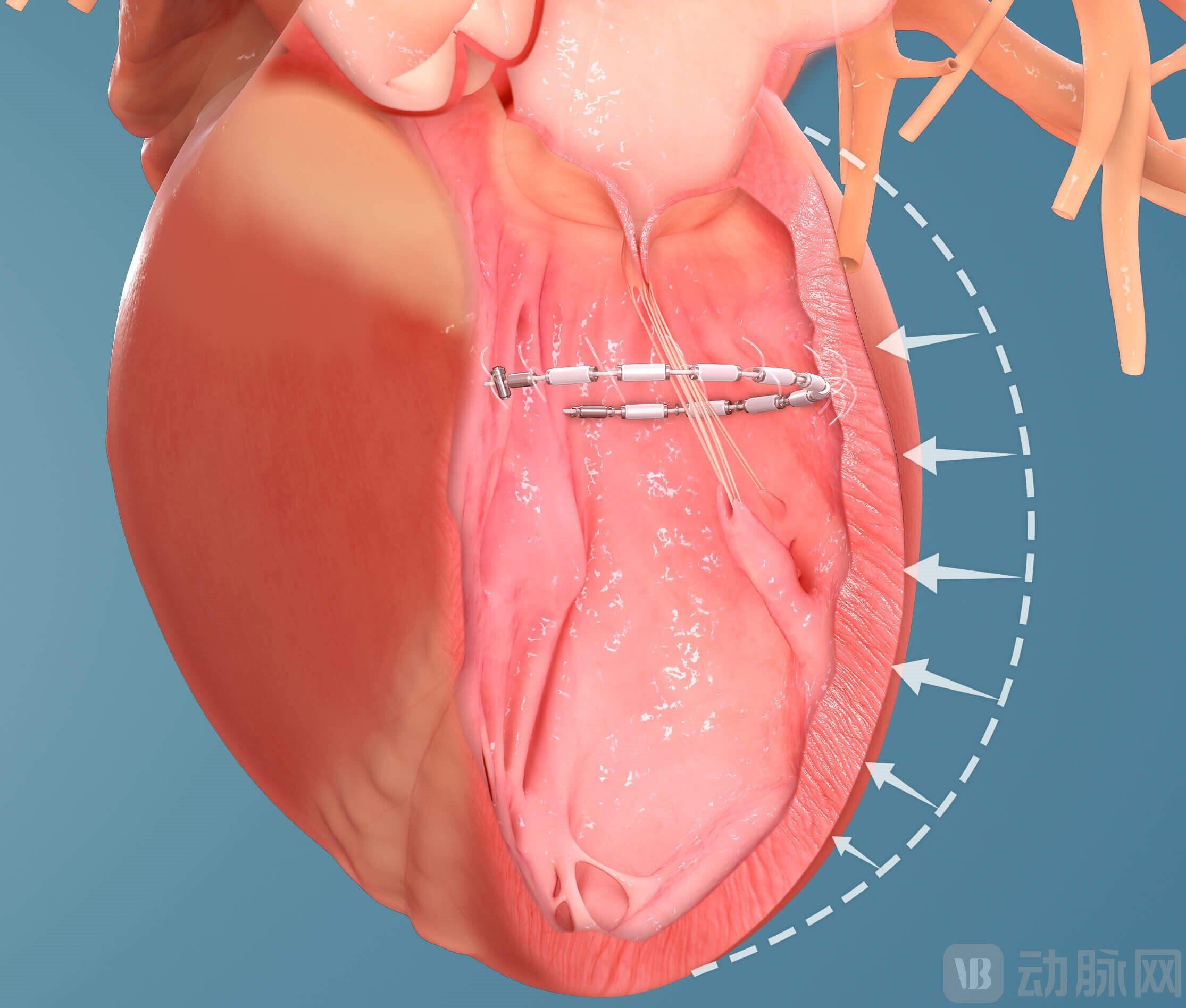
AccuCinch System Source: Ancora Heart official website
During the procedure, a catheter is advanced percutaneously via the femoral vein into the left ventricle to position the AccuCinch implant against the inner wall of the left ventricle. It is then tightened and locked into place using cable-connected anchors. Once the AccuCinch system is cinched, left ventricular volume is reduced, ventricular wall stress is decreased, and the cardiac wall is supported and reinforced.
AccuCinch directly targets left ventricular dilation and dysfunction for treatment, utilizing a percutaneous transfemoral approach. Previously, most interventional therapies for mitral regurgitation primarily relied on transapical and transseptal access routes. While the transapical approach is straightforward to perform, features a short learning curve, and more readily achieves the optimal position for delivery sheath manipulation, it is associated with poorer patient prognosis. In contrast, the transfemoral approach is minimally invasive, causes less tissue trauma, and offers superior patient tolerability.
Moreover, unlike transcatheter mitral valve clips and prosthetic mitral annuli,AccuCinch avoids traction and suturing of the mitral valve, preserving its native anatomy, and offers a minimally invasive and low-risk treatment option.
Currently, AccuCinch is undergoing clinical trials. CORCINCH-HF is a prospective, multicenter, randomized clinical trial designed to evaluate the safety and efficacy of AccuCinch in patients with symptomatic heart failure with reduced ejection fraction (HFrEF). The trial will enroll 400 patients across up to 80 sites globally, and the study results will be used to submit a Pre-Market Approval (PMA) application to the FDA.
The study features a unique design, wherein a preliminary analysis of safety and clinical efficacy for the PMA submission will be conducted after the first 250 trial patients complete their 6-month follow-up, followed by a second analysis after the entire patient cohort completes the 12-month follow-up.
Interventional therapy for mitral regurgitation has emerged as the most prominent focus in the field of structural heart disease, following Transcatheter Aortic Valve Replacement (TAVR).
According to Frost & Sullivan data, the global number of patients with moderate-to-severe mitral regurgitation will exceed 100 million in 2022 and reach 122 million by 2030. The global market size for mitral valve repair devices is projected to grow to USD 5.4 billion by 2030, with a compound annual growth rate (CAGR) of 20.5% from 2019 to 2030.
Abbott, Edwards Lifesciences, and Medtronic have all placed bets on this sector, while domestic players Hanyu Medical and Nuomai Medical have filed IPO prospectuses.
The penetration rate of mitral valve interventions in China remains low, despite a substantial clinical demand. The pace of population aging in China significantly exceeds the global average. In 2019, approximately 10 million patients had moderate-to-severe mitral regurgitation, yet only 4,200 mitral valve procedures were performed domestically that year.
Conventional surgery is highly invasive and causes significant trauma, limiting the pace of advancement in mitral regurgitation treatment. In China, 50% of patients with mitral regurgitation are ineligible for conventional surgery due to advanced age, impaired cardiac function, and multiple comorbidities. Mitral valve interventional therapy offers them a new direction for the heart.
To date, transcatheter edge-to-edge repair (TEER) features the most mature technology and market, and is recommended by numerous clinical guidelines. The "2021 ESC/EACTS Guidelines for the Management of Valvular Heart Disease" assigns a Class IIa recommendation to TEER therapy, upgraded from a Class IIb recommendation in the 2017 edition of the guidelines.
Globally, a total of six transcatheter mitral valve repair devices and one transcatheter mitral valve replacement device have received marketing approval. In the Chinese market, only Abbott’s MitraClip mitral valve system has been approved for commercialization.
The advent of the Abbott MitraClip system has brought transcatheter edge-to-edge repair (TEER) technology into clinical practice. Guided by three-dimensional echocardiography and DSA, the MitraClip mitral valve system grasps the mid-portions of the anterior and posterior mitral leaflets, transforming the mitral orifice from a single large opening into two smaller openings during systole, thereby reducing mitral regurgitation.
The COAPT trial first demonstrated the safety and efficacy of the MitraClip procedure for the treatment of severe mitral regurgitation secondary to heart failure. In March 2019, the FDA expanded the indications for MitraClip to include heart failure patients with moderate-to-severe functional mitral regurgitation who are refractory to medical therapy. In June 2020, the product received marketing approval from the NMPA.
Currently, the MitraClip system is the most established transcatheter edge-to-edge repair (TEER) device globally, as well as the most mature transcatheter mitral valve intervention device, with over 100,000 procedures performed worldwide. Previously, Abbott had already launched the fourth-generation MitraClip G4 product.
Edwards Lifesciences has introduced the Cardioband System, which involves placing an adjustable prosthetic band at the valvular annulus to reduce its diameter for therapeutic purposes, a procedure known as annuloplasty. The system is currently still in the clinical trial phase.
Following Abbott's precedent, domestic companies have largely focused on transcatheter mitral valve clipping. For example, ValveClamp, a transapical TEER device developed by Hanyu Medical, has previously entered the Special Review Procedure for Innovative Medical Devices.
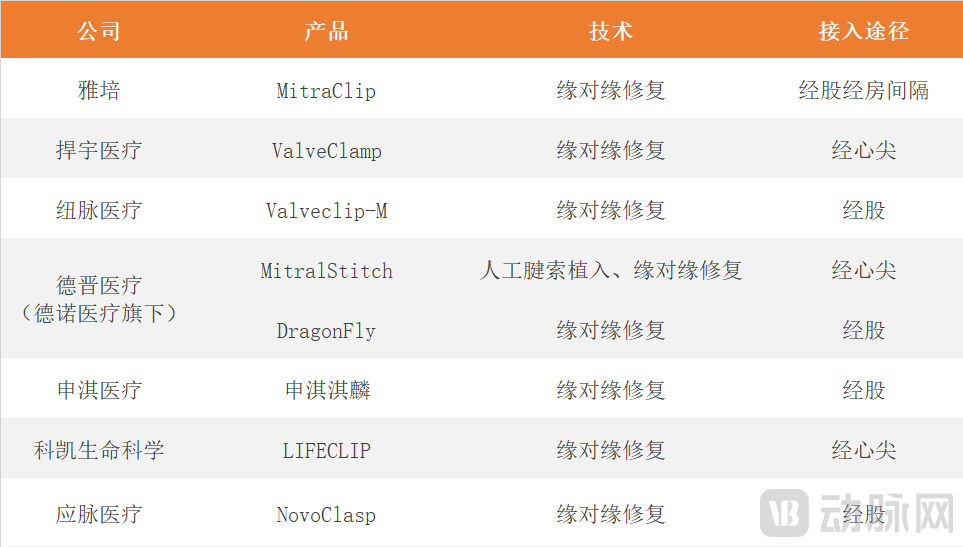
`Chinese Transcatheter Mitral Valve Repair Products`
To develop mitral valve repair devices tailored to the Chinese market, domestic enterprises have made certain improvements to mitral valve clips in terms of handling performance, indications, and delivery systems.
HanU Medical's ValveClamp demonstrates minimal hardware dependence, eliminating the need for a DSA machine, while offering straightforward operation and a short learning curve for physicians. Newmai Medical's Valveclip-M features an integrated, barbed design that minimizes clip dislodgement, and its reduced delivery sheath diameter makes it more suitable for the Asian population. Dejin Medical's DragonFly mitral clip incorporates a unique central occlusion mesh design to further reduce central regurgitation.
Beyond technological advancement and cost reduction, mitral valve device companies aiming to commercialize their products in China must also comprehensively consider the impact of the broader social environment. Given the uneven distribution of medical resources across the country, physicians require substantial technical training and a learning period to effectively utilize mitral valve repair devices. Furthermore, since these interventions are performed under imaging guidance, the concurrent development of medical imaging technology is equally critical.
In recent years, China has been vigorously training vascular interventional specialists and advancing interventional radiology, with domestic medical device manufacturers actively participating. As domestic brands enter the market, China's mitral valve repair sector is certain to achieve significant growth.
Reference: TEER from HERE: Transcatheter Edge-to-Edge Repair—From Now On
ESC Expert Commentary | Prof. Wu Yongjian: Update on the 2021 ESC/EACTS Guidelines for the Management of Valvular Heart Disease