

Leading the Future of Health IoT and Building a Smart Healthcare Ecosystem

AstraZeneca
Biopharmaceutical Manufacturer
WUXI, China, Oct. 24, 2021 /PRNewswire/ -- Recently, AstraZeneca, a global leading biopharmaceutical company, made its sixth consecutive appearance at the World Internet of Things (IoT) Expo. Focusing on five innovative medical scenarios, the company partnered with collaborators to showcase a series of smart integrated diagnosis and treatment innovations in chronic diseases and oncology, comprehensively demonstrating how cutting-edge technologies integrating IoT, 5G, artificial intelligence, and big data enable patients to achieve seamless online-and-offline integrated full-course disease management. On the opening day of the Expo, AstraZeneca supported the Health Commission of Jiangsu Province, the Health Commission of Wuxi City, and the Administrative Committee of Wuxi National High-Tech Industrial Development Zone in hosting a Health IoT Summit Forum themed "Smart Connectivity for Health, Digital Leadership for the Future." The forum gathered experts and scholars from government, industry, academia, research, healthcare, and investment sectors to share insights and discuss the development and application of innovative technologies such as IoT in the medical industry, while envisioning the future of health IoT. Additionally, a roadshow for outstanding health IoT projects was held concurrently during the Expo, continuously stimulating innovation vitality in healthcare and driving the development of a smart health ecosystem.
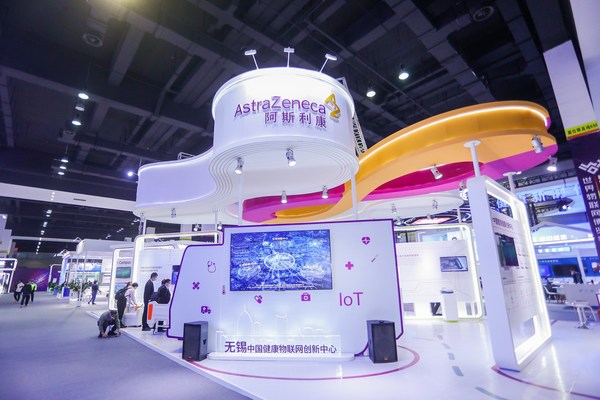
AstraZeneca Booth at the 2021 World Internet of Things (IoT) Expo
Wang Lei, Executive Vice President of AstraZeneca and President of International Business and China, stated: “To observe the development of the global Internet of Things (IoT), look to China; to observe the development of China’s IoT, look to Wuxi. AstraZeneca’s innovations in the IoT sector originated in Wuxi. Leveraging the advantages of the regional IoT industrial cluster, the innovative solutions and concepts we have developed alongside our partners, powered by technologies such as IoT, big data, 5G, and AI, have been deployed across China and even expanded internationally, covering countries and regions along the Belt and Road. Looking ahead, we will continue to be rooted in Wuxi, harness smart technologies, and explore more integrated online and offline diagnosis and treatment models to provide patients with more comprehensive and convenient healthcare services.”
Cross-Sector Wisdom Exchange: Exploring the Future of Healthcare IoT
On the opening day of the IoT Expo, the Health IoT Summit Forum was convened under the theme “Smart Connectivity for Health, Digital Leadership for the Future”. Authoritative representatives from government, industry, healthcare, academia, research, and investment sectors engaged in dynamic exchanges, focusing on cutting-edge trends in smart health, industrial policies for home-use medical devices, smart rehabilitation, and related fields. They explored how technologies such as the Internet of Things, 5G, and artificial intelligence are empowering the development of the medical industry. Distinguished guests including Yu Mengsun, Academician of the Chinese Academy of Engineering and Director of the Aviation Medical Engineering Research Center at the Air Force Aviation Medical Research Institute; Hu Jianping, Deputy Director of the Statistics and Information Center of the National Health Commission; Lan Qing, Deputy Director of the Jiangsu Provincial Health Commission; and Yu Xueqing, President of Guangdong Provincial People's Hospital, all attended the forum. They engaged in constructive discussions on how smart IoT can drive the advancement of the broader healthcare sector, sharing the latest applications, achievements, and insights from their respective fields.
Leveraging Innovative Healthcare Scenarios, Sharing Smart Health Achievements
At this edition of the World IoT Expo, AstraZeneca comprehensively showcased its smart healthcare innovations through a 200-square-meter exhibition booth. The display covered the entire disease journey—from health education, screening, diagnosis, and treatment to rehabilitation and follow-up—across five core scenarios: mobile screening, hospital screening, hospital diagnosis and treatment, post-discharge home patient management, and online disease management. On-site visitors could immersively experience these IoT-enabled solutions and scenarios, gaining firsthand insight into a comprehensive, scientific, and efficient healthcare service model empowered by smart technology. In the mobile screening scenario, the AIBUS intelligent breast ultrasound robot model made its debut, alongside a fully operational mobile screening vehicle equipped with the AIBUS system, which was stationed in the expo hall for visitors to experience. In the hospital scenario, AstraZeneca and its partners highlighted innovative screening and diagnostic technologies, including a proteinuria screening device tailored for diabetic patients and the "Perspective Eye" holographic puncture navigation system, all designed to facilitate early screening, diagnosis, and treatment of chronic diseases. Additionally, the "Self-Service Nebulization Station" on display demonstrated how IoT technology can seamlessly extend disease management from the hospital to the home. By simply scanning a QR code with a smartphone, patients can instantly rent a nebulizer on-site and access express delivery services for convenient pickup and return, effectively bridging the "last mile" gap in home nebulization therapy for asthma patients.
The online scenario showcases the integrated online-to-offline end-to-end disease management services provided by AstraZeneca's partners in the digital healthcare sector. Empowered by the "Internet+" initiative, these services facilitate the long-term management of chronic conditions. The home-care scenario highlights the concept of advanced IoT connectivity. By linking next-generation devices such as blood pressure monitors, blood glucose meters, smart speakers, 5G-enabled smart turning beds, and ambulatory ECG monitors to digital applications, patients can access convenient and highly precise home-based healthcare services. Furthermore, the Wuxi International Life Sciences Innovation Center and the smart factory made their debut at the IoT Expo pavilion, demonstrating AstraZeneca's strategic leverage of Wuxi's local industrial advantages to consolidate domestic and global innovative resources, thereby constructing a multi-dimensional healthcare innovation ecosystem.
Gathering the Achievements of Healthcare IoT, Co-creating a Healthcare Innovation Ecosystem
Innovative frontier technologies, represented by the Internet of Things (IoT), serve as a crucial "accelerator" for the current development of medical diagnosis and treatment. Developing and implementing IoT-based solutions—including "smart healthcare" for medical professionals, "smart services" for patients, and "smart management" for hospitals—and collaboratively building new ecosystem models have become a new trend in the future development of the health sector. During this IoT Expo, with the support of the Translational Medicine Branch of the China Association of Medical Equipment, the "Health IoT Outstanding Project Roadshow Conference" was held concurrently. Leveraging roadshows of exemplary cases, the event aims to promote synergy and integration among industry, academia, healthcare, and research, accelerate the industrialization of clinical research, further drive the emergence of innovative medical products, technologies, and models, and ultimately build a comprehensively collaborative new health ecosystem.
At the conference, twelve outstanding cases emerged after a rigorous selection process, prominently showcasing the application of IoT in healthcare. These cases demonstrate innovative models that integrate in-hospital diagnostic and treatment services with out-of-hospital health management across diverse settings, including hospitals, retail pharmacies, and homes, while seamlessly combining online and offline approaches. This further transforms traditional healthcare models, delivering multi-faceted benefits to medical institutions, patients, and society. Among the projects presented at the live roadshow, several innovative solutions jointly supported and advanced by AstraZeneca and its partners were selected. Covering therapeutic areas such as oncology, cardiovascular diseases, and chronic conditions, these solutions include post-diagnosis smart healthcare programs, chronic disease management solutions empowering retail pharmacies, primary care mobile screening initiatives, and whole-course management programs for chronic kidney disease. AstraZeneca aims to collaborate with partners to leverage diverse innovations in products, technology, management, and business models. By focusing on key challenges across clinical research and the entire diagnosis and treatment continuum, the company seeks to develop scientifically driven solutions that further elevate care standards and deliver greater benefits to patients.
Since 2016, Wuxi has successfully hosted six consecutive World Internet of Things Expos. As its influence continues to expand, Wuxi has gradually emerged as a new hub for the development of the IoT industry in China and globally. AstraZeneca will continue to leverage Wuxi’s strategic locational advantages in the biomedical sector, partnering with more collaborators from the technology fields of IoT, big data, 5G, and AI, as well as the capital sector, to build a more open healthcare ecosystem. By empowering innovative healthcare with smart technologies, we will incubate more new achievements, technologies, and business models, support Wuxi in establishing a leading center for the life and health industry in the Taihu Bay region, and ensure that the "innovations" originating from Wuxi, China, benefit patients worldwide.
About AstraZeneca
AstraZeneca (LSE/STO/Nasdaq: AZN) is a global, science-led biopharmaceutical company focused on the research, development, manufacturing and marketing of prescription medicines, with a primary focus on three major therapeutic areas: oncology, cardiovascular, renal and metabolism, and respiratory and immunology. Headquartered in Cambridge, UK, AstraZeneca operates in over 100 countries worldwide, and its innovative medicines benefit millions of patients globally. For more information, please visitwww.astrazeneca.com。
About AstraZeneca China
Since entering China in 1993, AstraZeneca has remained committed to a science-led approach and a focus on innovation to meet the country's growing healthcare needs, striving to realize its grand vision of "pioneering innovation, benefiting patients, and becoming China's most trusted healthcare partner." AstraZeneca's China headquarters is located in Shanghai, with regional headquarters established in Beijing, Guangzhou, Wuxi, Hangzhou, and Chengdu, employing nearly 20,000 people across China. The company has invested in manufacturing sites in Wuxi and Taizhou, Jiangsu Province, and established a China logistics center in Wuxi. In China, AstraZeneca's business focus is primarily concentrated on therapeutic areas with the most urgent patient needs, including respiratory, cardiovascular, metabolic, oncology, gastrointestinal, and renal diseases. In 2017, the China Health IoT Innovation Center was established in Wuxi, aiming to explore innovative Health IoT solutions for integrated diagnosis and treatment and full-course disease management. That same year, AstraZeneca formed a joint venture with SDIC Innovation to establish Dizal (Jiangsu) Pharmaceutical Co., Ltd., to accelerate the pace of local novel drug R&D. In 2019, AstraZeneca announced a collaboration with Wuxi to co-establish the Wuxi International Life Sciences Innovation Park, pooling global expertise to benefit patients in China. Also in 2019, the company announced the establishment of its Global R&D China Center in Shanghai and the launch of a global healthcare industry fund. In 2020, AstraZeneca announced its support for the "Internet Hospital" initiative.