

Sanofi Launches New Indication for Non-Calcium-Based Phosphate Binder Renvela® (Sevelamer Carbonate) in China for Non-Dialysis CKD Patients with Hyperphosphatemia

Sanofi
Pharmaceutical R&D Developer
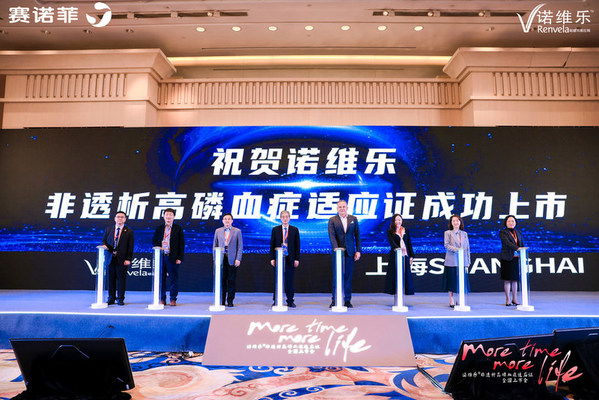
SHANGHAI, Nov. 2, 2021 /PRNewswire/ -- Recently, Sanofi, a global leader in biopharmaceuticals, announced that Renvela®(Sevelamer carbonate) has officially been approved for a new indication in China for the treatment of hyperphosphatemia in adult patients with chronic kidney disease not on dialysis. Previously, Renvela®The indication in China is limited to the treatment of hyperphosphatemia in adult patients with chronic kidney disease (CKD) undergoing dialysis.
Professor Jiang Gengru, Xinhua Hospital Affiliated to Shanghai Jiao Tong University School of Medicinestated: “Hyperphosphatemia in patients with chronic kidney disease is associated with adverse outcomes, including vascular calcification, chronic kidney disease progression, and increased risk of mortality.[i], previously, none of the non-calcium-based phosphate binders marketed in China had an indication for hyperphosphatemia in patients with chronic kidney disease not on dialysis. Renvela®The marketing approval of the non-dialysis indication brings new opportunities and hope for phosphate management therapy in patients with chronic kidney disease not on dialysis.”
Professor Li Guisen of Sichuan Provincial People's Hospital stated:“Renvela®"The approval of the new indication introduces a novel treatment option for patients with hyperphosphatemia associated with non-dialysis chronic kidney disease, providing clinicians with improved therapeutic choices that are expected to further enhance the treatment rate and clinical outcomes for hyperphosphatemia in China."
Professor Zuo Li of Peking University People's Hospital stated:“Veltassa®The launch of the indication for hyperphosphatemia in non-dialysis patients fills the gap in the market in China for the absence of non-calcium-based phosphate binders for hyperphosphatemia in non-dialysis chronic kidney disease (CKD) patients. Based on this, Renvela®becoming the only non-calcium-based phosphate binder in China covering the entire course of hyperphosphatemia in chronic kidney disease (including both non-dialysis and dialysis stages).”
Prof. Liang Xinling of Guangdong Provincial People's Hospital stated: "Renvela®“The approval of the non-dialysis indication for CKD has provided us with more scientific approaches to managing early calcium and phosphorus metabolism disturbances in CKD, enabling serum phosphorus management in CKD-MBD to truly achieve early detection, early assessment, early treatment, and early benefit. Meanwhile, in the management of hyperphosphatemia, it is essential to emphasize the integrated management of multiple clinical parameters.”
Professor Chen Wei of The First Affiliated Hospital of Sun Yat-sen University stated:“The results of a Phase III clinical trial (RECOVER) conducted in non-dialysis chronic kidney disease patients with hyperphosphatemia in China demonstrated that Renvela®efficacy and safety. Compared with the placebo group, Renvela®can significantly reduce serum phosphorus, total cholesterol, low-density lipoprotein cholesterol, and calcium-phosphorus product levels, while Renvela®Adherence in the group was good, and the incidence of adverse events was not significantly different from that in the placebo group.[ii]。”
Ms. Liu Jing, General Manager of the Innovation & Core Business Unit, Sanofi Chinastated: "As a leader in chronic disease management, Sanofi has consistently upheld the 'patients first' principle and continues to advance its initiatives in disease prevention and comprehensive chronic disease management. Renvela®The market launch of the new indication for non-dialysis patients has provided a novel therapeutic option for the management of hyperphosphatemia in chronic kidney disease. Meanwhile, Renvela®"It will also become the first calcium-free phosphate binder in China to cover the full spectrum of hyperphosphatemia in chronic kidney disease (including both non-dialysis and dialysis-dependent stages), further serving as a cornerstone in the treatment of hyperphosphatemia in CKD and benefiting more patients.”
With the intensifying trend of population aging, the prevalence of chronic kidney disease in China has shown a continuous upward trend in recent years. Data indicate that the prevalence of chronic kidney disease among Chinese adults is as high as 10.8%.[iii], meaning that approximately one in ten adults has chronic kidney disease.
Hyperphosphatemia is one of the important complications in patients with chronic kidney disease. Persistently elevated serum phosphorus levels can lead to various complications, including hyperparathyroidism, renal osteodystrophy, and vascular calcification, and are closely associated with increased mortality.[iv]. A cross-sectional study based on the China chronic kidney disease cohort (C-STRIDE) showed that the prevalence of hyperphosphatemia among Chinese non-dialysis chronic kidney disease patients increased steadily with disease progression, while up to 71.6% of hyperphosphatemic patients received no phosphate binder therapy.[v]。
[i] Vervloet MG, Sezer S, Massy ZA, et al. Nat Rev Nephrol, 2017, 13(1): 27-38.
Cozzolino M, et al. Contrib Nephrol 2017,190:71-82;
Wei Qing, et al. Research progress on the hazards of hyperphosphatemia in patients with chronic kidney disease. Chinese Journal of Practical Diagnosis and Therapy 2014,28(11):1041-1043;
[ii] Xueqing Yu,Nephrology Dialysis Transplantation, Volume 35, Issue Supplement_3, June 2020, gfaa142.P0880
[iii] Zhang, Luxia, et al. "Prevalence of chronic kidney disease in China: a cross-sectional survey." The Lancet 379.9818 (2012): 815-822.
[iv]Chen Menghua, Yu Xueqing. "Management of Hyperphosphatemia in Non-Dialysis Patients with Chronic Kidney Disease." Chinese Journal of Nephrology 36(2): 154-159.
[v] Zhou C, et al. Chin Med J (Engl). 2016 Oct 5;129(19):2275-80.