

2021 China Hemophilia Patient White Paper Officially Launched at CIIE

Takeda
Biopharmaceutical Manufacturer
SHANGHAI, Nov. 7, 2021 /PRNewswire/ -- Today, the *2021 White Paper on Hemophilia Patients in China* (hereinafter referred to as the "White Paper"), initiated by the China Primary Health Care Foundation and supported by Takeda China, was officially released at the Takeda Pharmaceutical booth at the 4th China International Import Expo. Focusing on the living conditions of hemophilia patients receiving charitable assistance, the "White Paper" provides an in-depth analysis of the pain points and burdens associated with daily disease management and treatment among hemophilia patients in China. It aims to further raise awareness and attention across all sectors of society regarding the current situation of hemophilia patients, jointly contribute to building a more robust disease management mechanism and multi-tier medical security system, and help the hemophilia patient community in China achieve standardized treatment and disease management, enabling them to return to normal life.
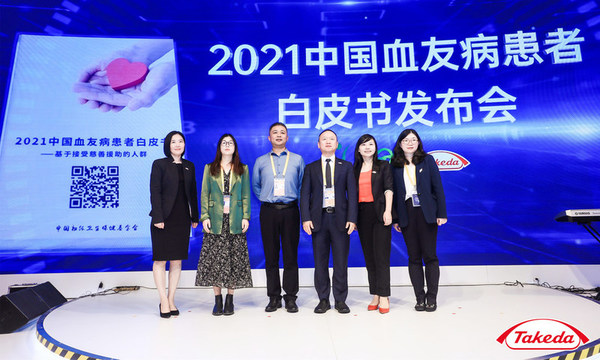
《2021 White Paper on Hemophilia Patients in China》 Press Conference
Mr. Ouyang Wanjun, Secretary-General of the Life Oasis Patient Assistance Public Welfare Fund under the China Primary Health Care Foundation; Prof. Wu Runhui, Chief Physician of the Hematology and Oncology Center at Beijing Children's Hospital, Capital Medical University; and Mr. Shan Guohong, Senior Vice President, Global, and President, Takeda China, Takeda Pharmaceutical Company Limited, along with other guests, attended the launch event via a hybrid online and offline format.
Hemophilia is a recessively inherited rare disease primarily caused by a deficiency of coagulation factors in patients, leading to coagulation disorders. Its symptoms primarily manifest as bleeding in the joints, muscles, and deep tissues, or in internal organs such as the gastrointestinal tract and central nervous system. Currently, there are an estimated 49,000 patients in China.[1], due to limited awareness and financial burden, among other factors, most patients currently still widely adopt a low-dose prophylactic treatment regimen.
To support more hemophilia patients in receiving regular prophylactic therapy and alleviate poverty and financial hardship caused by the disease, the China Primary Health Care Foundation, with support from Takeda China, launched the “Bleeding Under Control, Life Unbound” Hemophilia Patient Assistance Project in 2015. By the end of September 2021, the project had expanded to 120 cities across China, providing assistance to 3,241 hemophilia patients and helping them return to normal daily life. Building on six years of implementation and achievements, in July 2021, the China Primary Health Care Foundation further initiated the 《White Paper》 project targeting hemophilia patients receiving charitable aid. This initiative integrated and analyzed existing literature, data from current patient assistance programs, and findings from an online survey of 620 patients with Hemophilia A across 30 provinces and 139 cities in China, aiming to gain an in-depth understanding of the unmet medical needs and disease burden among hemophilia patients.
The survey findings of the 《White Paper》 indicate that the heavy medication burden remains a primary challenge for patients with hemophilia. The prophylaxis rate among adult hemophilia patients stands at merely 30%, with over 70% of patients still reporting that "overall treatment costs are too high to afford." Furthermore, the survey results show that while the prophylactic treatment rate for pediatric hemophilia patients is higher than that of adults, 5% of patients under 18 years of age still take long-term sick leave or drop out of school, more than 25% are unable to attend school, and the school retention rate falls below the requirements set by the Ministry of Education. In light of this,Professor Runhui Wu, Chief Physician, Hematology and Oncology Center, Beijing Children's Hospital, Capital Medical Universitystated: "Childhood is a critical period for hemophilia management. Early initiation of standardized prophylactic therapy in pediatric patients can effectively prevent disability resulting from hemophilic arthropathy. It is recommended to develop individualized treatment regimens tailored to each patient's clinical profile to promote the healthy physical and psychosocial development of children with hemophilia."
Mr. Ouyang Wanjun, Secretary-General of the Life Oasis Patient Assistance Charity Fund, China Primary Health Care Foundationstated: “The publication of this white paper comprehensively and profoundly highlights the pain points and burdens encountered by China’s hemophilia patient community in daily disease management. It will enable various sectors of society to provide more targeted and diversified support for hemophilia patients in China, and holds significant guiding value for strengthening the diagnosis and treatment management of hemophilia patients and improving China’s hemophilia prevention and treatment system.”
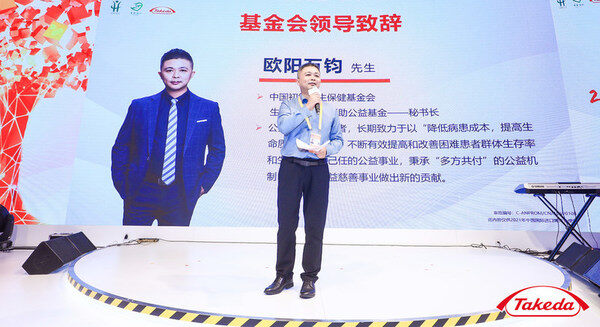
Ouyang Wanjun, Secretary-General of the Life Oasis Patient Assistance Public Welfare Fund, China Primary Health Care Foundation
Mr. Shan Guohong, Senior Vice President, Global and President, Takeda China, Takedastated: “Takeda Pharmaceutical Company Limited has been deeply committed to the field of rare diseases such as hemophilia for many years, boasting a robust product pipeline and extensive accumulated experience. While accelerating the delivery of high-value innovative therapies to patients with rare diseases like hemophilia in China, we are also actively fulfilling our corporate responsibility by collaborating with various sectors of society to launch patient support, medication assistance, and disease education programs. We hope to gain a deeper understanding of patients' actual needs through this white paper research project, thereby assisting all stakeholders in establishing a comprehensive, multi-tiered support system. This will further promote the widespread adoption of long-term standardized treatment and disease management concepts for hemophilia, ultimately helping Chinese hemophilia patients achieve a life free from restrictions.”
[1] The Prevalence of Hemophilia in Mainland China: a systematic review and meta-analysis, Southeast Asian J Trop Med Public Health. 2014 Mar;45(2):455-66
Statement:
1. This content is exclusively for use at the 2021 China International Import Expo.
2. This article aims to convey cutting-edge medical and pharmaceutical information and does not constitute a recommendation or promotion of any drug or diagnosis and treatment plan.
3. For more information on diseases, medicines, diagnosis, or treatment, please consult a healthcare professional.
# About Takeda
Takeda Pharmaceutical Company Limited (Tokyo Stock Exchange Code: 4502) (NYSE: TAK) is a Japan-headquartered, values-driven, R&D-led global biopharmaceutical company. Takeda is dedicated to translating scientific discoveries into highly innovative medicines, safeguarding healthier lives and brighter futures for patients. Takeda focuses its drug development on four therapeutic areas: Oncology, Gastroenterology (GI), Neuroscience, and Rare Diseases, with targeted R&D investments in Plasma-Derived Therapies and Vaccines. We remain focused on developing highly innovative medicines, pioneering novel treatment approaches and strengthening our collaborative R&D engine to build a robust and diverse product pipeline that helps improve people's lives. Our employees span approximately 80 countries and regions, working alongside local healthcare partners to deliver better health to patients worldwide.
Takeda entered China in 1994. Headquartered in Shanghai, Takeda China's main business centers in mainland China are located in cities and regions such as Beijing, Shanghai, Tianjin, Guangzhou, and the Hong Kong Special Administrative Region. With offices established in major cities across China, the company currently employs over 2,000 staff in the country. Driven by China's economic development and the growing demand for healthcare, China has become one of Takeda's most important emerging markets globally.
For more information, please visithttps://www.takeda.com
Forward-Looking Statements
This document and any materials distributed in connection therewith may contain forward-looking statements, views, or opinions regarding Takeda’s future business, future conditions, and operating performance, including Takeda’s estimates, projections, targets, and plans. Forward-looking statements often contain, but are not limited to, words such as “aim,” “plan,” “believe,” “hope,” “continue,” “anticipate,” “intend,” “ensure,” “will,” “may,” “should,” “would,” “could,” “expect,” “estimate,” “predict,” or similar expressions or the negative thereof.
The forward-looking statements contained herein are based solely on estimates and assumptions made by Takeda as of the date of release. Such forward-looking statements are not guarantees of future performance by Takeda or its management and involve known and unknown risks, uncertainties, and other factors, including, but not limited to: economic conditions affecting Takeda's global operations, including the macroeconomic environments in Japan and the United States; competitive pressures and developments; changes in applicable laws and regulations; the success or failure of product development programs; decisions by regulatory authorities or the timing of such decisions; fluctuations in interest and exchange rates; claims or questions regarding the safety or efficacy of marketed products or product candidates; the timing and impact of post-acquisition integration efforts for acquired companies; and the ability to divest assets non-core to Takeda's operations and the timing of any such divestitures. All of these factors could cause Takeda's actual results, performance, achievements, or financial condition to differ materially from any future results, performance, achievements, or financial condition expressed or implied by such forward-looking statements.
For more information regarding the above and other factors that may affect Takeda's results, performance, achievements, or financial condition, please refer to Takeda's latest Annual Report on Form 20-F filed with the U.S. Securities and Exchange Commission, "Item 3. Key Information—D. Risk Factors" and other reports, available on Takeda's website.https://www.takeda.com/investors/reports/sec-filings/Orwww.sec.gov. Takeda's actual future results, performance achievements, or financial position may differ materially from those expressed or implied by the forward-looking statements. Persons receiving this press release should not place undue reliance on any forward-looking statements. Takeda undertakes no obligation to update any forward-looking statements contained in this press release or any other forward-looking statements that the company may issue, except as required by law or securities exchange rules. Past performance is not indicative of future performance, and the performance of Takeda referenced in this press release does not represent, nor is it intended as, a projection, prediction, or estimate of Takeda's future performance.