CooperVision Completes Enrollment in Largest Real-World Myopia Control Study Across U.S. and China with Over 3,000 Children
CooperVision
Contact Lens Manufacturer
In the field of myopia management, the product landscape has expanded significantly: orthokeratology lenses, defocus soft contact lenses, defocus spectacle lenses, low-concentration atropine, and red light therapy devices are all evolving across diverse market environments. The real question is now becoming:Who can provide long-term, safe, interpretable, and reproducible real-world evidence?
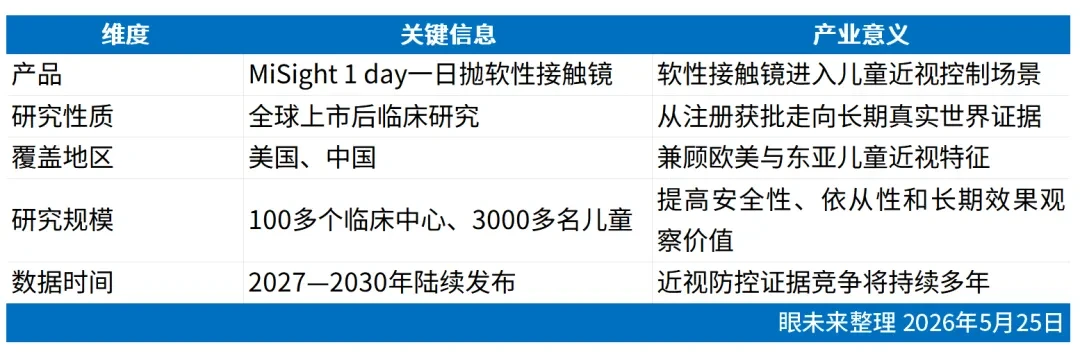
RecentlyCooperVision announces:MiSight 1 day Global Post-Approval Study (PAS) Completes Full Enrollment. This spans acrossUnited States & China | 100+ Clinical Centers | 3,000+ Childrenof the large-scale study, the company stated, this isOne of the largest international clinical evidence programs to date in the field of soft contact lens myopia control interventions., final data will be2027–2030Will be announced successively.
China has a large population of myopic children and adolescents with a strong demand for intervention. However, since myopia prevention and control directly target children, product safety, long-term compliance, axial length control efficacy, and clinical management systems are all more critical than merely achieving "clear vision".
01 What was the objective of this MiSight 1 day study?
MiSight 1 day is a daily disposable soft contact lens developed by CooperVision for pediatric myopia control. According to the U.S. FDA database, the product was approved in 2019 and is indicated for children aged 8 to 12 years at the initiation of treatment, who are free of ocular disease, have a refractive error of -0.75 D to -4.00 D, and astigmatism not exceeding 0.75 D, for the correction of myopia and slowing of myopia progression.
The study that has completed enrollment is not a pre-approval study conducted prior to the product's initial approval, but rather a post-market study—specifically, a Post-Approval Study (PAS). Its value lies in evaluating the product's performance in a setting that more closely reflects real-world clinical practice.
02 Why is "axial length" increasingly emphasized in myopia prevention and control?
The core of myopia prevention and control lies in controlling axial elongation.
One of the fundamental issues in pediatric myopia is the elongation of the eye's anterior-posterior diameter. Changes in refractive error can be influenced by accommodation, refraction techniques, and short-term fluctuations, whereas axial length better reflects the structural changes of the eyeball.
Previous multicenter randomized studies of MiSight 1 day have demonstrated that over a 3-year follow-up period, compared with single-vision daily disposable lenses, the MiSight group showed a 59% reduction in myopia progression as calculated by spherical equivalent, and a 52% reduction in axial elongation.
However, clinical trial results are not equivalent to real-world performance.
A multicenter real-world study conducted in Taiwan, China, published in *Frontiers in Medicine* in 2026, enrolled 368 children with a mean follow-up of 19.2 months. The study demonstrated that MiSight 1 day wearers exhibited a mean axial elongation of 0.17 mm/year, representing a relative reduction of approximately 27% in axial growth compared to a matched normative cohort of children in Taiwan, China. Additionally, 98% of the children achieved a visual acuity of 20/25 or better.
This difference is highly instructive: randomized controlled trials can answer "whether the product is effective under strictly controlled conditions," whereas real-world studies more closely address "whether the product can maintain consistent efficacy in routine clinical practice."
Ultimately, myopia control products must operate within a complex ecosystem jointly shaped by children, parents, schools, eye care professionals, and long-term follow-up.
03 Competition in Myopia Control ProductsSituation
The myopia control market has historically been described as having "enormous demand." However, from an industry perspective, high demand does not guarantee product success. Pediatric myopia control presents several unique characteristics:
First, the intervention period is long.
Myopia control is not a one-time treatment but a long-term management process. Factors such as ease of adherence, the frequency of required follow-up examinations, and the level of family involvement demanded will all impact real-world effectiveness.
Second, high safety margin.
As the product is intended for pediatric use, any regimen involving corneal contact, affecting visual development, or requiring long-term use must establish more rigorous safety evidence.
Third, efficacy evaluation is complex.
The degree of myopia, axial length, visual quality, wearing comfort, compliance, and changes following discontinuation may all influence the clinical judgment of both physicians and families.
Fourth, commercialization relies on the service system.
In myopia management, whether utilizing orthokeratology lenses, defocus soft contact lenses, or defocus spectacle lenses, the process requires screening, fitting, follow-up examinations, data recording, and communication with parents. True competition often lies beyond the product itself.
04 China Market: Myopia Control Has Entered the Stage of Evidence-Based Competition
China is one of the most important global markets for myopia prevention and control in children and adolescents. Surveillance data from the National Administration of Disease Control and Prevention indicate that in 2022, the overall myopia prevalence rate among children and adolescents in China was 51.9%, with rates of 36.7% for primary school students, 71.4% for junior high school students, and 81.2% for senior high school students. Although the overall myopia rate has declined compared to previous periods, the underlying population base remains large, and prevalence rates at higher grade levels continue to remain high.
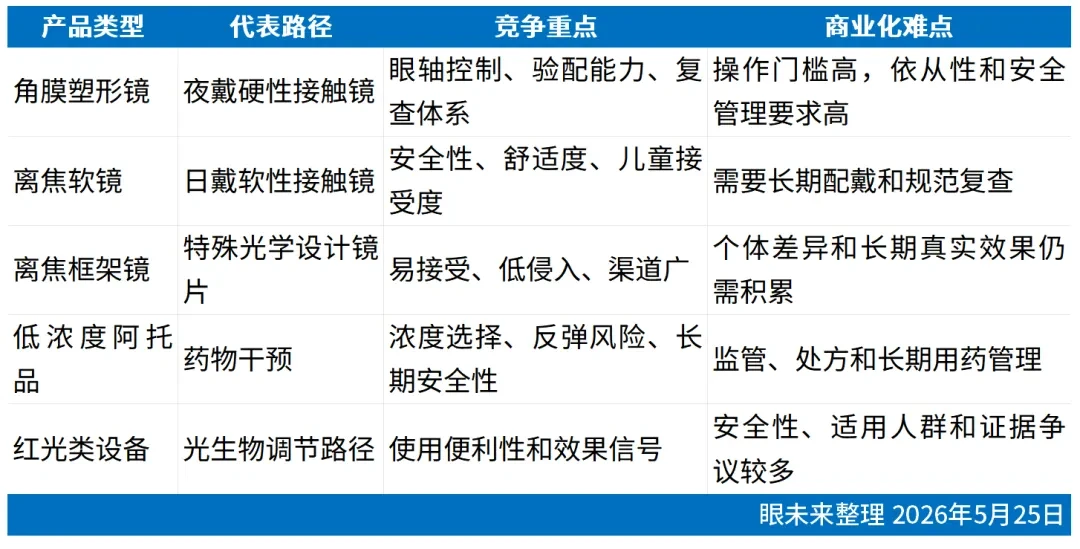
On the one hand, orthokeratology lenses have already achieved strong clinical recognition and a well-established service network in China; on the other hand, defocus spectacle lenses are rapidly gaining popularity due to a wearing experience that closely resembles conventional eyeglasses. Meanwhile, low-concentration atropine, red-light therapy devices, AI screening, and optometric management systems are also driving competition across various channels. This indicates that competition among myopia control products in China will revolve around at least four core issues:
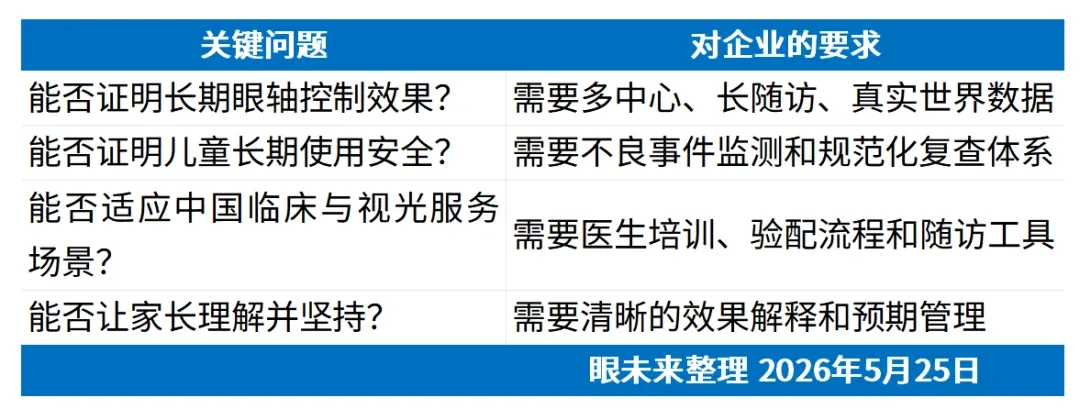
Eye Future Insights
The myopia control sector is shifting from competition driven by product popularity to competition based on long-term clinical evidence.
In the past, the market focused more on "whether there are new products," "whether they are approved," and "what the control rate is." Going forward, the more important questions will become:How long is the study follow-up period? What is the sample size? Does it include East Asian children? What is the real-world adherence rate? Are the axial length data stable? Is the safety profile supported by long-term observation?
For Chinese enterprises, the opportunities remain substantial. China boasts the world's most extensive clinical settings for myopia prevention and control, along with a vast population of children and adolescents and a continuously growing demand for optometric services. However, this also means that Chinese companies cannot merely view myopia prevention and control as a "consumer-level mass market," but rather must understand it as an eye health industry that is highly dependent on medical evidence, long-term management, and comprehensive service systems.
The next phase of competition in myopia control will hinge on who can consistently generate credible long-term data and translate it into clinical pathways that are actionable for physicians, parents, and children.

Ophthalmic Solutions Case Studies