

ChenGuang Medical's Reveal 24 CT device secures NMPA approval for market launch

ChenGuang Medical
Developer, Manufacturer, and Supplier of Core Components in the MRI Industry Chain
SHANGHAI, May 27, 2026 — Shanghai ChenGuang Medical Technology Co., Ltd. (Shanghai ChenGuang Medical) announced via its official WeChat account that its Reveal 24 X-ray computed tomography system has obtained official marketing approval from the National Medical Products Administration (NMPA) of China.
According to public disclosure documents, the device was officially approved on April 14, 2026, with the medical device registration certificate number "20263060773".
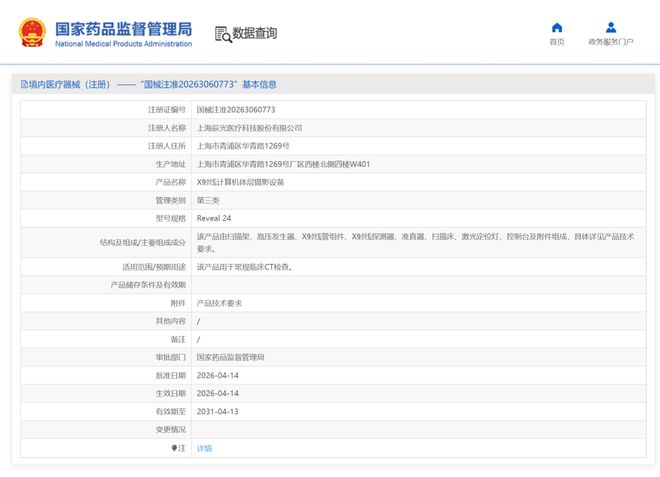
The approval information has been verified in the company's official announcements and mainstream financial disclosure platforms. The product launch signals a new milestone for China's medical imaging industry, which is shifting from basic grassroots substitution to high-end core technological competition amid continuous industrial upgrading.
Computed tomography (CT) has long remained one of the most technically sophisticated tracks in the medical imaging field. A complete CT system involves multiple core industrial links, including X-ray tubes, high-voltage generators, detectors, image reconstruction algorithms, motion control systems and post-processing software. Among these core components, detectors and X-ray tubes have historically been recognized as key technical bottlenecks restricting industrial development, while image reconstruction algorithms and low-dose imaging capabilities directly determine the clinical performance of CT devices.
As highlighted in the annual report of United Imaging Healthcare, core technical barriers in the CT industry center on sophisticated detectors, X-ray tubes and high-voltage generators. For more than a decade, the global high-end CT market has been overwhelmingly dominated by international giants, including GE HealthCare, Siemens Healthineers, Philips and Canon Medical Systems, which have long captured the majority shares of China's high-end medical imaging market.
In recent years, Chinese imaging manufacturers have made steady breakthroughs in core component manufacturing, iterative reconstruction algorithms and AI-assisted diagnostic technologies, enabling home-grown CT products to rapidly penetrate the mid-to-high-end market. Earlier this year, the NMPA disclosed that Chinese enterprises had rolled out innovative CT devices equipped with dual-source and dual-wide detector technology, which greatly enhances cardiac scanning performance and lowers clinical examination thresholds. The recent approval of ChenGuang Medical's Reveal 24 further demonstrates the expanding momentum of China's CT industry.
ChenGuang Medical has yet to fully release the full technical parameters of its Reveal 24 device through public channels. Nevertheless, product naming specifications and official registration data verify that the product falls into the category of X-ray computed tomography equipment, belonging to the standard clinical CT product lineup. Notably, ChenGuang Medical has long been positioned by the market as a supplier specializing in MRI-related medical equipment. The regulatory approval of Reveal 24 signifies the company's formal and further foray into the CT market, enabling it to diversify its business layout and expand its product coverage in the medical imaging sector.
On the one hand, CT remains one of the most essential imaging devices deployed across China's hospitals. Compared with MRI equipment, CT scanners feature faster scanning speed, broader adaptability for emergency treatment and wider clinical indications, delivering irreplaceable diagnostic value in trauma treatment, pulmonary screening, cardiovascular and cerebrovascular diagnosis, and tumor detection, sustaining robust market demand that fuels continuous industrial expansion.
Furthermore, the expansion of county-level and grassroots medical services is driving sustained growth in market demand for CT devices. In recent years, China has continuously promoted the construction of county-level medical communities, the national "Thousand-County Medical Improvement Program", and the optimization of large medical equipment allocation. A large number of grassroots and county-level hospitals are still in the phase of releasing demand for mid-to-high-end CT equipment. Therefore, the current growth of China's CT market is driven by two core factors — emerging incremental medical demand and industrial technological upgrading — rather than relying solely on import substitution.
Despite promising market prospects, the CT track remains extremely challenging with high technical barriers. Globally, competition for premium CT equipment has gradually shifted from simple hardware stacking to three core technological dimensions. First is detector performance, which determines image collection efficiency, temporal resolution and low-dose imaging capability. Wider detector coverage and higher temporal resolution have become core development trends for modern high-end CT devices.
Second, low-dose imaging capability has become a core competitive edge across the industry. United Imaging Healthcare has long laid out systematic R&D layouts in low-dose imaging, real-time image processing and automatic exposure control technologies to improve clinical safety and accuracy.
Third, AI reconstruction algorithms are reshaping the industrial competition landscape. In recent years, artificial intelligence has been deeply integrated into the CT industry, covering low-dose image enhancement, sparse sampling reconstruction and intelligent post-processing technologies. Latest public industry studies have explored ultra-low sampling CT reconstruction and large model-based CT image restoration technologies. This indicates that future CT competition will no longer focus merely on hardware capabilities, but on comprehensive strengths including algorithms, computing power and software ecosystem development.
For Chinese imaging manufacturers, breaking into the high-end market requires not only independent equipment manufacturing capabilities, but also the ability to build a complete professional imaging technology platform.
Competition in the market targeted by the Reveal 24 device has intensified significantly. China's CT market has formed a distinct tiered competitive structure. In the high-end segment, United Imaging Healthcare has emerged as one of the country's leading home-grown enterprises. Its product portfolio covers ultra-high-end CT, PET/CT and other fields, while the company continues to expand its global footprint. According to its 2025 annual report, the firm has accumulated more than 10,000 patent applications and is steadily advancing the global promotion of its high-end CT products.
Meanwhile, domestic players including Shinva are also ramping up their CT product layouts. In 2024, Shinva announced that its X-ray computed tomography device had obtained official registration approval, supporting application scenarios including clinical diagnosis, interventional therapy and intraoperative navigation. International manufacturers such as GE, Siemens and Philips still maintain solid advantages in the ultra-high-end CT sector, with profound technical accumulation in high-end cardiac CT, spectral CT and photon-counting CT. Photon-counting CT is widely recognized as one of the key technical directions for next-generation CT systems.
United Imaging Healthcare has publicly confirmed that it has launched the country's first home-grown photon-counting spectral CT device. This highlights two emerging characteristics of future competition in China's CT market: continuous upgrading of high-end technologies, and accelerated breakthroughs made by local manufacturers in core premium markets. Against such a backdrop, while the Reveal 24 may not directly target the ultra-high-end market, its regulatory approval demonstrates the continuous growth in the number of local CT manufacturers and the diversification of home-grown CT product lines.
China's medical imaging equipment industry is entering an era of systematic competition. A long-term observation reveals a prominent shift taking place across the domestic medical imaging sector. The industry previously prioritized standalone product breakthroughs, whereas it now focuses heavily on comprehensive platform capabilities. For industry enterprises, possessing a single competitive device is no longer sufficient. The core competitiveness lies in building a complete imaging product matrix, robust clinical collaboration capabilities and sustainable technological iteration capacity.
Driven by the rapid development of AI-based medical imaging technology, CT devices of the future will evolve beyond simple scanning instruments to achieve in-depth integration with intelligent diagnosis tools, cloud-based imaging platforms and telemedicine systems. This means competition among Chinese CT manufacturers will increasingly resemble the systematic ecosystem competition seen among global industry giants. From this perspective, the approval of ChenGuang Medical's Reveal 24 signifies far more than a new product launch. It represents another key milestone in the ongoing high-end transformation of China's medical imaging industry.
For the entire sector, the continuous launch of such innovative devices is propelling China's high-end medical imaging equipment industry to shift from being a market follower to a formal global competitor.