

Horimed Care Completes Series C Financing to Advance Its Integrated Intravascular Diagnosis and Therapy Platform, with HaoYue Capital as Exclusive Financial Advisor
Horimed
OCT Imaging Equipment R&D and Manufacturer
VCBeat learned that recently, Horimed Technology Co., Ltd. (hereinafter referred to as "Horimed") announced the completion of a new round of financing. This round of financing was exclusively invested by Tasly Capital, and Haoyue Capital served as the exclusive financial advisor. This round of financing will help Horimed accelerate product research and development and registration, and promote the commercialization of products already on the market.
Horimed Technology Co., Ltd., established in 2016, focuses on the research, production, and sales of Intravascular Ultrasound (IVUS) equipment and catheters, Optical Coherence Tomography (OCT) equipment and catheters, dual-catheter systems integrated with IVUS/OCT, Fractional Flow Reserve (FFR) platforms based on IVUS and OCT for non-invasive blood flow assessment, and intravascular laser plaque ablation technology. The company has mastered optical, ultrasound, and catheter platform technologies. Its future product portfolio will comprehensively cover coronary intervention, peripheral intervention, and neurointervention, aiming to become a leading enterprise in endovascular diagnosis and treatment.
At present, Horimed has nearly 100 patents that have been authorized or are in the application process, of which nearly 50 are invention patents. In terms of scientific research cooperation, Horimed has established deep cooperative relationships with more than ten hospitals, including the Second Affiliated Hospital of Harbin Medical University, the Second Affiliated Hospital of Zhejiang University, the General Hospital of the People's Liberation Army, Sir Run Run Shaw Hospital of Zhejiang University, the Tenth People’s Hospital Affiliated to Tongji University, the First Affiliated Hospital of Xi’an Jiaotong University, Hangzhou First People’s Hospital, and Fuwai Hospital. It has also entered into strategic cooperation with institutions such as Tianjin University. Meanwhile, Horimed has undertaken multiple scientific research projects, including two projects under the National Natural Science Foundation of China and key projects under the Tianjin Key Research and Development Program.
Currently, the number of patients with arterial vascular diseases in China is enormous. According to Frost & Sullivan's analysis, the number of patients with coronary artery disease exceeds 25 million, those with peripheral artery disease exceed 50 million, patients with intracranial stenosis exceed 20 million, and individuals with intracranial aneurysms surpass 50 million. Among these, Percutaneous Coronary Intervention (PCI) started relatively early in China and has developed to a more mature stage; it is estimated that the total number of PCI procedures nationwide exceeded 1.1 million in 2021.
Non-intraluminal imaging methods such as digital subtraction angiography (DSA) are regarded as the gold standard for basic diagnosis. However, since they rely on two-dimensional images for assessment, there are inherent limitations in evaluating vascular diseases and providing corresponding treatment plans. In comparison, intraluminal imaging technologies like IVUS and OCT are widely recognized as crucial tools for making PCI more precise.
IVUS, with its deep imaging capability, can more accurately assess the vascular wall morphology and the degree of stenosis. It is particularly valuable in evaluating plaque burden, left main bifurcation lesions, and positive or negative vascular wall remodeling. OCT, with its high resolution, plays a significant role in determining the composition and nature of coronary plaques, identifying thrombi, observing the immediate effects post-stent implantation, assessing stent apposition, detecting intimal tears after stent placement, evaluating plaque prolapse within stents, and monitoring vascular endothelial repair and proliferation post-stent implantation. It is especially advantageous in the full-cycle monitoring of fully degradable stents (BVS). Of course, for routine PCI procedures, the assistance of intravascular imaging diagnosis can significantly reduce the difficulty and duration of the surgery for operators, providing patients with more precise treatment.

Clinical Recommendation Level of IVUS/OCT Technology
In recent years, intravascular IVUS/OCT technology has gained widespread recognition in high-end medical markets such as the United States, the European Union, and Japan, with clinical guideline recommendation levels all at II,a. Compared to the penetration rates of intravascular imaging in Japan (90%) and Europe (35%) in 2019, although China ranks first globally in the volume of PCI procedures, the proportion of IVUS catheter usage in China during the same period accounted for only about 5.4% of PCI procedures, and the proportion of OCT catheter usage was even less than 1%. This is related to the fact that, prior to the centralized procurement of coronary stents and balloons, precise diagnostic awareness had not yet fully taken root during the rapid development of PCI procedures in China, along with the previous imperfections in payment methods and low health insurance coverage.
After the coronary artery stent procurement, with the further increase in the penetration and popularity of PCI surgeries, the market is gradually expanding to lower-tier hospitals. More grassroots hospitals are progressively performing these surgeries. With the assistance of IVUS/OCT, the learning curve for emerging operators will be significantly reduced. In terms of medical insurance policies, IVUS coverage has been rolled out nationwide, while OCT coverage has started pilot programs in a few provinces. The rapid implementation of DRG/DIP payment methods will also provide growth opportunities for precise treatment methods like IVUS/OCT. The comprehensive and precise interventional diagnosis and treatment are inevitable trends for the future.
In 2021, the penetration rate of IVUS/OCT in China significantly narrowed the gap compared to previous years and to countries like Europe, the U.S., and Japan, with usage rates rapidly surging. Certain brands even experienced stockouts at one point. Statistics show that the usage of IVUS catheters in China in 2021 is expected to exceed 200,000 units, with a penetration rate close to 20%. The usage of OCT catheters is projected to surpass 50,000 units, with a penetration rate nearing 5%. In the future, as PCI procedural processes become standardized and clinical academic awareness further improves, China's intravascular imaging market will continue to expand. Conservative estimates predict that by 2025, the IVUS penetration rate will reach 30%, with a terminal market value exceeding 5 billion RMB; the OCT penetration rate will reach 15%, with a terminal market space surpassing 3 billion RMB.
Why Horimed Breaks the Deadlock?
At present, IVUS and OCT procedures have been fully recognized internationally, while in China, they are still in a period of rapid growth in comparison. Currently, whether it is IVUS or OCT, the domestic market in China is close to being monopolized by imports. Horimed's breakthrough strategy involves two aspects: the inevitable replacement of imports and the early layout of an extensive blue ocean market.
Currently, all players in the IVUS market are imported brands, with no domestically produced IVUS available yet; Horimed is expected to become the first. In the OCT field, imported brands nearly monopolize the market, and import substitution remains an inevitable trend.
In addition, the blue ocean market has enormous potential. According to the latest white paper data, as of the first half of 2020, the number of domestic hospitals in China equipped with IVUS was approximately 700, while the number equipped with OCT was over 100. There is still significant room for growth before reaching the more than 3,000 hospitals in China that currently perform interventional procedures. Moreover, there are over 13,000 hospitals in China that are potential customers for adopting interventional surgeries (secondary-level hospitals and above), as well as private hospitals (exceeding 20,000) with a large pool of potential clients such as Yaxin Hospital and Teda Hospital.
For the competition of domestically produced medical devices, speed is king in the short term, while product strength, platform iteration capability, and cost control determine the future. Overall, Horimed has absolute strength both in the short and long term.
In the short term, Horimed maintains a steady pace in obtaining certifications and rapidly executes commercialization. The IVUS device and catheter have completed clinical enrollment and are expected to receive NMPA approval before Q3 2022, potentially becoming the first domestically produced option. The OCT device has recently received NMPA approval, and the OCT catheter is expected to receive NMPA approval before Q2 2022. Horimed’s uniquely developed dual-catheter system, combining IVUS/OCT in an all-in-one machine, is planned for certification in 2023.
In the long term, in terms of product strength, Horimed benchmarks against the latest generation of products from imported brands. At the same time, Horimed is the only domestic company that fully masters the key technologies of IVUS and OCT equipment and catheters. Based on its platform-type technology for intravascular endoluminal imaging, the company can achieve rapid product iteration and upgrades. Its pipeline layout has gradually expanded from cardiovascular to peripheral and neuro-interventional fields.
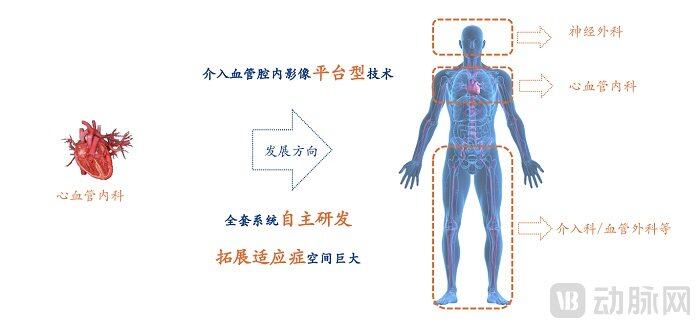
Horimed's full suite of systems are independently developed, featuring an interventional vascular endoluminal imaging platform technology.
From the perspective of commercial implementation, Horimed's uniquely self-developed IVUS/OCT integrated dual-catheter system allows for flexible choices in marketing promotion as one integrated machine can connect with both IVUS and OCT consumables. This enables a single salesperson to handle IVUS/OCT products separately, significantly simplifying the promotion process and offering tremendous growth potential. On the hospital side, the integrated machine also saves substantial space in the catheterization lab, making it convenient for use and后期维护管理 while drastically reducing budget requirements.
In terms of cost control, the company has achieved full independent research and development of core components, with the capability for scaled production of IVUS and OCT equipment and consumables, offering significant room for cost reduction. This supports the company in becoming a key player in the future market.
Dr. Shi-Yong Zhao, Founder of HorimedHorimed stated that China's vascular interventional precision diagnosis and treatment industry has just started, and there is still a long way to go. As a member of this field, Horimed will focus on technology and products in the future while also concentrating on assisting clinical efforts to carry out systematic training for vascular interventional precision diagnosis and treatment. We hope to grow together with the vast number of vascular intervention doctors, enabling more doctors to understand, master, and be committed to promoting vascular interventional precision diagnosis and treatment, gradually aligning China with international standards in this field, and ultimately benefiting more patients. We are very grateful for the continued support of both new and existing shareholders, and we also thank this round’s financing partner, VCBeat Capital, for their strong project execution capabilities and deep, precise understanding of the industry. With the help of capital, we believe that in the future, the company will become a leading enterprise in vascular interventional endoluminal diagnosis and treatment through its solid, innovative technologies and products.
Mr. Wang Chen, Senior Partner of Tasly Capital Holding (Beijing) Co., Ltd.Tasly Capital's investment team has been continuously focusing on the field of intravascular imaging within cardiovascular interventions. Optical Coherence Tomography (OCT) and Intravascular Ultrasound (IVUS), as intravascular imaging technologies, have become essential tools in catheterization labs after more than 30 years of development. They are now recommended by guidelines as important diagnostic and surgical evaluation tools for doctors, benefiting a large number of cardiovascular patients. Horimed, a leading company in this industry, owns both major technological platforms and consistently adheres to the concept of technology-driven innovation and localization. We firmly believe that under the leadership of the founding team, with the efforts of all employees, and with the support of all shareholders and investors, the company will provide patients with reliable and cost-effective products, benefiting a wide range of patients. Tasly Capital will unwaveringly continue to support the development of Horimed, contributing to the advancement of precision cardiovascular interventions in China.
Mr. Yang Zhenjun, Managing Partner of Haoyue CapitalWe are honored to assist Horimed in completing this round of financing. Comprehensive and precise diagnosis and treatment represent the trend of medical development. Intravascular imaging is the most powerful technique for achieving accurate diagnosis in the field of vascular intervention, and it has gained recommendations from clinical guidelines as well as widespread recognition in high-end medical markets globally. In recent years, driven by healthcare reforms and the increasing penetration of interventional procedures, intravascular imaging in China has experienced rapid growth and holds significant potential for future expansion. All products of Horimed Technology Co., Ltd. are fully independently developed with proprietary intellectual property rights, including core components, supported by platform-based technologies, and possess the capability for large-scale production and cost control of both equipment and consumables. VCBeat Capital continues to have high expectations for the company, growing alongside it, and looks forward to more high-quality products reaching the market soon to benefit a wide range of patients.
About Horimed
Horimed Technology Co., Ltd., established in 2016, focuses on the R&D, production, and sales of IVUS equipment and catheters, OCT equipment and catheters, IVUS/OCT integrated dual-catheter systems, non-invasive FFR platforms based on IVUS and OCT, and intravascular laser plaque ablation technology. The company has mastered optical, ultrasound, and catheter platform technologies. Its future product portfolio will comprehensively cover coronary intervention, peripheral intervention, and neurointervention, with the goal of becoming a leading enterprise in endovascular diagnosis and treatment.
About Tasly Capital
Tasly Capital, relying on the industrial resources of its shareholder Tasly Holding Group, adheres to the concept of industrial investment and persists in the 4D investment strategy. It focuses on building an ecosystem for pharmaceuticals, medical devices, diagnostics, and digital health industries around disease areas such as cardiovascular, oncology, metabolism, and gastroenterology, striving to assist start-up and growth-stage enterprises. Since its establishment in 2007, the company has managed a scale exceeding 10 billion RMB, with seven RMB funds and three USD funds successively. It has invested in over 100 projects cumulatively, exited more than 30 projects, including 16 IPOs. These include well-known industry enterprises such as Innovent Biologics, Leadbiologics, CARsgen Therapeutics, I-Mab, Berry Genomics, Xinwei Medical, and Land Therapeutics. Tasly Capital's nearly 60 professional investment team members will delve deeper into the industry and become entrepreneurial partners for entrepreneurs in the pharmaceuticals and healthcare industry.
About Haoyue Capital
HaoYue Capital was founded in January 2014, dedicated to becoming the bridge connecting China's healthcare industry with capital. The research areas and transaction scope of HaoYue Capital cover multiple sub-sectors such as biopharmaceuticals, innovative medical devices, IVD and precision medicine, medical services, and smart healthcare. The team of HaoYue Capital consists of senior investment bankers who have been deeply involved in China’s healthcare industry for many years. They closely track the dynamics and investment trends in the healthcare investment market over the long term, issuing a weekly healthcare investment report and thematic research reports, offering insights through the HaoYue perspective on new policies and cutting-edge developments.