

How Johnson & Johnson Captured Over 40% of the Global Electrophysiology Market: The Rise of Biosense Webster

Biosense Webster
Developer of Diagnostic and Therapeutic Devices for Arrhythmia
In 26 years, merely a fleeting moment for an industry, yet sufficient for Johnson & Johnson to establish its subsidiary, Biosense Webster, as the globally recognized leader in cardiac electrophysiology.
In 1996, Johnson & Johnson acquired Biosense and officially entered the cardiac electrophysiology industry. Since then, Johnson & Johnson has continuously increased its investment through acquisitions, divestitures, channel support, and academic promotions, relying on its global sales channels to drive the development of its cardiac electrophysiology business.By 2015, Biosense Webster had captured 40% of the global cardiac electrophysiology market, becoming the globally recognized leader in the cardiac electrophysiology industry.。
In China, Johnson & Johnson's cardiac electrophysiology business is more dominant, with revenue reaching 3.03 billion yuan in 2020, accounting for 58.8% of the domestic cardiac electrophysiology market.
So, can China-produced cardiac electrophysiology companies overtake competitors by cutting corners and achieve domestic substitution? Can China give birth to a super cardiac electrophysiology giant like Biosense Webster? How has Johnson & Johnson's cardiac electrophysiology business developed? What inspiration can it bring to domestic cardiac electrophysiology enterprises?
Johnson & Johnson's electrophysiology business has grown so rapidly, closely related to two companies it once acquired: Cordis and Biosense.
Cordis Webster (Webster Laboratories), a subsidiary of Cordis, was co-founded by senior engineer Will Webster and a cardiologist. It was acquired by Cordis in 1994 and established as Cordis Webster. Data shows that Will Webster and his team not only focused on catheter technology but also developed radiofrequency ablation catheters for the treatment of arrhythmias.
Biosense was founded in 1993 by Professor Shlomo Ben-Haim, a visiting professor at Harvard University, focusing on electrophysiological mapping catheters.In 1995, Biosense launched the world's first three-dimensional cardiac electrophysiological mapping system., Although its revenue is less than 1 million US dollars, the leading nature, convenience, and effectiveness of its products have gained consistent recognition in clinical settings.
In 1996, Johnson & Johnson officially entered the market, successively acquiring Cordis and Biosense for $1.8 billion and $400 million, respectively, marking its formal entry into the cardiac electrophysiology field.At the same time, Johnson & Johnson merged Cordis Webster (part of Cordis' business) with Biosense, combining Cordis Webster's catheter ablation technology with Biosense's three-dimensional electrophysiological mapping technology to form what would later become the world-renowned cardiac electrophysiology giant, Biosense Webster, Inc. Will Webster served as the Senior Scientific Advisor of Biosense Webster, and Biosense's original R&D team also transferred to Biosense Webster to continue research, development, and innovation.
After completing the merger, Biosense Webster began its journey to dominate the global cardiac electrophysiology market.
Johnson & Johnson stated in its annual report that the rapid increase in revenue from its cardiac electrophysiology business was due toMarket Growth(Growth in cardiac electrophysiology procedures)New Product Promotion。
From the perspective of market growth, the volume of global cardiac electrophysiology procedures began to grow rapidly around 1995. Taking China as an example, cardiac electrophysiology procedures in China only started slowly in the 1990s, but by 2015, the annual number of procedures had reached 118,000, and by 2020 it had reached 212,000. According to data from BioSig Technologies, the global volume of cardiac electrophysiology procedures is expected to reach 1.455 million cases in 2022.
With the increase in the number of surgeries, the market size of cardiac electrophysiology has also expanded simultaneously. According to foreign media data, the global cardiac electrophysiology market has grown from 3.4 billion US dollars in 2015 to 6.4 billion US dollars in 2021, with an annual compound growth rate of 11%.
From the perspective of new product promotionBiosense Webster, on the one hand, increases R&D investment and continuously and rapidly launches new products; on the other hand, it relies on Johnson & Johnson's group resources and marketing resources to actively engage in academic marketing and vigorously promote its products.
In terms of product developmentBiosense Webster has successively iterated its three-dimensional cardiac electrophysiology mapping system, adding three-dimensional electrophysiology surgical consumables and module algorithms to make electrophysiological procedures more accurate and convenient; pioneered the adjustable catheter, making electrophysiological examinations and radiofrequency ablations more precise; and launched a circular mapping catheter to support a new procedure for treating arrhythmias—circular pulmonary vein radiofrequency ablation.
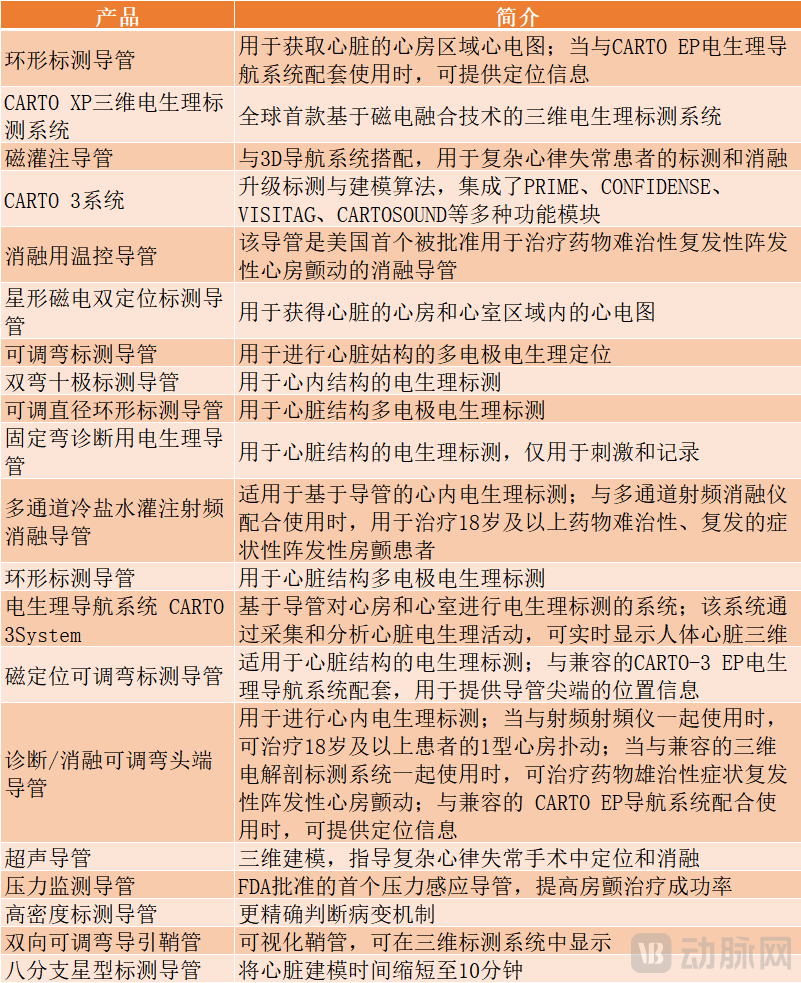
(Partial statistics of Biosense Webster products, data source: VCBeat整理 according to publicly available information)
Compared with traditional two-dimensional image-guided cardiac radiofrequency ablation, catheter ablation guided by a three-dimensional electrophysiological mapping system is more precise and greatly simplifies the surgical process. Public information shows that two-dimensional cardiac electrophysiological surgery cannot accurately combine intracavitary electrocardiograms with the three-dimensional structure of the heart, and it lacks spatial positioning and memory functions. Clinicians can only rely on their own experience and personal memory for mapping, which results in larger errors, higher difficulty, and longer operation times.
Three-dimensional (3D) cardiac electrophysiology surgery utilizes a 3D electrophysiological mapping system to create a 3D model of the heart on a computer. This provides a clear visualization of the 3D structures of the heart and blood vessels, integrating intracavitary electrocardiograms with the heart's three-dimensional anatomy. As a result, clinicians can easily perform catheter manipulation and positioning, improve ablation success rates, lower the learning curve, and reduce operation time.
Relying on its first-mover advantage, Biosense Webster quickly entered the market and achieved scaled revenue. Leveraging the advantages of 3D electrophysiology procedures, Biosense Webster rapidly increased the penetration rate of cardiac electrophysiology procedures, expanding the market scale and the company’s revenue. Meanwhile, Biosense Webster's 3D cardiac electrophysiology mapping system is a closed system that requires the use of Biosense Webster’s own magnetic localization mapping catheters, ablation catheters, and other consumables. Consequently, the scaled sales of the 3D cardiac electrophysiology mapping system further drove the sales of its electrophysiology products.
In terms of academic marketingBiosense Webster has conducted multiple clinical trial studies to demonstrate that cardiac radiofrequency ablation is safe and effective, reducing the likelihood of related complications and recurrence. The trial results were published in top-tier journals or presented at significant conferences. For instance, the ATTEST clinical study led by Biosense Webster involved 29 medical institutions across 13 countries and included 255 patients with paroxysmal atrial fibrillation, proving that cardiac radiofrequency ablation is superior to antiarrhythmic drug therapy alone in delaying the progression of atrial fibrillation.
At the same time, Biosense Webster frequently participates in cardiac electrophysiology academic conferences, encouraging and supporting experts who use cardiac radiofrequency ablation to give speeches, promoting its products and cardiac electrophysiology procedures. In addition, Biosense Webster has installed cardiac 3D electrophysiology mapping systems in most of the top hospitals and teaching institutions worldwide, allowing medical students to become familiar with its products in advance and enabling these "future doctors" to become accustomed to using its products.
Besides the factors of market growth and new product promotion mentioned above, we have found other reasons for Biosense Webster's continuously increasing revenue performance. For instance, relying on Johnson & Johnson’s corporate resources, Biosense Webster promotes innovative products in the EU, the U.S., Asia, and the Middle East. Its strategy is to first collaborate with top local medical institutions and renowned experts to raise awareness of cardiac electrophysiology procedures, followed by large-scale promotion.
For instance, Biosense Webster relies on Johnson & Johnson's Medical Professional Education Institute to train clinicians in cardiac electrophysiology surgical techniques. Data shows that Johnson & Johnson's Medical Professional Education Institute integrates 24 professional education institutes worldwide and multiple online education platforms, helping doctors, nurses, and other professionals enhance their skills. Currently, Johnson & Johnson's Medical Professional Education Institutes are located in 24 cities globally, covering the United States, the United Kingdom, Germany, Switzerland, Spain, Russia, China, India, Japan, South Korea, Singapore, Australia, and Brazil.
With the help of Johnson & Johnson's Medical Professional Education Institute, the number of doctors able to perform cardiac electrophysiology procedures is gradually increasing, simultaneously driving a significant rise in the volume of these procedures. For instance, in China, Johnson & Johnson trains hundreds of cardiac electrophysiology doctors annually, progressively enhancing the penetration rate of cardiac electrophysiology surgeries year by year.
With the implementation of multiple strategies, Biosense Webster's revenue has been steadily increasing, growing from an initial amount of less than one million US dollars to over one billion US dollars, making it one of Johnson & Johnson's fastest-growing businesses. According to foreign media reports, Johnson & Johnson's electrophysiology business accounted for approximately 40% of the global cardiac electrophysiology market in 2015, standing out as a leader in the field.。
Since Biosense Webster achieved scale revenue and demonstrated the vast market potential in cardiac electrophysiology, numerous companies such as Abbott, Boston Scientific, and Acutus Medical have also entered the cardiac electrophysiology arena. Medtronic, after acquiring CryoCath in 2008, gained cryoablation technology for arrhythmia treatment, initiating a "cold vs. heat" battle with Johnson & Johnson’s radiofrequency ablation technology.
Facing Medtronic, Abbott, and other competitors, Johnson & Johnson chose to strike at its rivals from two fronts to capture the market.
First, Biosense Webster provides a full range of products for cardiac electrophysiology.Biosense Webster provides all the instruments needed for cardiac electrophysiology procedures, which can reduce the surgical risks associated with switching to products from different companies. It also facilitates more efficient supply chain management and postoperative monitoring for hospitals. At the same time, the complete product line enables Biosense Webster to adopt more flexible pricing strategies to respond to market competition.
To expand its own product pipeline, Biosense Webster continuously invests in R&D to introduce innovative products, while also expanding its offerings through collaborations, agency agreements, and acquisitions.
For example, in terms of R&D, Biosense Webster took the lead in developing cutting-edge products of its time such as 3D cardiac electrophysiology mapping systems, deflectable catheters, cold saline infusion catheters, adjustable diameter circular mapping catheters, contact force sensing catheters, high-density mapping catheters, and bidirectional deflectable guiding sheaths. Among these, several products are global firsts with significant advantages.
At the same time, Biosense Webster has also cooperated with international device giants such as GE Healthcare to jointly develop real-time ultrasound imaging systems for cardiac electrophysiology.
It is worth mentioning that today, innovative technologies such as pulsed field ablation and robotics have become the next breakthrough in the cardiac electrophysiology field, and Biosense Webster has also made its move in this area. For instance, its pulsed field ablation product has initiated clinical trials in Europe and has entered the special review process for innovative medical devices in China; regarding robotics, it established a partnership with Stereotaxis, a magnetic navigation electrophysiology robotics company, as early as 2011.
Second, Biosense Webster leverages its first-mover advantage by adopting a "point-to-surface, cooperative sales" approach to promote its products.After Biosense Webster launched its 3D cardiac electrophysiology mapping system, it aggressively promoted the product by leveraging the advantages of 3D electrophysiology procedures and its first-mover advantage.
At the same time, Biosense Webster has developed its cardiac 3D electrophysiology mapping system into a semi-closed system, meaning that some of the consumables and instruments required for 3D surgery must be used with its own brand products, while others can choose products from other brands. With the widespread application of the cardiac 3D electrophysiology mapping system, Biosense Webster's high-density mapping catheters, 3D ablation catheters, and other products have increased exponentially, forming a sales pattern of "driving overall growth from key points."
On the other hand, Biosense Webster collaborates with companies such as GE Healthcare, while relying on Johnson & Johnson's global channels to jointly promote the sales of its products. In 2012, GE Healthcare signed an agreement with Biosense Webster to distribute its product series. With the support of GE Healthcare’s sales system, Biosense Webster’s products will enter more hospitals, further increasing its market share.
It is worth mentioning that Biosense Webster continuously iterates and optimizes its products while launching new ones to enhance the safety, effectiveness, and convenience of cardiac electrophysiology procedures. The high-quality advantage of these products gives sales personnel more confidence in promoting them.
For example, in 1995, it launched the world's first three-dimensional cardiac electrophysiological mapping system, followed by subsequent updates such as the CARTO XP with magnetic and electrical positioning, the CARTO 3 loaded with multiple functional modules, and the CARTO 3 V6 with new algorithms. Another example is the bidirectional deflectable guiding sheath introduced by Biosense Webster, which enables visualization and can be displayed in the three-dimensional cardiac electrophysiological mapping system; the eight-branch star-shaped mapping catheter they introduced can reduce cardiac modeling time to 10 minutes.
With the support of a full range of products and reasonable sales strategies, Biosense Webster's market share continues to grow. In 2020, Biosense Webster accounted for 58.8% of China's cardiac electrophysiology market with a revenue of 3 billion yuan, while Abbott and Medtronic accounted for 21.4% and 6.7%, respectively.
Today, Biosense Webster has become the undisputed global leader in cardiac electrophysiology on behalf of Johnson & Johnson.
Looking into the future, can China give birth to a cardiac electrophysiology giant like Biosense Webster? Currently, the answer seems to be yes.
First, the market size. Public data shows that the number of patients with arrhythmia in China reached 20 million in 2016. As an effective treatment for arrhythmia, catheter-based radiofrequency ablation has been widely used in more than 600 hospitals in China. The number of surgeries increased from 101,000 cases in 2014 to 152,000 cases in 2018, with a compound annual growth rate of 10.7%.
A large patient base and rapidly increasing surgical volumes have fostered a broad electrophysiology market: In 2020, the scale of China's electrophysiology market was approximately 5.85 billion yuan, and it is expected to grow to 18.89 billion yuan by 2025.
Secondly, the overseas strategy of China-produced device companies. A review of the growth history of China's medical device industry reveals that: China-produced device companies basically started by breaking foreign monopolies, then increased the localization rate, and ultimately moved towards international competition. China-produced cardiac electrophysiology companies are no exception. Currently, they are in the early stage of breaking monopolies and increasing the localization rate. With the impact of national centralized procurement and intense competition, they will inevitably go global and tap into the international market.
Finally, the research and development of innovative technologies. Today, in the global cardiac electrophysiology industry, technologies such as pulsed field ablation, 3D imaging, and robotics are the key focus areas for companies. Chinese innovative companies are also making strides in these fields with relatively fast progress. For instance, Jinjiang Electronics' self-developed pulsed field ablation system completed patient enrollment for its registration clinical trial in November 2021. RDN Biotech’s atrial fibrillation pulsed field ablation system is about to enter clinical trials. In July 2021, Denovo EP successfully completed Asia's first pulsed field ablation surgery for persistent atrial fibrillation.
From the perspective of market development, a decentralized market will move towards concentration. The cardiac electrophysiology market will shift from a state of diverse competition to oligopoly, and with the emergence of oligarchs, China's leading cardiac electrophysiology giants will also be born.