

Gilead's CD47 Monoclonal Antibody Magrolimab Combined with Azacitidine Faces Partial Clinical Hold by FDA

Gilead Sciences
Antiviral Drug Developer

FDA
U.S. Food and Drug Administration
On January 25, Gilead Sciences announced that the U.S. FDA has placed a partial clinical hold on the company’s combination study of CD47 monoclonal antibody magrolimab and azacitidine due to a significant imbalance in suspected unexpected serious adverse reactions (SUSARs) reported by researchers across study groups.
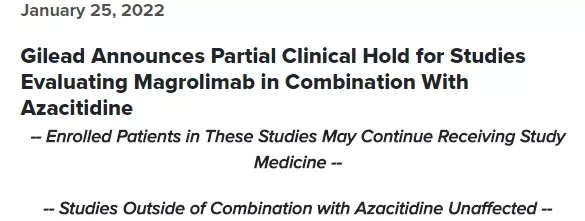
During the partial clinical hold, any studies involving magrolimab in combination with azacitidine will pause screening and enrollment of new participants. Patients already enrolled may continue to receive magrolimab in combination with azacitidine or placebo treatment and will continue to be closely monitored according to the current study protocol. Other studies or cohorts not involving magrolimab in combination with azacitidine will continue without being affected by the partial clinical hold.
Studies affected by partial clinical holds include:
- Phase III ENHANCE Study: Myelodysplastic Syndromes (MDS; NCT04313881);
- Phase III ENHANCE-2 Study: Acute Myeloid Leukemia (AML; TP53-mutated patients; NCT04778397);
- Phase III ENHANCE-3 Study: Untreated Acute Myeloid Leukemia (AML) Unsuitable for Intensive Chemotherapy;
- Stage Ib MDS (NCT03248479);
- Phase II Malignant Myeloid Hematological Disorders (NCT04778410) *Azacitidine Combination Cohort Only
Unaffected Studies:
- Phase II Diffuse Large B-Cell Lymphoma (NCT02953509);
- Phase II Multiple Myeloma (NCT04892446);
- Head and Neck Squamous Cell Carcinoma (NCT04854499);
- Phase II Solid Tumors (NCT04827576);
- Phase II Triple-Negative Breast Cancer (NCT04958785);
- Phase II Colorectal Cancer, Planned Recruitment, Not Yet Recruiting
Gilead Sciences stated that while no clear trend of adverse reactions or new safety signals has been identified so far, as more data is collected, Gilead is implementing a partial clinical hold on all ongoing global studies of magrolimab in combination with azacitidine to ensure the best interests of patients and conduct analyses to address the issues raised by the FDA.
Magrolimab is a First-in-class monoclonal antibody targeting CD47 that Gilead acquired through the $4.9 billion cash acquisition of the immuno-oncology company Forty Seven in March 2020.
CD47-SIRPα is an inhibitory pathway of phagocytes, but CD47 is also widely expressed in tumor cells. Blocking this pathway can activate the immune mechanism for phagocytosis of tumor cells, making it once considered a highly promising new target. Many pharmaceutical companies in and outside China have invested in this field:

However, this mechanism requires the simultaneous blockade of CD47-SIRPα in platelets and red blood cells to be activated, which implies that this treatment approach may cause hematological toxicity. Magrolimab had previously triggered a crisis regarding the drugability of the CD47 target due to clinical hematological toxicity.
Fortunately, Magrolimab's ultimately positive clinical data dispelled this concern. Later developers also tried to avoid possible side effects in their research and design.