

AbbVie 2021 Financial Report: Humira Surpasses $20 Billion, Paving the Way for a Diversified Portfolio Beyond Autoimmune Dominance

AbbVie
Innovative Drug Developer
On February 2, AbbVie announced its 2021 performance, with total annual revenue of $56.197 billion, representing a year-over-year increase of 22.7%. R&D investment reached $7.08 billion, marking an 8% increase.
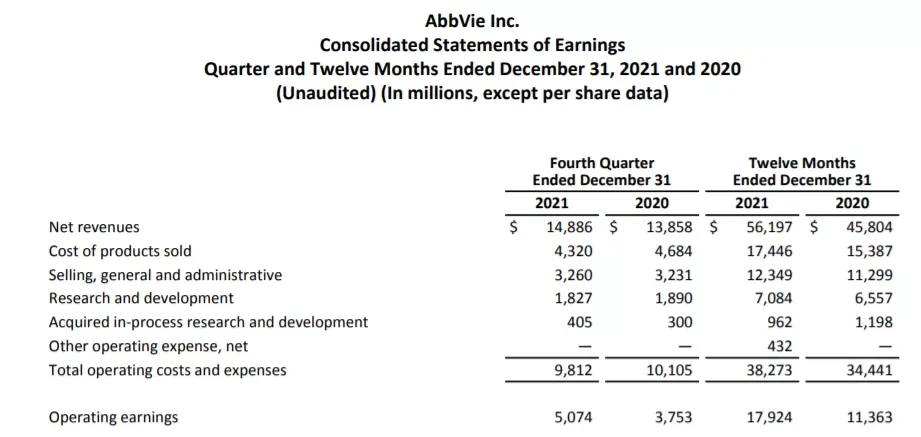
AbbVie's current business mainly focuses on autoimmune diseases, hematology/oncology, aesthetics, neurology, ophthalmology, and women’s health. Among these, autoimmune diseases still account for nearly half of the revenue share (45%), with an income of $25.284 billion in 2021, representing a year-on-year increase of 14.1%. Additionally, the revenue from hematology/oncology was $7.228 billion (+8.7%), the neurology sector brought in $5.927 billion, and the aesthetics business generated $5.233 billion.
Top 20 Products by Sales of AbbVie in 2022 (USD billion)
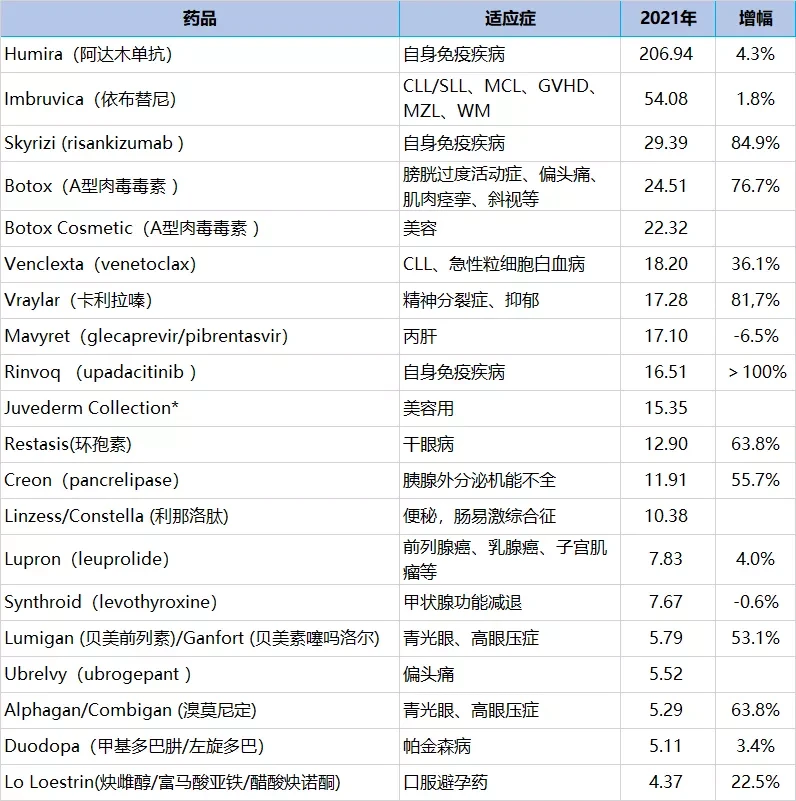
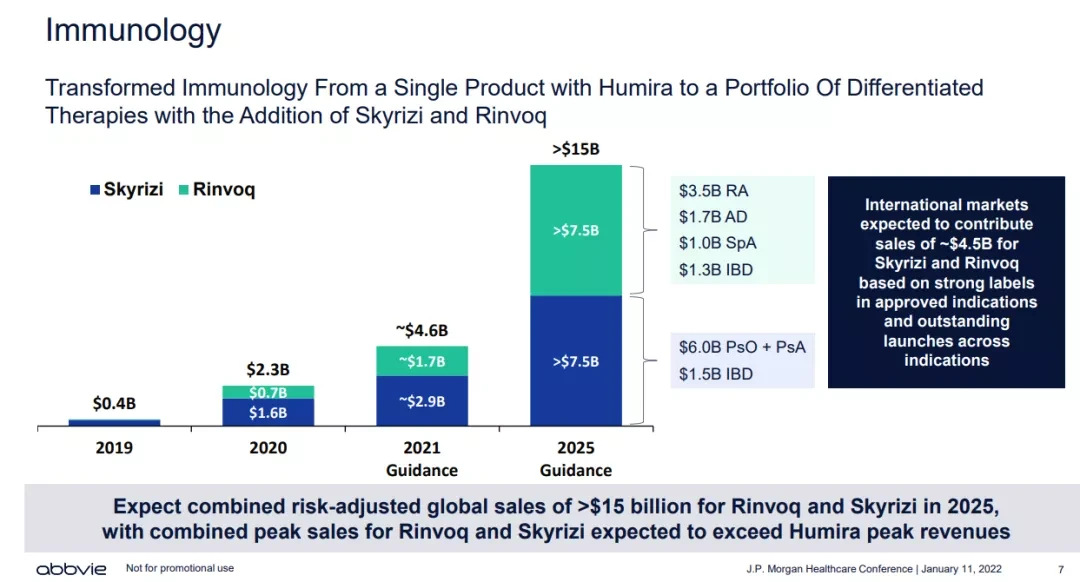
In terms of specific products, Humira achieved sales revenue of $20.694 billion in 2021 with a modest growth of 3.5%, accomplishing the feat of breaking through the $20 billion annual sales barrier for a single drug, fulfilling the expectations many had for this star product. Humira will lose its exclusive status in the U.S. market in 2023, a fact that is now widely understood, and AbbVie's subsequent autoimmune pipeline has stepped up strongly. The 2021 sales revenue of IL-23 monoclonal antibody Skyrizi (risankizumab) was $2.939 billion, representing a year-on-year increase of 84.9%; the revenue from oral JAK1 inhibitor Rinvoq (upadacitinib) reached $1.65 billion, with an increase of over 100% year-on-year.
Competition in the autoimmune field is becoming increasingly fierce, and it may be difficult to see another miracle like Humira. AbbVie is currently relying on the two aforementioned products as a dual safeguard. However, JAK inhibitors encountered setbacks in 2021 when safety data for tofacitinib indicated an increased risk of cardiac events. As a result, the approval of Rinvoq’s indications for moderate to severe atopic dermatitis and ulcerative colitis was delayed. Ultimately, the FDA required that JAK products carry a black box warning before gradually granting approvals. Consequently, AbbVie adjusted its sales forecast for Rinvoq, reducing its projected 2025 revenue by $500 million while increasing Skyrizi's projected sales by the same amount. AbbVie anticipates that Skyrizi and Rinvoq will achieve combined sales of $15 billion by 2025.
In the field of oncology, AbbVie won the Imbruvica (ibrutinib) patent litigation and reached a settlement with generic drug manufacturers in 2021, ensuring that no generic versions of Imbruvica will enter the U.S. market before March 30, 2032. However, due to increased market competition and other reasons, Imbruvica's growth was only 1.8% year-over-year in 2021. Venclexta (venetoclax) generated revenue of $1.82 billion in 2021, representing a year-over-year increase of 36.1%, securing another strong position for AbbVie.
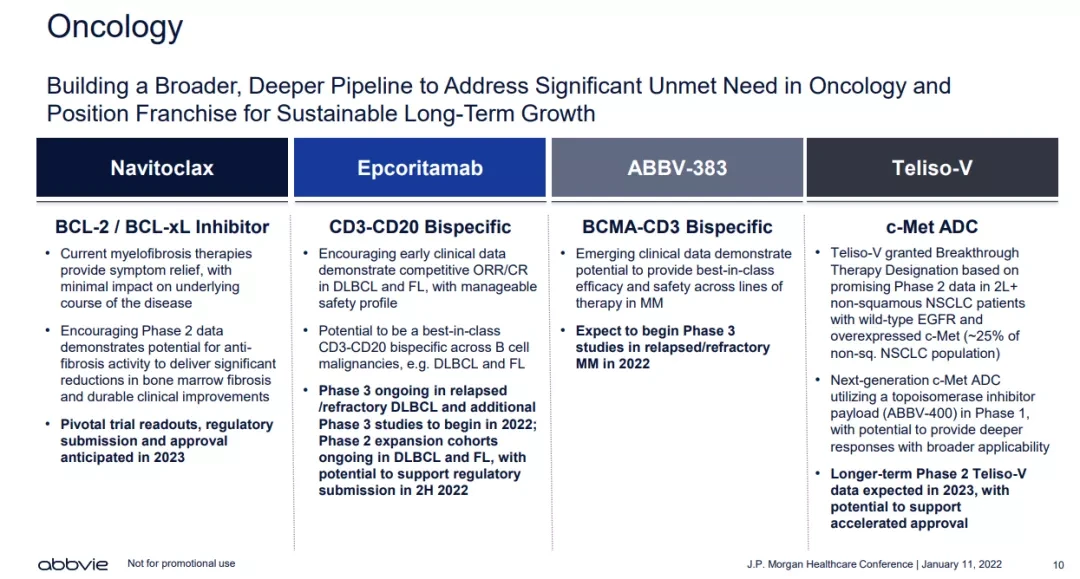
AbbVie regards oncology as the second-largest segment outside of autoimmune diseases and continues to expand its pipeline in the oncology field, including securing exclusive rights to TNB-383. AbbVie previously reached a $3.9 billion collaboration with Genmab to introduce the bispecific antibody drug epcoritamab, and ABBV-383 will also enter Phase III studies in 2022.
In the field of neurological diseases, Vraylar (cariprazine) contributed $1.728 billion in 2021, representing an 81.7% year-over-year increase. AbbVie predicts that Vraylar’s peak sales could reach $4 billion. The new migraine drug Ubrelvy (ubrogepant) generated $552 million in revenue in 2021, but its market share is being eroded by Biohaven's Nurtec ODT. With AbbVie’s new migraine drug Qulipta approved in September, it is expected to mitigate the impact brought by Nurtec ODT. However, some analysts still believe that AbbVie’s Ubrelvy and Qulipta will struggle to match the leading position of Nurtec ODT.
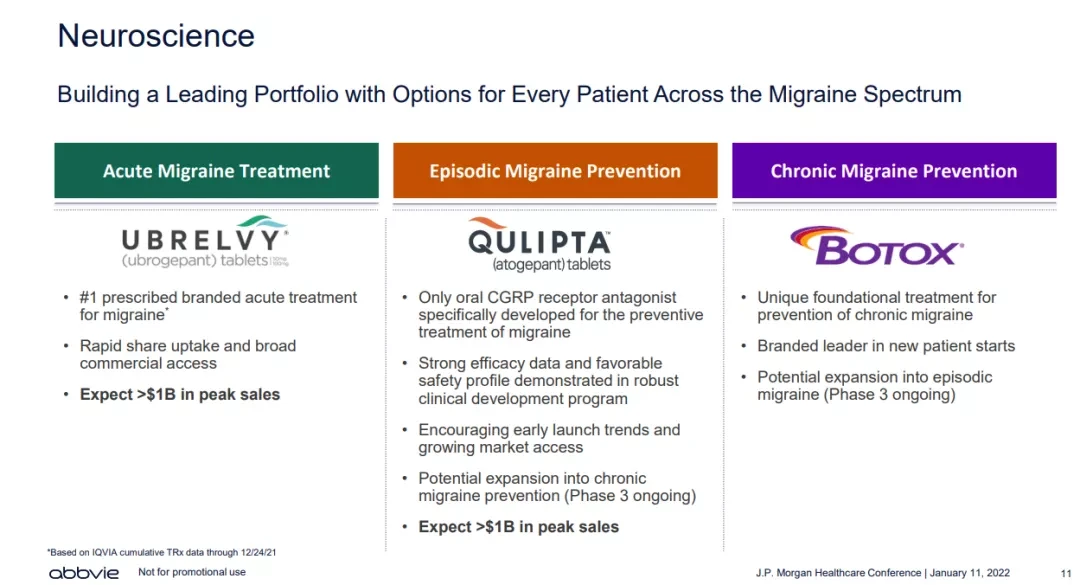
In other neurology products under research, Cariprazine has reached the primary endpoint in Phase III studies as an adjunctive treatment for major depressive disorder. In 2021, AbbVie also announced the discontinuation of the development of the Tau protein inhibitor ABBV-8E12 for the treatment of Alzheimer's disease.
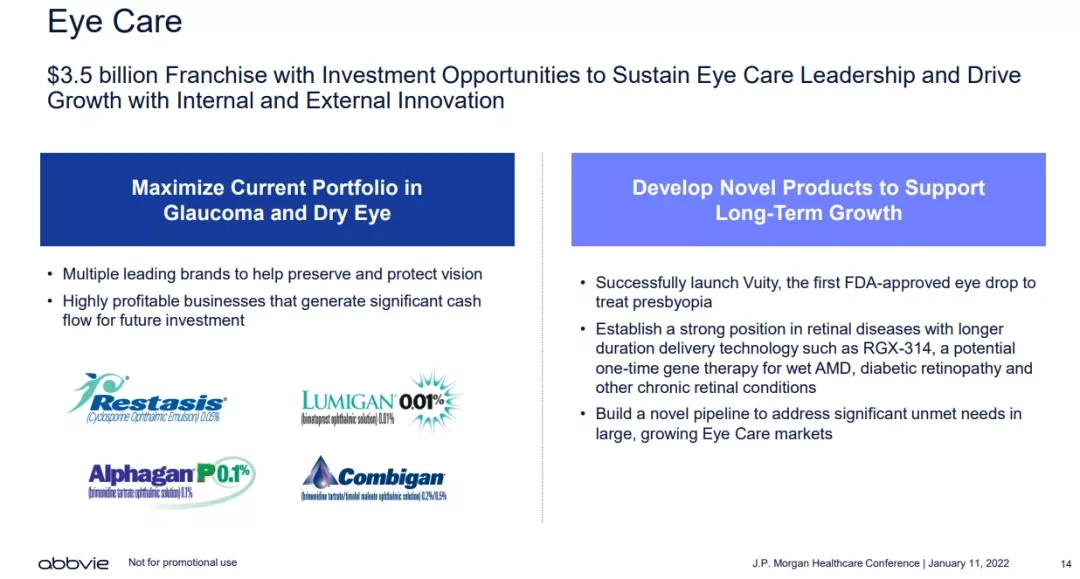
In the field of ophthalmology, AbbVie also made a breakthrough in 2021 with the innovative presbyopia drug Vuity (1.25% pilocarpine eye drops) receiving FDA approval for marketing in October 2021. At the same time, AbbVie is actively advancing in ophthalmic gene therapy, having reached a cooperation agreement with Regenxbio to develop the gene therapy RGX-314 for treating age-related macular degeneration (wet AMD), diabetic retinopathy (DR), and other chronic ocular diseases (see: wAMD treatment may require only one injection! AbbVie acquires gene therapy RGX-314 for $1.75 billion).
Looking ahead to 2022, AbbVie has several milestone events, including the expansion of indications for Skyrizi and Rinvoq, regulatory decisions on the bispecific antibody drug epcoritamab, and the disclosure of key data.
Overall, AbbVie is still employing various strategies to expand its product portfolio and address potential revenue declines following the loss of Humira's market exclusivity. After integrating Allergan, AbbVie’s current marketed product mix now heavily relies on Skyrizi and Rinvoq, while aesthetic medicine products show promising performance, and ophthalmology offerings provide differentiated competitiveness. Additionally, several blockbuster-potential products are in development. AbbVie has successfully moved away from over-reliance on Humira. Its ongoing R&D pipeline and external collaboration efforts primarily focus on small molecules, antibodies, and cell therapies across oncology, immunology, neurology, ophthalmology, and other disease areas. A diversified pharmaceutical giant has set sail with full force.