

Merck Reports 2021 Financial Results: Keytruda Sales Reach $17.2 Billion, China Revenue Surges by 60%

MSD
Pharmaceutical R&D and Manufacturer
On February 3, MSD announced its 2021 performance, with total revenue of $48.704 billion, a year-on-year increase of 17%. Of this, pharmaceutical business revenue was $42.754 billion, a year-on-year increase of 17%, and animal health revenue was $5.568 billion, a year-on-year increase of 18%.
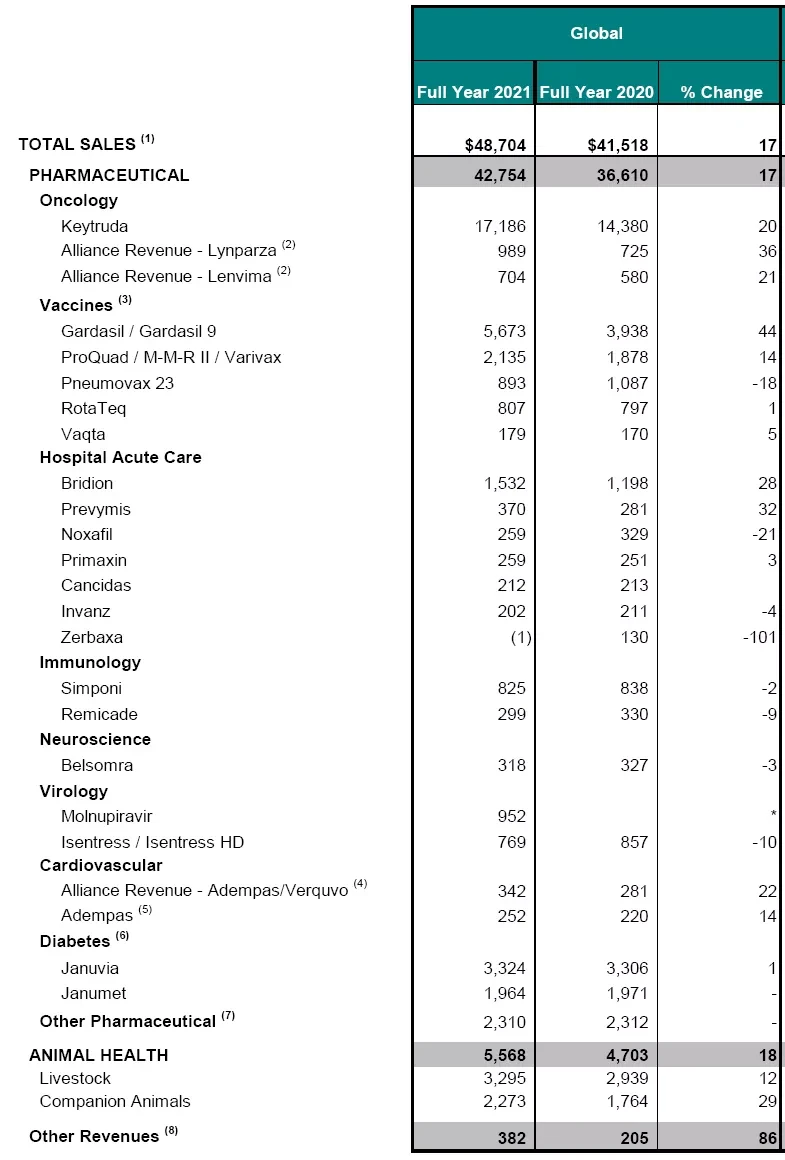
MSD's revenue growth was driven not only by its star products, Keytruda and the cervical cancer vaccines Gardasil/Gardasil 9, but also significantly by royalty income growth of over 20% from three externally partnered products: Lynparza (Olaparib), Lenvima (Lenvatinib), and Adempas (Riociguat). Additionally, a notable incremental revenue source was the oral COVID-19 treatment molnupiravir, which was granted emergency use authorization in November 2021 and contributed $952 million within just over a month.
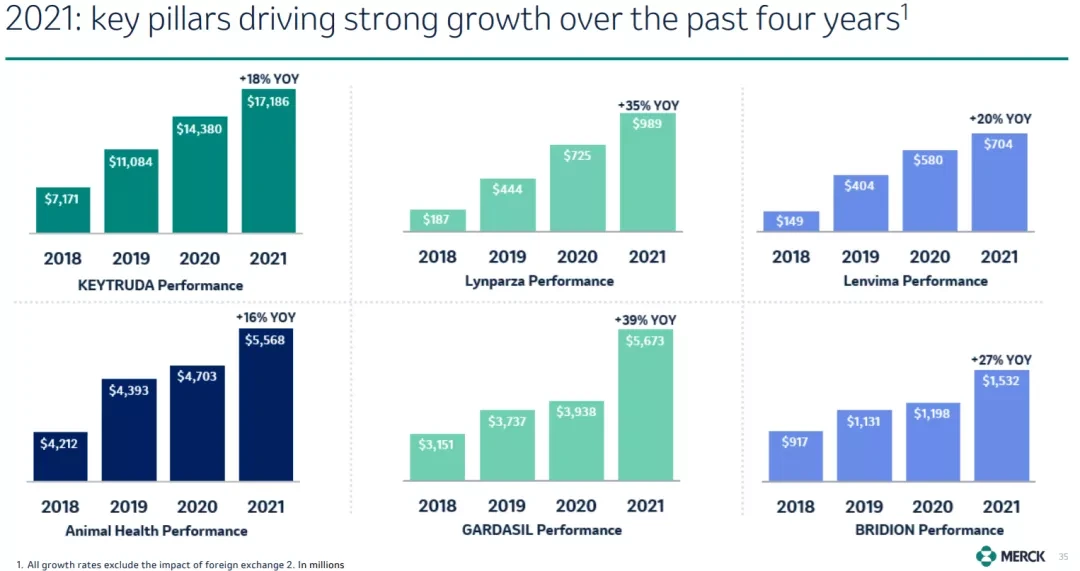
The growth of Keytruda is mainly due to its continued penetration and maintenance of significant market advantages in key cancer types such as NSCLC, triple-negative breast cancer, renal cell carcinoma, head and neck squamous cell carcinoma, and MSH-I. Additionally, its clinical use is increasingly shifting towards earlier first-line treatment. It is projected that Keytruda will surpass the $20 billion mark in 2022.
Gardasil/Gardasil 9 experienced a "revenge growth" starting from Q2 2021 after going through supply shortages and recovering from the pandemic's impact. In Q4 2021, its sales revenue in markets outside the U.S. (including China) reached $1.253 billion, marking a 177% year-over-year increase. As a result, MSD China became the best-performing region for MSD globally in 2021, with a total revenue of $4.262 billion, representing a 60% year-over-year growth.

MSD completed the spin-off of its women's health products, off-patent branded drugs (including Zetia, etc.), and biosimilars (including infliximab, etanercept, and trastuzumab biosimilars) into an independent company named Organon in June 2021. This move has enabled MSD to focus more on innovative drugs.
However, the problems faced by MSD have always been very obvious: the competitiveness of other internal pipeline products outside Keytruda and Gardasil 9 is insufficient, making it difficult to sustain subsequent growth. In 2021, MSD's R&D investment was $12.245 billion, a 9% decrease compared to 2020. This may be due to the slowing pace of clinical trial expansion after Keytruda covered almost all possible indications. This is also a hidden concern for MSD's future growth.
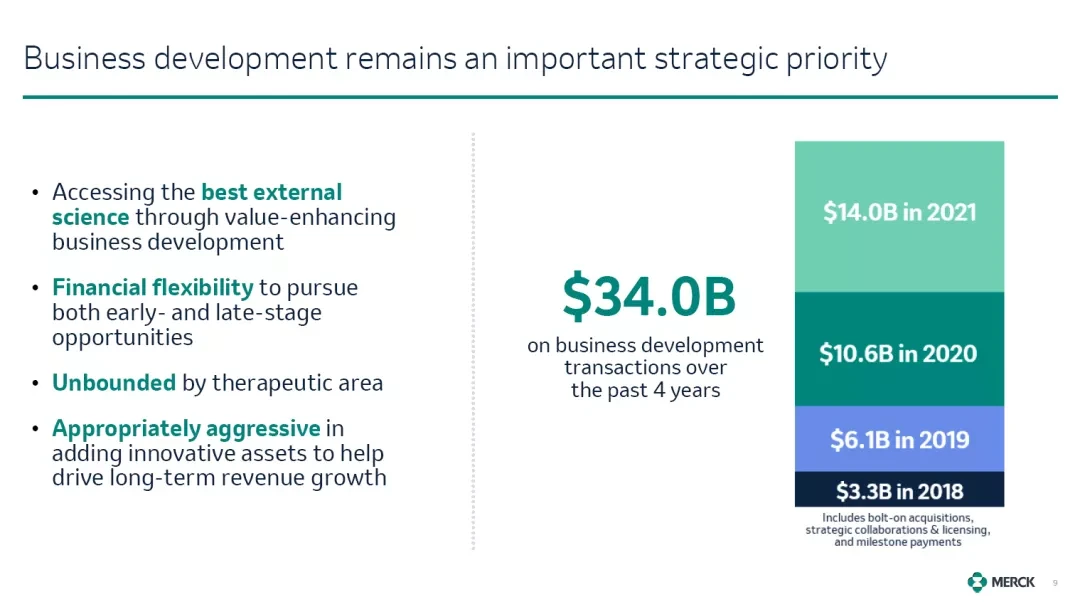
Therefore, MSD made external deal cooperation its top strategic priority several years ago. The revenue growth from Lynparza and Lenvima also came from externally collaborated products. In 2021, MSD executed two major acquisitions. On February 25, it acquired Pandion for $1.85 billion, gaining PT101, an IL-2 fusion protein, and a PD-1 receptor agonist, strengthening its autoimmune disease pipeline. On September 30, MSD reached an $11.5 billion acquisition agreement with Acceleron Pharma, obtaining Reblozyl (luspatercept), a newly approved drug for anemia, and sotatercept, a pulmonary arterial hypertension drug under development.
MSD has also been highly open to external collaborations over the past four years, showing continuous growth momentum, with a cumulative expenditure of $34 billion, including nearly $14 billion from the aforementioned two deals. It is not difficult to predict that MSD will have more deal-making moves in 2022.
MSD's business strategy focuses on areas such as oncology, cardiovascular/metabolic, immunology, infectious diseases, and vaccines. It is committed to becoming a leader in the oncology field by 2025 and developing a product pipeline that can sustain this advantage over the long term. At the same time, MSD is advancing the development of internally researched products and acquiring high-quality external assets to expand its influence in the fields of cardiovascular/metabolic, infectious diseases, and neurological disorders.
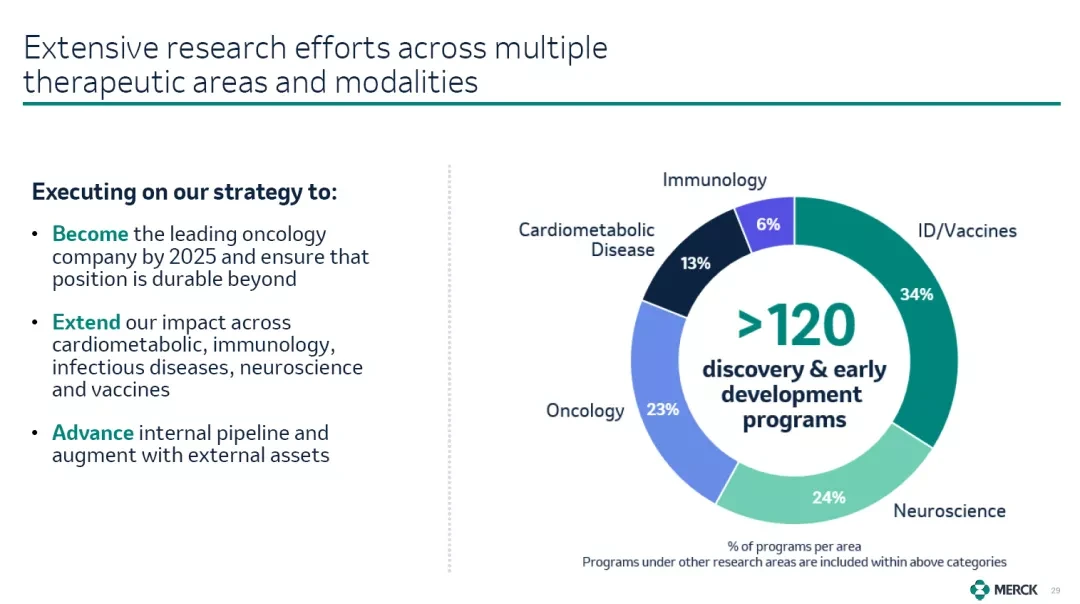
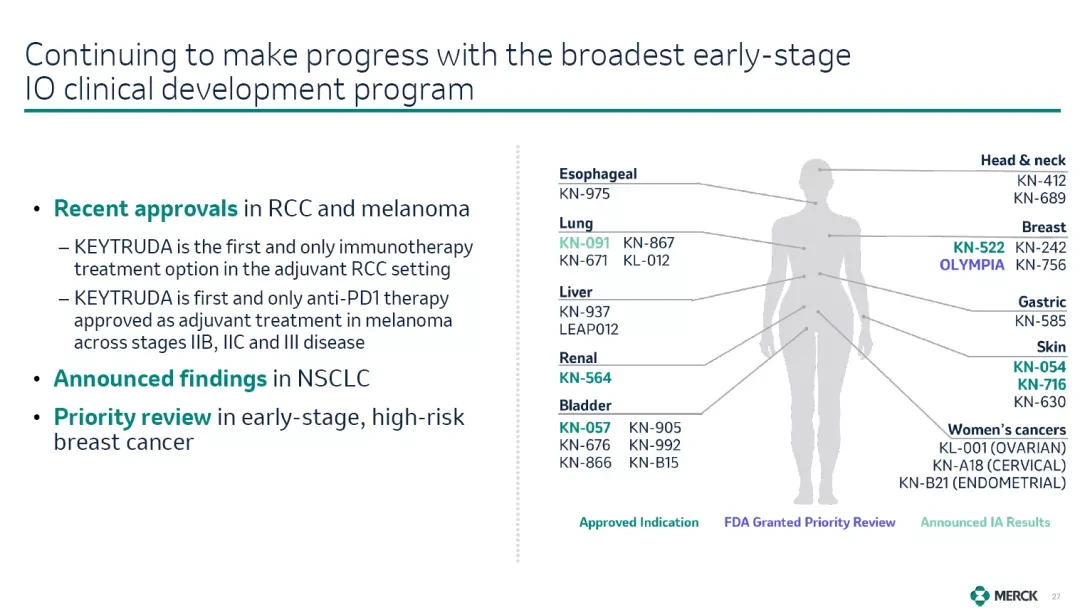
Currently, MSD's pipeline also contains a large number of early I-O projects, covering various types of tumors.
MSD expects global sales to be between $56.1 billion and $57.6 billion in 2022, with a significant increase compared to 2021 primarily driven by the COVID-19 drug molnupiravir, which is projected to contribute $5 billion to $6 billion.