

BMS 2021 Financial Report: Opdivo Rebounds to $7.5B, Next-Gen Pipeline Poised for Growth
Bristol-Myers Squibb
Biopharmaceutical and Nutritional Product R&D and Sales
On February 4, Bristol-Myers Squibb (BMS) announced its 2021 performance, with total annual revenue of $46.385 billion, representing a 9% year-over-year increase. R&D investment reached $11.4 billion, marking a 2.3% year-over-year growth.
After the merger of Bristol-Myers Squibb and Celgene, the company focuses on three major fields: oncology, hematology, and immunology. Its revenue is highly concentrated, with eight products—Revlimid (lenalidomide), Eliquis (apixaban), Opdivo (nivolumab), Orencia (abatacept), Pomalyst/Imnovid (pomalidomide), Sprycel (dasatinib), Yervoy (ipilimumab), and Abraxane (albumin-bound paclitaxel)—generating combined sales revenue of over $43 billion, accounting for 93% of the company’s total income.
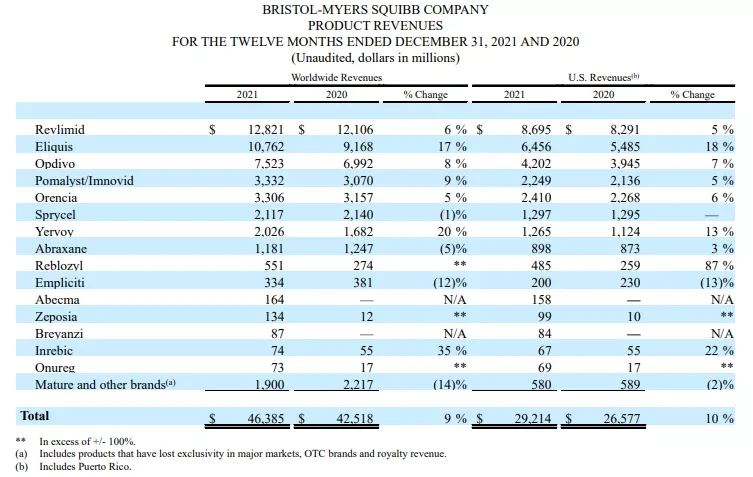
BMS faces certain pressure in maintaining continuous growth by relying on the above eight products. Revlimid (lenalidomide) and Eliquis (apixaban) are two mega blockbuster drugs currently held by BMS, each with annual sales exceeding 10 billion US dollars. However, Revlimid will lose market exclusivity in 2022, and its sales are expected to decline, with projected sales of 9.5-10 billion US dollars. Sprycel and Abraxane have already started to decline in 2021.
The main growth driver for BMS at present should still be the benchmark product Opdivo. Although Opdivo's sales revenue experienced a decline in 2020 and faced setbacks in 2021 with the withdrawal of its second-line hepatocellular carcinoma and second-line or later lung cancer indications, Opdivo has regained its growth momentum, achieving $7.523 billion in revenue in 2021, representing an 8% year-over-year increase.
This is mainly because Opdivo has made significant progress in expanding its indications, including being approved for first-line treatment of renal cell carcinoma in the U.S. and EU in Q1 2021, first-line treatment of pleural mesothelioma in Japan, the EU, and China in Q2 2021, first-line treatment of gastric cancer in China in August 2021, and adjuvant treatment of high-risk recurrent urothelial carcinoma in the U.S. in August 2021. The addition of new patient populations and the advancement of clinical medication sequencing are expected to help Opdivo maintain its growth momentum. Moreover, Opdivo is also exploring immunotherapy as an adjuvant treatment, as well as combination therapies like O+Y and PD-1+LAG3. It is foreseeable that Opdivo will continue to be Bristol-Myers Squibb’s leading product.
Although Opdivo (O药) offers promise, for a pharmaceutical giant with $500 billion in revenue following the merger with Celgene, relying on a single flagship product as the growth driver is somewhat insufficient. Bristol-Myers Squibb (BMS) needs to focus on nurturing other next-generation blockbuster products beyond Opdivo.
Reblozyl (luspatercept) is the first erythroid maturation agent approved by the FDA and the first new drug for myelodysplastic syndromes in nearly a decade. It is suitable for patients who have failed treatment with erythropoiesis-stimulating agents and require blood transfusions. In 2021, its revenue achieved over 100% growth reaching $550 million. Additionally, in December 2021, a new indication for treating non-transfusion-dependent (NTD) beta-thalassemia was submitted to the FDA for approval. In January 2022, it also received NMPA approval for marketing in China. These advancements are significant boosts for Reblozyl's growth.
Breyanzi is a CD19 CAR-T cell therapy launched by BMS in February 2021. Due to the significant first-mover advantages of similar products from Novartis and Gilead, Breyanzi's performance in its first year was not ideal, generating only $87 million. However, BMS still has high hopes for Breyanzi, considering it one of the five drugs expected to make significant contributions to BMS’s sales in the next two years, with projected revenue of over $3 billion by 2029.
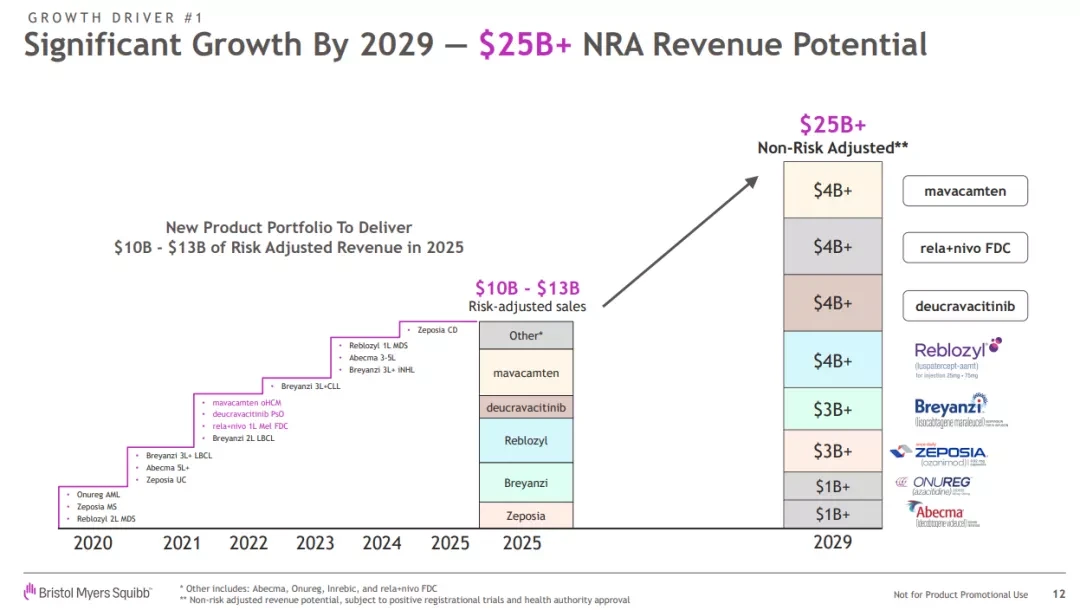
As the first company to bring CTLA-4 and PD-1 inhibitors to market, BMS is undoubtedly a pioneer in the I-O field, with its development of the LAG-3 antibody further establishing leadership in the I-O race! In 2021, BMS announced the RELATIVITY-047 Phase II/III trial data for relatlimab + Opdivo (LAG3+PD1) as a first-line treatment for metastatic or unresectable melanoma. The results confirmed that the fixed-dose combination of relatlimab + nivolumab was more effective than Opdivo alone, though its efficacy was comparable to Opdivo + Yervoy (PD1+CTLA4). Advantages in safety may also facilitate the market expansion of this new combination product, with BMS projecting potential revenue growth of $4 billion.
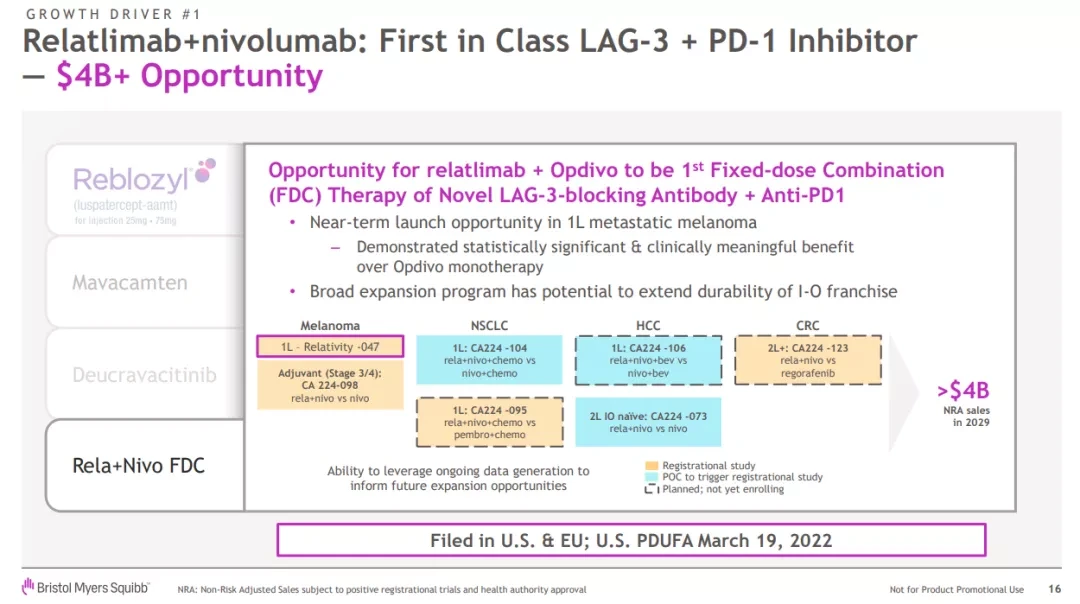
Another late-stage product of BMS, deucravacitinib (TYK inhibitor), has already submitted its marketing application for psoriasis. However, the competition in the psoriasis market is already very saturated, to the extent that Eli Lilly's mirikizumab voluntarily withdrew after clinical success. Deucravacitinib has a potential safety advantage over Jak inhibitors, but capturing market share in the crowded psoriasis field remains highly challenging. A more critical indication is moderate to severe ulcerative colitis; however, the low-dose group of deucravacitinib did not meet the primary clinical endpoint. If the high-dose group fails to achieve positive data, it will undoubtedly be a significant blow.
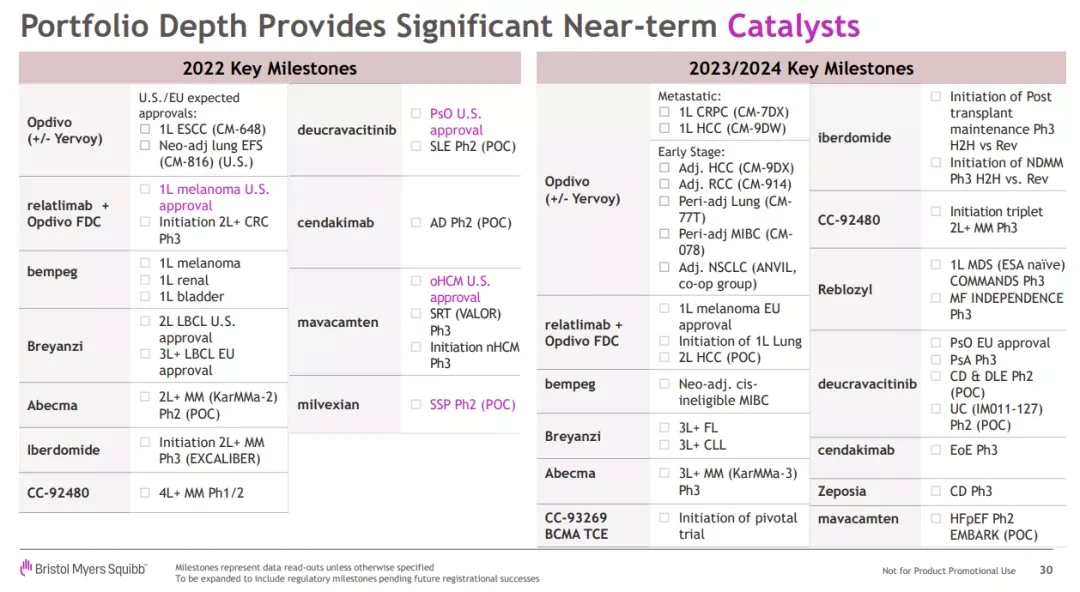
In 2022, BMS will face several key milestones. In addition to the previously mentioned Opdivo neoadjuvant therapy, relatlimab+nivolumab combination, and the potential regulatory approval of TYK2 inhibitor deucravacitinib, mavacamten, a cardiomyopathy drug acquired through BMS’s $13.1 billion acquisition of MyoKardia, is also expected to receive its first approval. This is the first drug developed to target the molecular defect in hypertrophic cardiomyopathy, and how much return it can bring to BMS is worth paying attention to.
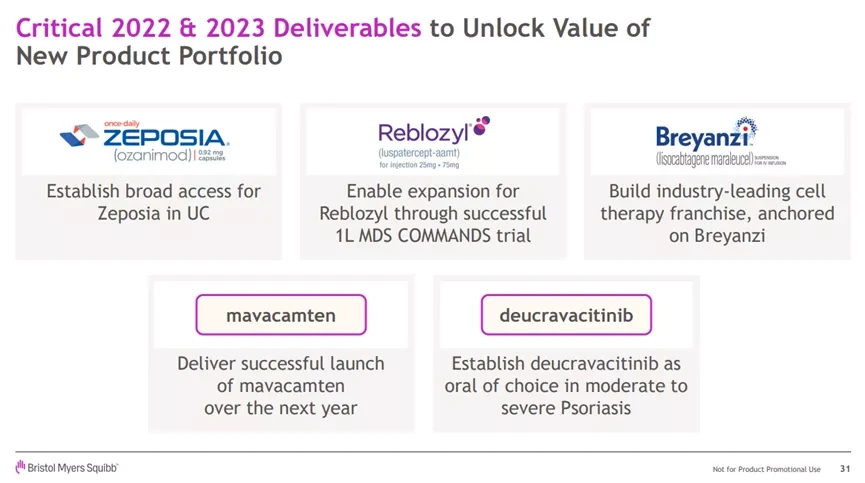
In summary, Reblozyl (luspatercept), Breyanzi (CD19 CAR-T), and Zeposia (ozanimod) are new-generation products that Bristol-Myers Squibb has high hopes for. The period from 2022 to 2023 is also considered by Bristol-Myers Squibb as a critical time to unlock the value of its new product portfolio.
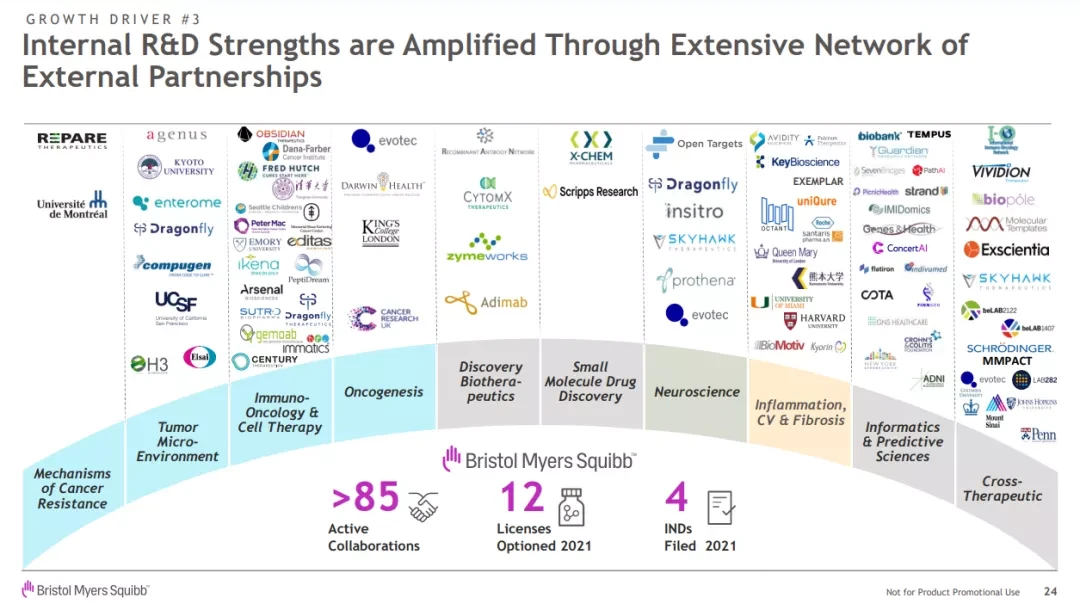
Good assets are always scarce, and BMS has been actively engaging in medium- and small-scale "bolt-on" deals that can complement its pipeline. The collaborations in 2021 were mainly focused on the oncology field, including the TIGIT bispecific antibody project with Agenus, the introduction of Eisai's FRα ADC drug, and the co-development of the SHP2 small molecule project; partnering with Century to develop iPSC-derived allogeneic cell therapies; collaborating with Exscientia, an AI-driven pharmaceutical company, to develop oncology and immune-modulatory drugs; and working with Prothena to develop the anti-tau antibody PRX005 for the potential treatment of Alzheimer’s disease.
Looking ahead to 2022, the sales红利 (revenue boost) from Bristol-Myers Squibb's acquisition of Celgene (products like Revlimid, Pomalyst, and Abraxane) will soon come to an end. The next generation of products will drive this pharmaceutical giant forward, though they will also need time to grow. In response, Bristol-Myers Squibb has adjusted its total product sales forecast for 2022, expecting a low single-digit growth to around $47 billion.