

Eli Lilly Reports 2021 Financial Results: Trulicity Sales Reach $6.5 Billion and Pipeline Targets 20 New Drug Launches in the Next Decade
Eli Lilly
Global Pharmaceutical R&D and Production Company
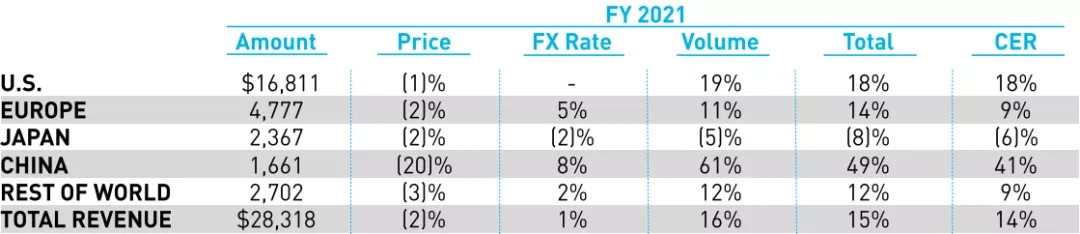
On February 3, Eli Lilly and Company announced its 2021 performance, with total annual revenue of $28.318 billion, a year-on-year increase of 15%. R&D investment was $7.026 billion, an increase of 15%. Revenue in the China market reached $1.661 billion, a 49% increase compared to $1.117 billion in 2020, making China the best-performing market globally for Eli Lilly. According to the financial report, Eli Lilly currently has 35,238 employees worldwide.
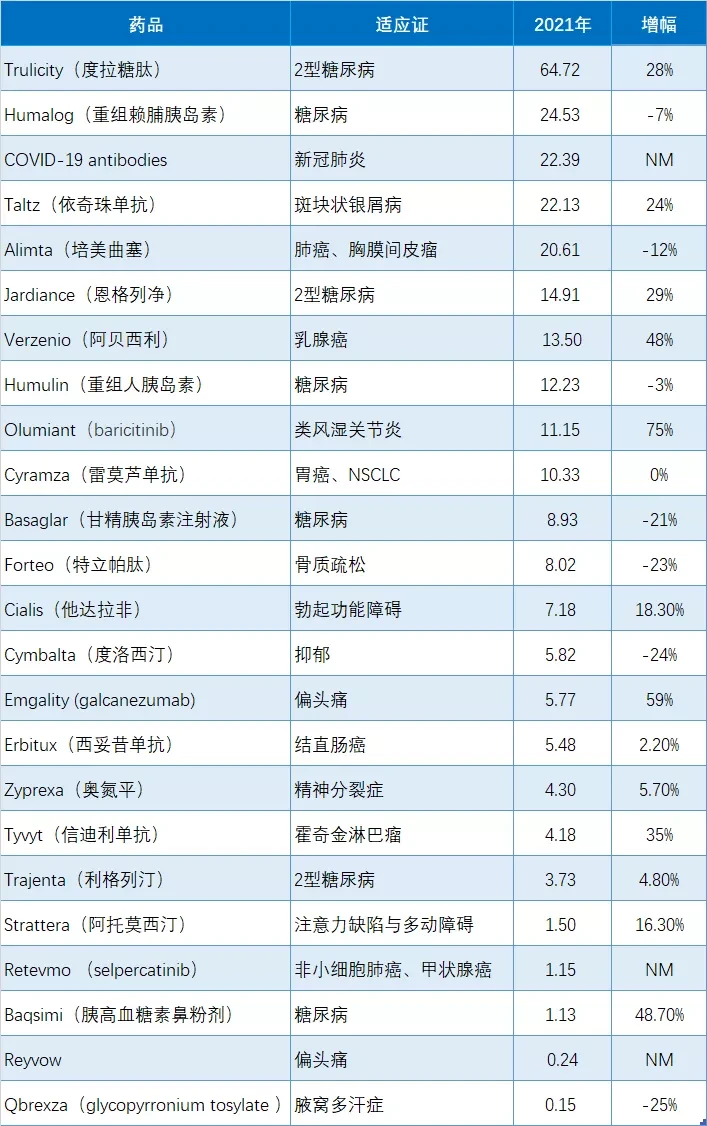
Eli Lilly's current business mainly focuses on four major disease areas: diabetes, oncology, immunology, and neurology. Diabetes has always been a key area where Eli Lilly holds an advantage and has made significant investments. The company’s portfolio of eight products, including Trulicity (dulaglutide), Humulin (recombinant human insulin), Humalog (insulin lispro), and Jardiance (empagliflozin), collectively generated $13.188 billion in revenue, accounting for 46.6% of Eli Lilly's total income. Among these, the GLP-1 receptor agonist Trulicity is currently Eli Lilly’s flagship product, which maintained steady high growth of over 20% in 2021, with sales reaching $6.472 billion.
2021 Sales of Major Products by Eli Lilly (USD billion)
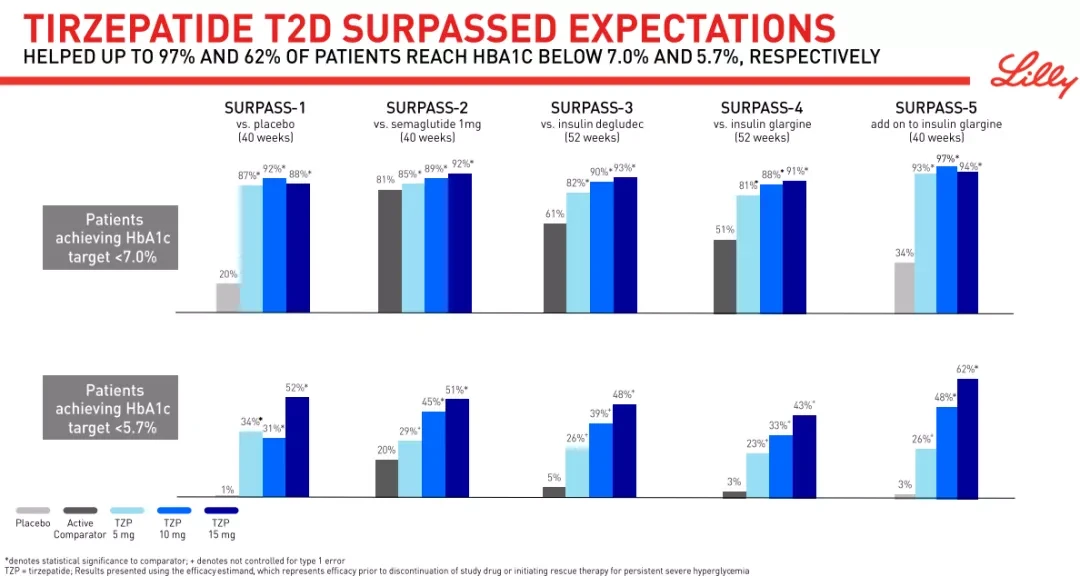
However, according to Novo Nordisk's disclosed financial report, the combined revenue of subcutaneous and oral formulations of semaglutide in 2021 reached $6.1 billion, showing a significant surge. In response, Eli Lilly and Company developed tirzepatide, a GLP-1R/GIP dual agonist. Its large-scale Phase III SURPASS program consists of 10 clinical trials, planning to recruit over 13,000 patients with type 2 diabetes. Among these, five trials are global registration studies. Not only are these trials designed similarly to semaglutide’s large-scale Phase III SUSTAIN program, but they also directly initiated "head-to-head" competition against semaglutide. As of May 2021, all five trials were successful. Additionally, tirzepatide is being developed for treating obesity, heart failure with preserved ejection fraction (HFpEF) associated with obesity, NASH, and more.
The oncology sector is the second-largest revenue contributor for Eli Lilly, generating $5.741 billion in income. Three of its oncology products have entered the "billion-dollar club": in addition to the established product Alimta (pemetrexed, $2.061 billion), there are also Verzenio (abemaciclib, $1.35 billion) and Cyramza (ramucirumab, $1.033 billion).
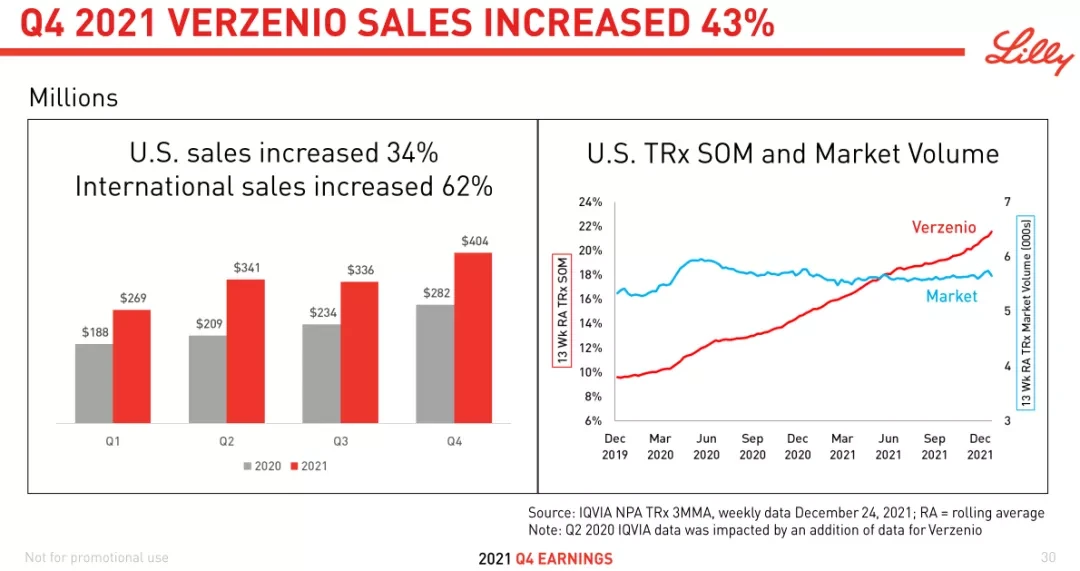
Verzenio is the third CDK4/6 inhibitor to be launched globally. The earlier launched Ibrance (Palbociclib) approached $5 billion in sales in 2019, leaving competitors far behind. However, a covert competition in mid-2020 for adjuvant treatment of early HR+/HER2- breast cancer (PALLAS study vs monarchE study) changed the landscape. The prescription volume of Verzenio has been steadily increasing, with revenue in 2021 growing by 48% year-on-year.
Tyvyt (Sintilimab), the PD-1 monoclonal antibody developed through the collaboration between Eli Lilly and Innovent, contributed $418 million. Despite a 35% growth for the full year, its revenue in Q4 of 2021 fell by 27% year-over-year. Tyvyt is currently only approved for the market in China and will face an FDA approval decision this month.
In the field of immunology, IL-17A monoclonal antibody Taltz (Ixekizumab) is another blockbuster product by Eli Lilly, which achieved a rapid growth of 24% to reach $2.213 billion in 2021. Since its first approval for marketing in March 2016, Taltz has been approved in major countries such as China, the United States, Japan, and Europe for multiple indications including psoriatic arthritis, ankylosing spondylitis, and plaque psoriasis.
Olumiant (Baricitinib), the JAK inhibitor jointly developed by Eli Lilly and Incyte, is one of this year's best-performing products, achieving $1.115 billion with a 75% growth rate. Notably, at the end of September this year, Eli Lilly announced detailed positive results from two pivotal Phase III clinical trials, BRAVE-AA1 and BRAVE-AA2, investigating Olumiant for the treatment of alopecia areata, and submitted an sNDA application. Olumiant has the potential to become the first therapy for millions of alopecia areata patients worldwide.
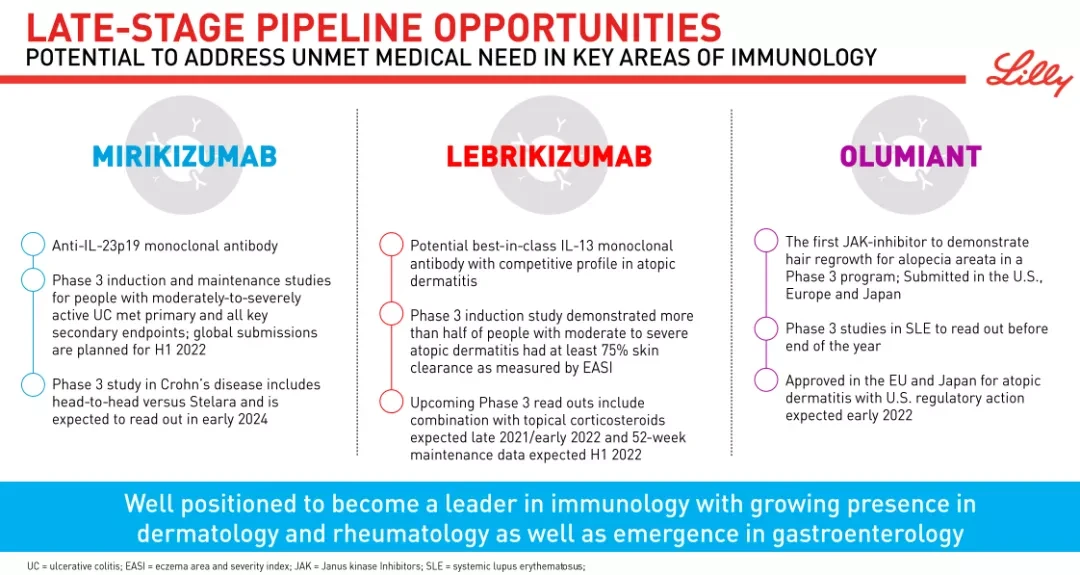
Eli Lilly's immunology pipeline shows strong momentum. The Phase III study of IL-23p19 monoclonal antibody mirikizumab for the treatment of moderate to severe active ulcerative colitis achieved positive results, and an application for marketing approval is expected to be submitted in the first half of 2022. Potential best-in-class IL-13 monoclonal antibody lebrikizumab, in combination with topical corticosteroids (TCS) for the treatment of moderate to severe atopic dermatitis (AD), achieved positive results in all three Phase III studies, and an application for marketing approval is expected to be submitted this year.
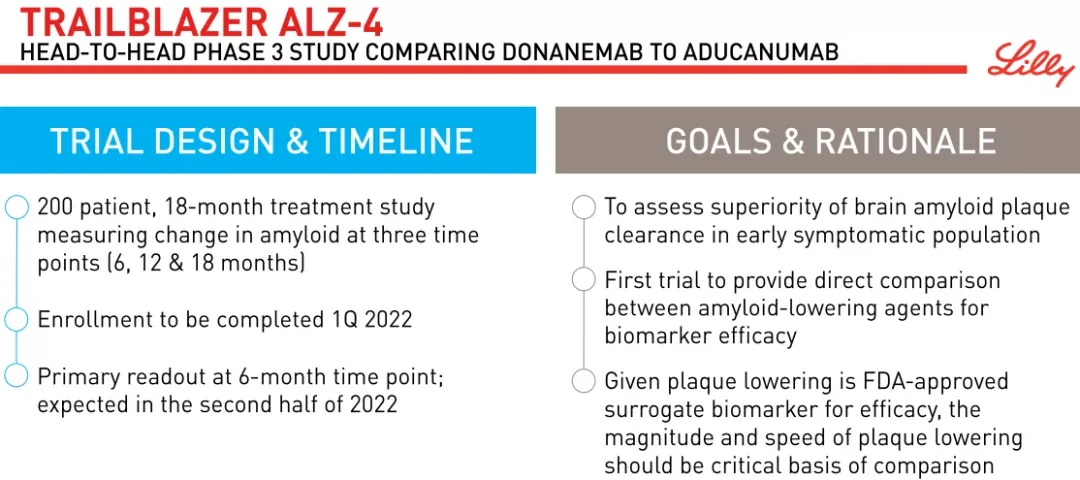
Neuroscience is also a key focus area for Eli Lilly. Although no blockbuster product with sales exceeding $1 billion has emerged, new progress was made in 2021. The Phase II clinical study (TRAILBLAZER-ALZ) of donanemab, an antibody drug targeting N3pG-beta amyloid, for the treatment of early Alzheimer's disease, yielded positive results in January 2021 and received FDA Breakthrough Therapy designation in June. A marketing application is planned to be submitted in 2022. Additionally, Eli Lilly plans to initiate a Phase III study comparing donanemab versus aducanumab (Aβ), with participant enrollment expected to be completed in the first quarter of this year.
Beyond the aforementioned four major disease areas, Eli Lilly was an early participant in the fight against the COVID-19 pandemic. The neutralizing antibody combination of etesevimab/bamlanivimab, co-developed with Junshi Biosciences, received FDA Emergency Use Authorization (EUA) in February 2021 for treating mild to moderate COVID-19 in patients aged 12 and above. In September, it received FDA EUA for post-exposure prophylaxis in individuals aged 12 and above at high risk. By December, it obtained FDA EUA for treating mild to moderate COVID-19 and for post-exposure prophylaxis in children from birth to under 12 years old, making it the world’s first and only neutralizing antibody therapy granted EUA coverage for populations under 12 years old. The expanding scope of applications also brought Eli Lilly $2.239 billion in revenue, marking a year-on-year increase of 157%.
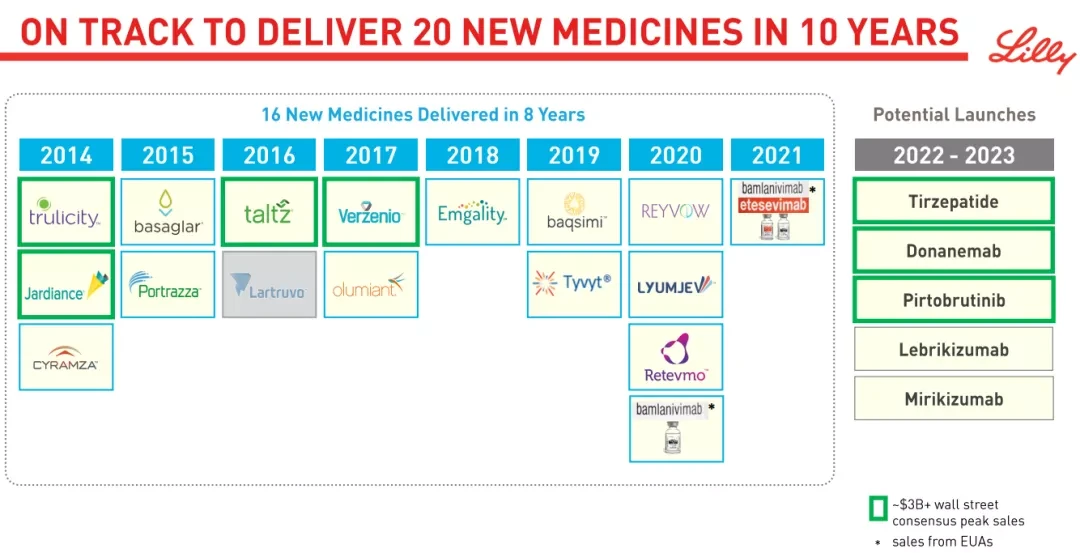
In the past eight years, Eli Lilly has launched 16 new drugs. In the next decade, it is expected that 20 new drugs will be approved. Only in 2022-2023, it is expected that five products will be approved for marketing.
Eli Lilly and Company is also actively supplementing its product pipeline through mergers and acquisitions. In 2021, Eli Lilly reached 16 deals, including:
- On January 19, Loxo, a subsidiary of Eli Lilly, and Merus, a clinical-stage oncology company developing multispecific antibodies, reached a collaboration and exclusive licensing agreement. The partnership will leverage Merus' proprietary Biclonics platform along with Loxo's drug design expertise to develop up to three CD3-engaging T-cell redirecting bispecific antibody therapies.
- On March 8, Eli Lilly and Biolojic reached a collaboration and licensing agreement to utilize Biolojic's AI-based platform for the discovery and development of novel antibodies for the treatment of diabetes.
- On May 11, Eli Lilly and Company entered into a global collaboration agreement with MiNA Therapeutics to develop new drug candidates using MiNA's proprietary small activating RNA (saRNA) technology platform.
- On July 29, Loxo and Kumquat Biosciences signed an exclusive cooperation agreement, focusing on the discovery, development, and commercialization of novel small molecules that potentially stimulate tumor-specific immune responses.
- On December 13, Loxo and Foghorn reached a collaboration to jointly develop and commercialize a selective BRM oncology program from Foghorn’s pipeline, another undisclosed oncology target program, and three additional programs discovered based on Foghorn's proprietary Gene Traffic Control platform.
For the 2022 performance outlook, Eli Lilly and Company expects to achieve revenue of $27.8-$28.3 billion, which is basically flat compared to 2021.