

Novartis Reports Strong 2021 Financial Results: Cosentyx at $4.7B, Entresto at $3.5B (+45%), China Revenue Reaches $3.05B (+18%)

Novartis
Drug Development and Manufacturing
On February 2, Novartis announced its 2021 performance, with full-year net sales reaching $51.626 billion, a year-on-year increase of 6%. Among this, sales revenue in the Chinese market was $3.052 billion, a year-on-year increase of 18%, accounting for 6% of Novartis' global total revenue.
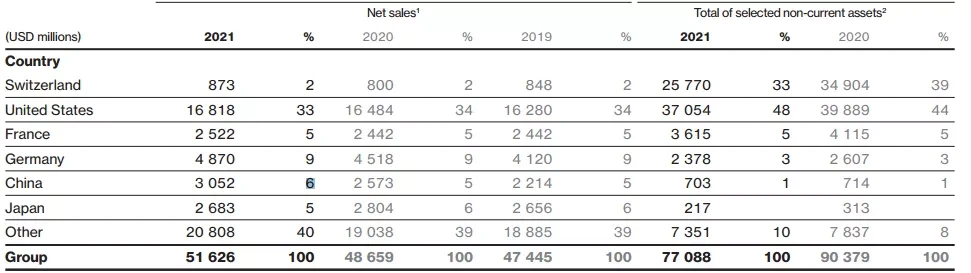
Novartis' strategy is to become a pharmaceutical company focused on innovation. Therefore, in 2019, it was the first to spin off Alcon, its ophthalmology business. Regarding the spin-off of the generic drug business unit Sandoz, Novartis has also made great efforts. Although previous multiple transaction rumors have not materialized, Novartis stated that it will complete this task in 2022. In addition, in November 2021, Novartis signed a transaction agreement worth $20.7 billion with Roche to sell all Roche shares held since the early 2000s back to Roche. After selling the Roche shares, Novartis announced a plan to repurchase up to $15 billion worth of shares from investors by the end of 2023. This is also a move under Novartis’ long-term innovation-focused strategy.
Novartis Innovative Medicines' revenue in 2021 was $42 billion, an increase of 8% year-on-year. It is currently divided into two business units: Novartis Oncology and Novartis Pharmaceuticals. The diseases covered by the Novartis Pharmaceuticals business unit currently include immunology, hematology, dermatology, ophthalmology, neurology, respiratory, cardiovascular, renal and metabolic diseases, as well as other established disease businesses.
Top 20 Novartis Products in 2021 (USD billion)
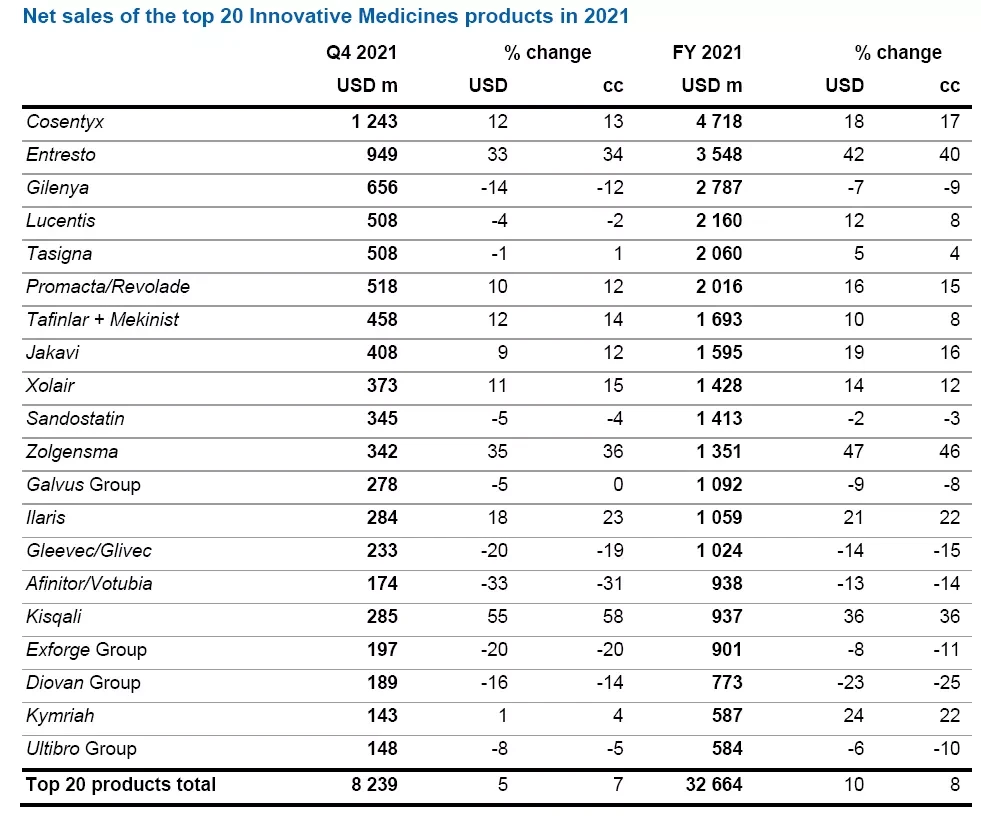
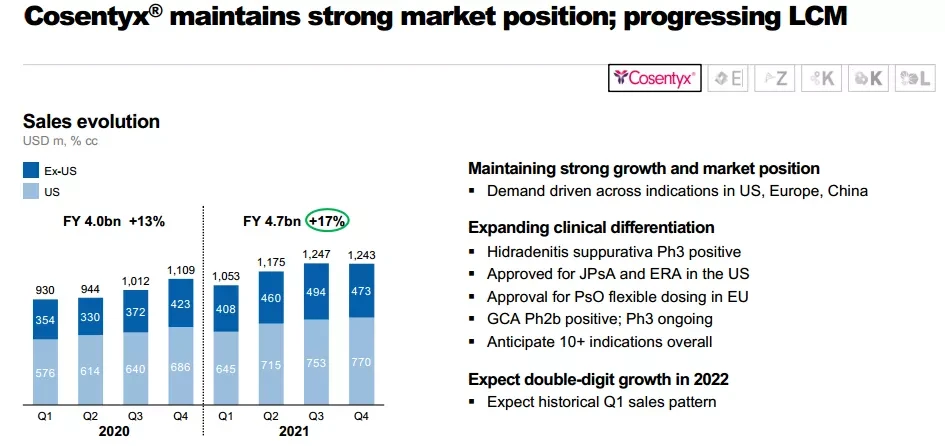
Specifically, Cosentyx (secukinumab) and the new heart failure drug Entresto (sacubitril/valsartan) collectively contributed $8.266 billion, becoming the most critical drugs driving Novartis' performance growth.
The potential demand for Cosentyx continues to be released in the U.S. and European markets, and it has also achieved strong growth in China after being included in the National Reimbursement Drug List (NRDL). In December 2021, Cosentyx was approved by the U.S. FDA for the treatment of active enthesitis-related arthritis (ERA) in patients aged 4 years and older and active juvenile psoriatic arthritis (JPsA) in patients aged 2 years and older, becoming the only biologic in the U.S. approved for pediatric and adolescent ERA and PsA.
Entresto's growth remains strong, driven by its status as the preferred therapy for heart failure patients with reduced ejection fraction (HFrEF) and the FDA's approval of its expanded indication to include heart failure patients with preserved ejection fraction (HFpEF), making Entresto the preferred treatment for both HFrEF and most HFpEF patients. In China, Entresto’s two indications for treating HFrEF and hypertension have been included in the National Reimbursement Drug List (NRDL), effective from January 2022.
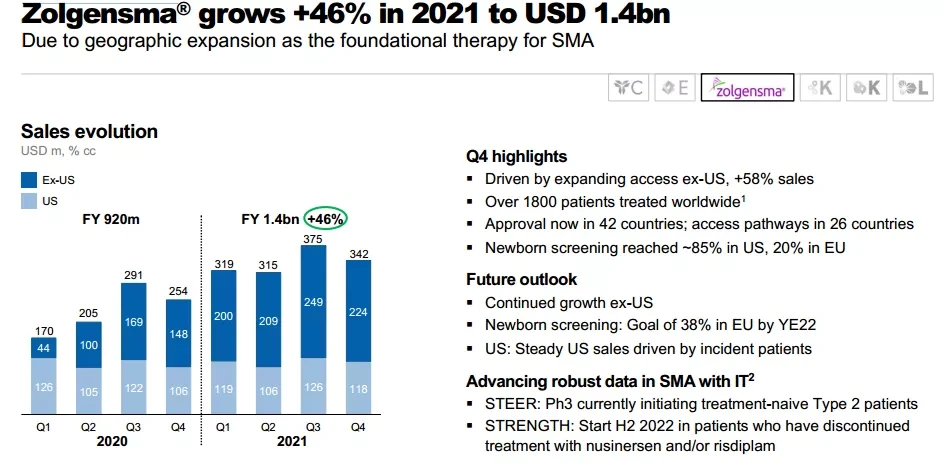
Zolgensma Gene Therapy Achieved $1.351 Billion in Revenue in 2021, Increasing by 47% Year-on-Year, Successfully Entering the "Billion-Dollar Club," Mainly Due to Expansion in Europe and Emerging Markets and Stable Sales in the U.S. Market. The Future Growth Potential of Zolgensma Lies in Gaining Approval in More Countries, Being Covered by Health Insurance in More Countries, and Increasing SMA Screening Rates for Newborns in Developed Regions Such as the U.S. and Europe. Zolgensma Has Been Approved in 42 Countries.
The development of the CAR-T product Kymriah has drawn significant attention. Kymriah, the first CAR-T cell therapy approved by the FDA, has been authorized for one or more indications across 30 countries and has over 350 certified treatment centers worldwide. With its expanding reach, Kymriah's sales reached $587 million in 2021, marking a 24% year-over-year increase. In October of the previous year, Kymriah’s third indication application was accepted by the U.S. FDA and the European EMA for adult patients with relapsed or refractory (r/r) follicular lymphoma (FL) who have received prior second-line treatment. In the field of follicular lymphoma, Kymriah will continue to face competition from Yescarta, developed by Kite Pharma, a subsidiary of Gilead Sciences. The latter obtained FDA approval in March of the previous year based on the ZUMA-5 study, which demonstrated an ORR of 91% and a CR of 60%.
One of the most notable events in 2021 regarding new drug approvals was the long-awaited siRNA lipid-lowering drug Leqvio (inclisiran) finally receiving FDA approval for marketing. Inclisiran is the first small interfering RNA drug targeting PCSK9, administered via subcutaneous injection. The first two doses are given three months apart, followed by once every six months. For patients who fail to achieve LDL-C goals despite treatment with the maximum tolerated dose of statins, Inclisiran can reduce LDL-C by up to 52% at week 52. This siRNA therapy represents a significant breakthrough in the field of lipid-lowering treatments and has an advantage over Sanofi/Regeneron's Praluent (alirocumab) and Amgen's Repatha (evolocumab) in terms of production cost and pricing competition. Its market performance is highly anticipated. In 2021, Leqvio generated revenue of $12 million.
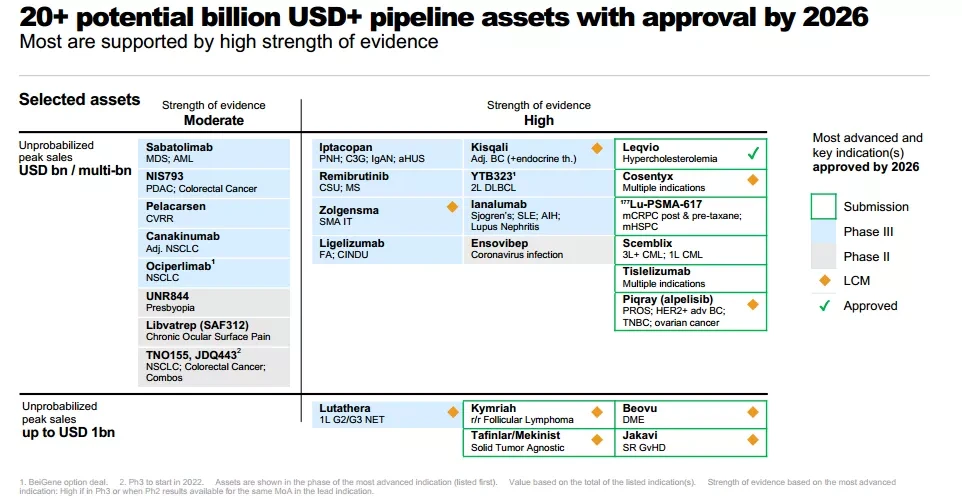
Currently, Novartis has 14 blockbuster products on the market, and it is expected that by 2026, 20 blockbuster projects with over 1 billion dollars will be approved.
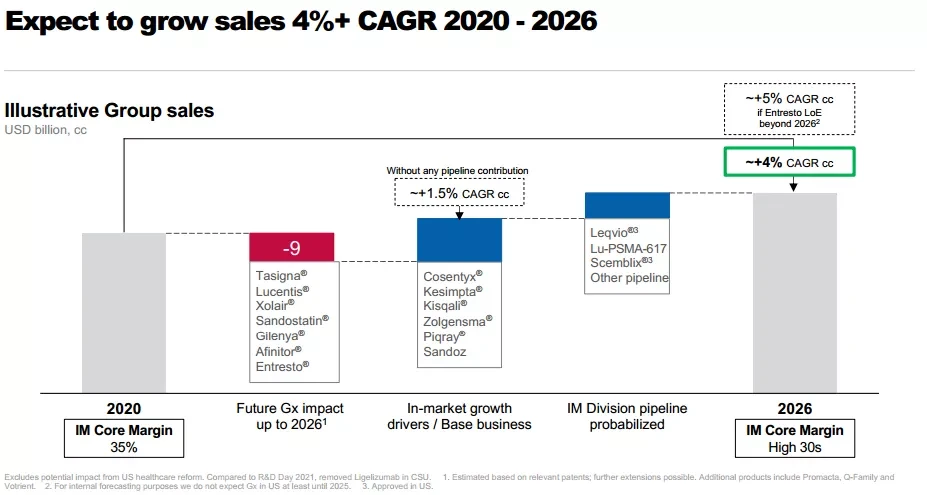
Novartis expects sales to achieve a compound annual growth rate (CAGR) of 4% from 2020 to 2026.
For future business layout, Novartis will continue to focus on the five major fields of cardiovascular/renal, immunology, neuroscience, oncology, and hematology, with a key emphasis on targeted protein degradation, cell therapy, gene therapy, radiation therapy, and xRNA technology platforms. At the same time, efforts will be made to ensure a consistent pace in the global development of innovative drugs.
In terms of external collaboration layout, apart from the attention-grabbing deals with BeiGene's PD-1 and TIGIT monoclonal antibodies. Novartis' actions in 2021 were basically also developed around the aforementioned disease areas and technology platforms, such as:
- On July 28, researchers from the Children's Hospital of Philadelphia and the Novartis Institutes for BioMedical Research published a research paper on the Xon gene therapy switch system in Nature. Xon is a switch system that requires oral administration of a specific small-molecule drug for induction and can precisely control the protein levels expressed by gene therapy vectors. The Children's Hospital of Philadelphia has licensed this technology to Novartis.
- On September 21, Novartis announced the acquisition of Arctos Medical for an undisclosed amount. This is the second startup developing ocular gene therapies that Novartis has acquired, following its $280 million purchase of Vedere in 2020.
- On November 2, a strategic collaboration and licensing agreement was reached with Dunad to develop orally bioavailable covalent and protein degrading small molecule drugs. The deal framework includes an upfront payment of $24 million and equity investment, with an additional $1.3 billion in milestone payments and royalties.
- On December 22, an agreement was reached with Gyroscope Therapeutics, a British ophthalmic gene therapy company, to acquire its issued shares. The upfront payment was US$800 million, with potential milestone payments of US$700 million, bringing the total transaction value to US$1.5 billion. This marks the third ophthalmic gene therapy company acquired by Novartis.
For the 2022 performance outlook, Novartis' innovative drug business sales are expected to grow at a single-digit rate, while Sandoz's generic drug business is expected to remain flat compared to the previous year.