

Biogen and Roche Partner to Co-Develop and Commercialize Mosunetuzumab, a CD20xCD3 Bispecific Antibody for B-Cell Non-Hodgkin Lymphoma
Biogen
New Drug Developer

Genentech
Pharmaceutical R&D Manufacturer

Roche
Oncology Drug Research, Development, and Manufacturing
On February 1, Biogen announced that it had exercised its option to collaborate with Genentech, a subsidiary of Roche, to jointly advance the development and commercialization of mosunetuzumab. In doing so, Biogen will make a one-time option exercise payment of $30 million to Genentech. Biogen will share in the operational profits and losses of mosunetuzumab in the U.S. market with Roche; in markets outside the U.S., Biogen is entitled to receive royalties in the low single-digit range based on sales revenue.
Mosunetuzumab is a CD20xCD3 bispecific antibody, which, like a normal antibody, has two Fab regions: one can target the CD20 antigen on the surface of malignant B cells, and the other can bind to the CD3 antigen on the surface of T cells. This dual-targeting characteristic can activate and redirect the patient's T cells, recruiting T cells to the vicinity of malignant B cells to kill tumor cells.
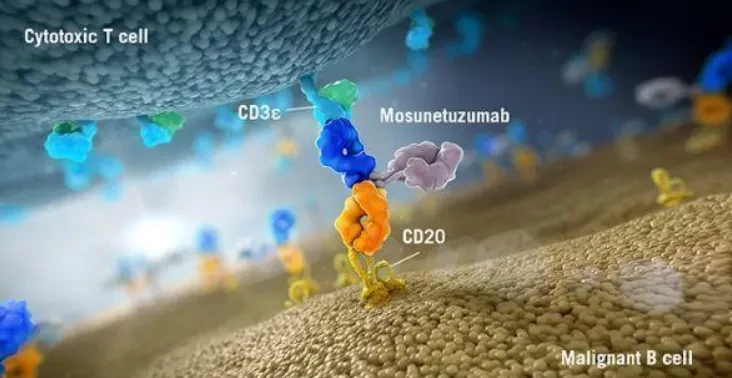
Mosunetuzumab is being developed for the treatment of B-cell non-Hodgkin lymphoma (NHL), including follicular lymphoma type 1 and diffuse large B-cell lymphoma (DLBCL). In June 2020, it was granted Breakthrough Therapy Designation by the FDA for adult patients with relapsed or refractory FL who have received at least two prior therapies.
Mosunetuzumab Receives BTD Designation Based on Results from the Multicenter, Open-Label, Dose-Escalation Phase I/Ib GO29781 Study (NCT02500407) Presented at ASH 2019. The study evaluated the safety and pharmacokinetics of mosunetuzumab in patients with relapsed or refractory B-cell non-Hodgkin lymphoma (R/R B-NHL). The enrolled patients included those who relapsed or were resistant to CAR-T cell therapy, for whom treatment options are very limited.
Results showed that the ORR was 62.7% (n=42/67) in the indolent NHL group, with a complete response rate (CR) of 43.3% (n=29/67); in the aggressive NHL group, the ORR was 37.1% (n=46/124), and the CR was 19.4% (n=24/124). Among patients who achieved complete remission in the indolent NHL group, 82.8% (n=24/29) remained in remission within 26 months after initial treatment, while in the aggressive NHL group, 70.8% (n=17/24) of those achieving complete remission remained in remission within 16 months after initial treatment.
At ASH2021, Roche presented updated key results from the GO29781 study, showing that R/R FL patients who had received heavy prior treatment could achieve complete remission for over 18 months, with a complete remission rate of 60.0%, a median PFS of 17.9 months, and a median duration of response of 22.8 months. The most common adverse event was CRS, mostly grade 1-2.
Roche has recently submitted a marketing authorization application for mosunetuzumab to the EMA and plans to submit a marketing application for mosunetuzumab to the FDA soon. If approved, it will be the first bispecific antibody therapy in the CD20xCD3 T-cell engager class to be approved for the NHL indication. In addition, Roche has also recently initiated a Phase Ib study of mosunetuzumab for the treatment of systemic lupus erythematosus (SLE), targeting the indication of SLE, which has significant unmet medical needs.
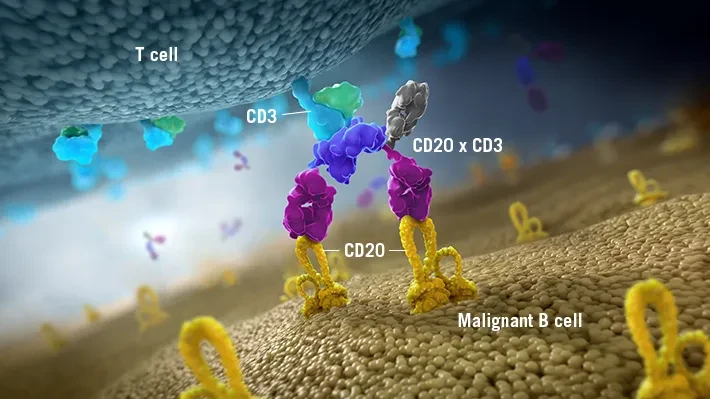
In addition to mosunetuzumab, Roche has another CD20xCD3 bispecific antibody, glofitamab, which together establish Roche's leading position in the field of CD20+ B-cell tumors. Unlike mosunetuzumab, glofitamab is a novel "2:1" bispecific antibody, containing two Fab fragments that bind to CD20 and one Fab fragment that binds to CD3ε. The activity of this "2:1" CD20 TCB is 10 to 1,000 times higher than that of traditional "1:1" bispecific antibodies.
According to the information disclosed at the ASH2021 conference, Roche's development strategy for mosunetuzumab and glofitamab is to combine them with standard therapies as frontline treatments in clinical practice.
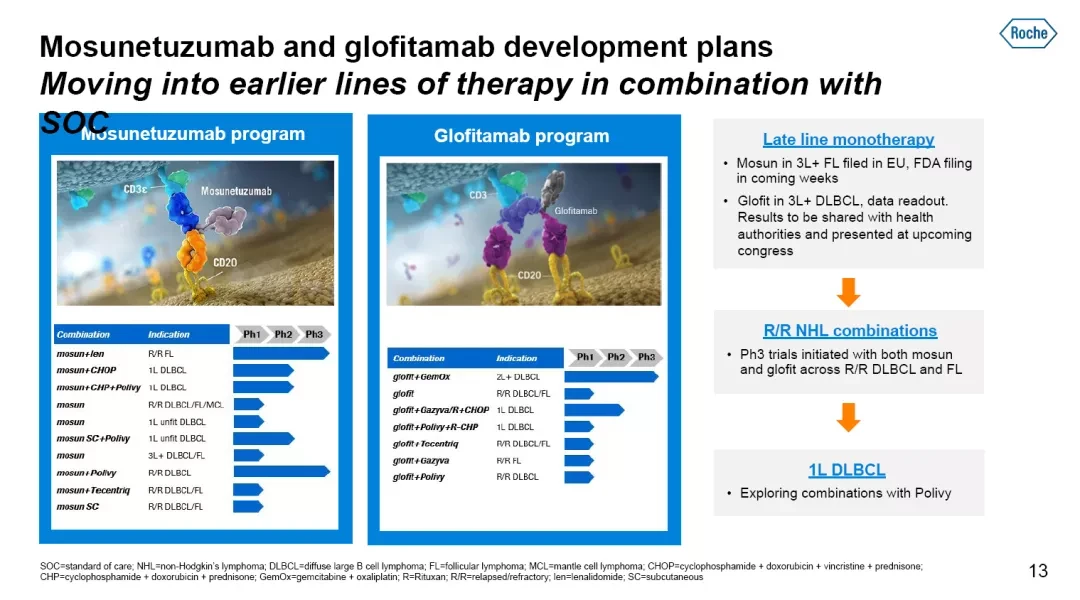
Preliminary results presented at ASH2021 showed that, in the Ib/II phase GO40516 study, mosunetuzumab + Polivy (CD79b ADC) achieved an ORR of 65.0% in heavily treated R/R NHL patients, with a CR rate of 48.3%. The incidence of CRS was 18%, and all adverse events occurred during the first treatment cycle and were grade 1-2. In the I/Ib phase dose-escalation NP30179 study, glofitamab monotherapy achieved an ORR of 81.0% in heavily pretreated R/R NHL patients, while the ORR for the glofitamab + Gazyva group was 100%. In the Ib/II phase NP39488 study, glofitamab + Polivy achieved an ORR of 73% in refractory DLBCL patients within a 3.2-month follow-up period, with a CR rate of 51.5%, and no grade 3 or higher CRS was observed.