

Sanofi Reports 2021 Financial Results: Dupixent Sales Reach €5.25 Billion, China Revenue Hits €2.72 Billion
Sanofi
Pharmaceutical R&D Developer
On February 4, Sanofi announced its 2021 performance, with a net income of 37.761 billion euros, representing a year-on-year increase of 7.1%. Among this, pharmaceutical business revenue totaled 26.970 billion euros (+7.6%), vaccine business revenue was 6.323 billion euros (+6.8%), and consumer healthcare business revenue reached 4.468 billion euros (+4.6%).
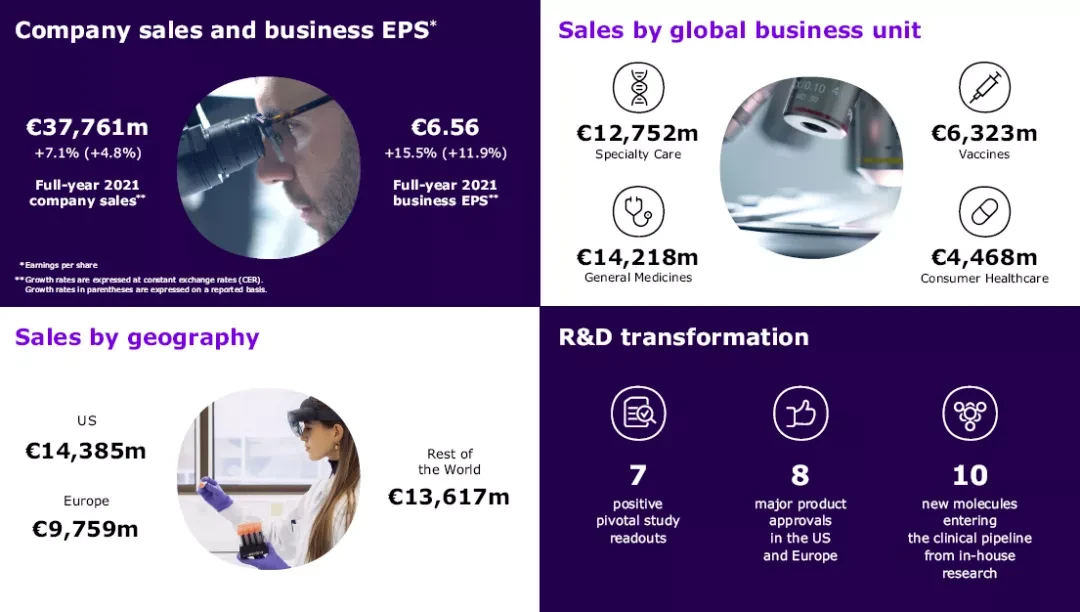
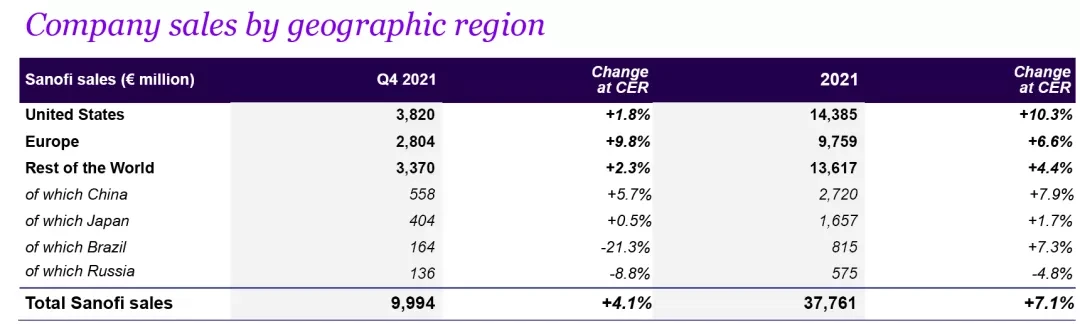
In terms of regional distribution of revenue, the U.S. market provided the strongest growth momentum for Sanofi (+10.3%), followed by the Chinese market. In 2021, revenue from China reached 2.72 billion euros, representing a year-on-year increase of 7.9%, mainly driven by the growth of Dupixent and the recovery of Plavix (clopidogrel) from the impact of volume-based procurement.
Sanofi's pharmaceutical business mainly focuses on areas such as immunology and inflammation, neurology, rare diseases, oncology, and diabetes. The diabetes business has largely withdrawn from direct competition with the two major giants, Novo Nordisk and Eli Lilly. The oncology business also offers few notable products. The more promising developments and strategic layouts are in the fields of neurology & immunology and rare diseases.
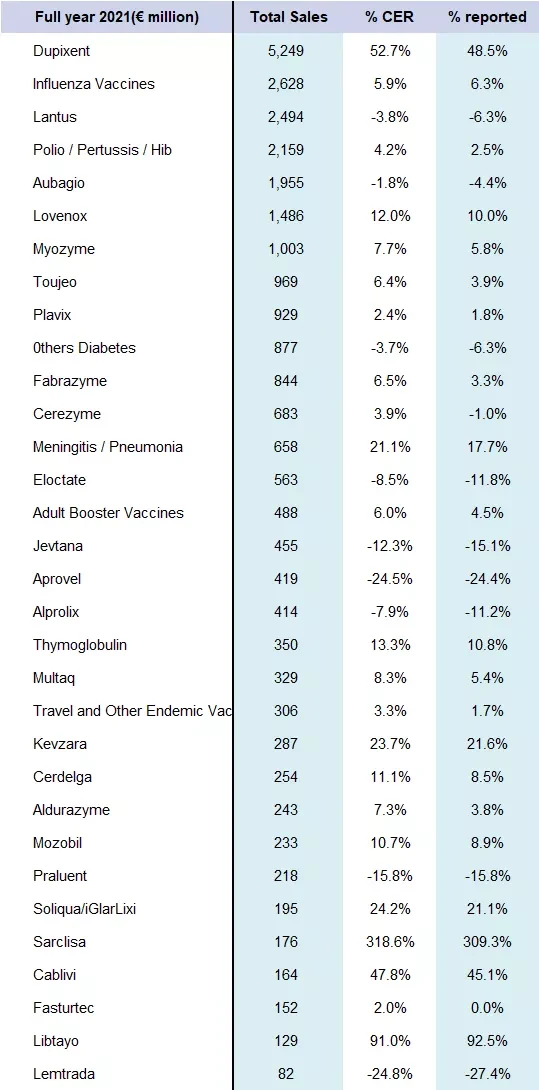
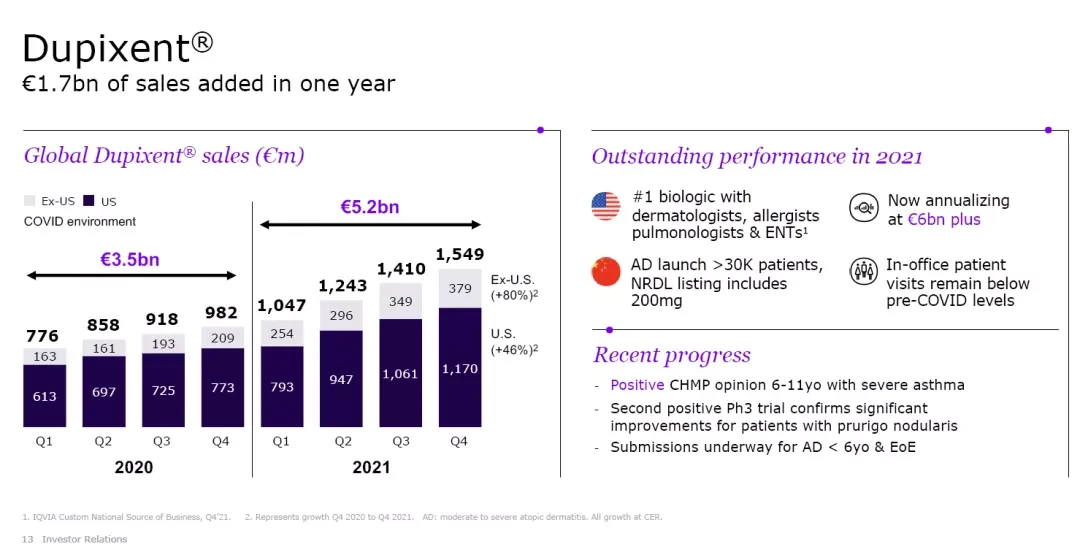
Dupixent (dupilumab) is Sanofi's current flagship product, with revenue in 2021 increasing by 52.7% year-on-year to reach €5.249 billion, continuing its strong push towards the target of over €10 billion. Its growth has been driven by the ongoing demand from adult, adolescent, and children aged 6-11 with atopic dermatitis, as well as the label expansion and increased patient penetration for indications such as asthma and chronic rhinosinusitis with nasal polyps (CRSwNP). Dupixent is currently the first biologic in the U.S. that spans dermatology, allergy, and respiratory departments. In June 2020, it was approved in China for the treatment of adult patients with moderate-to-severe atopic dermatitis and was included in the 2020 National Reimbursement Drug List, covering more than 30,000 patients. In September 2021, it was further approved in China for use in adolescents aged 12 and above with atopic dermatitis.
Dupilumab can bind to the common receptor module IL-4Rα of IL-4 and IL-13, simultaneously blocking IL-4 and IL-13, demonstrating excellent control over various type 2 inflammatory responses. Therefore, the indications and clinical plans under development for Dupixent are also extremely extensive.
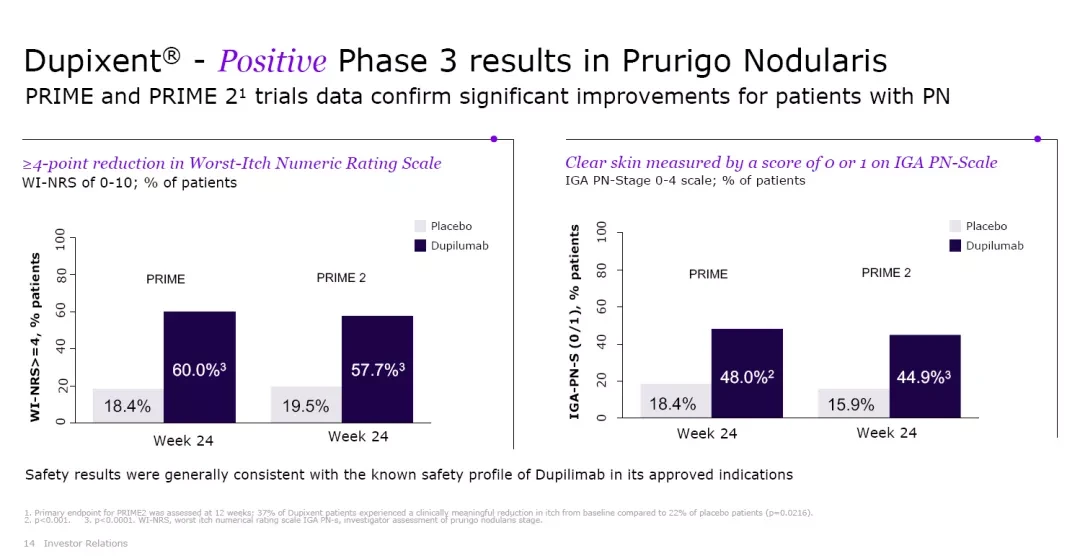
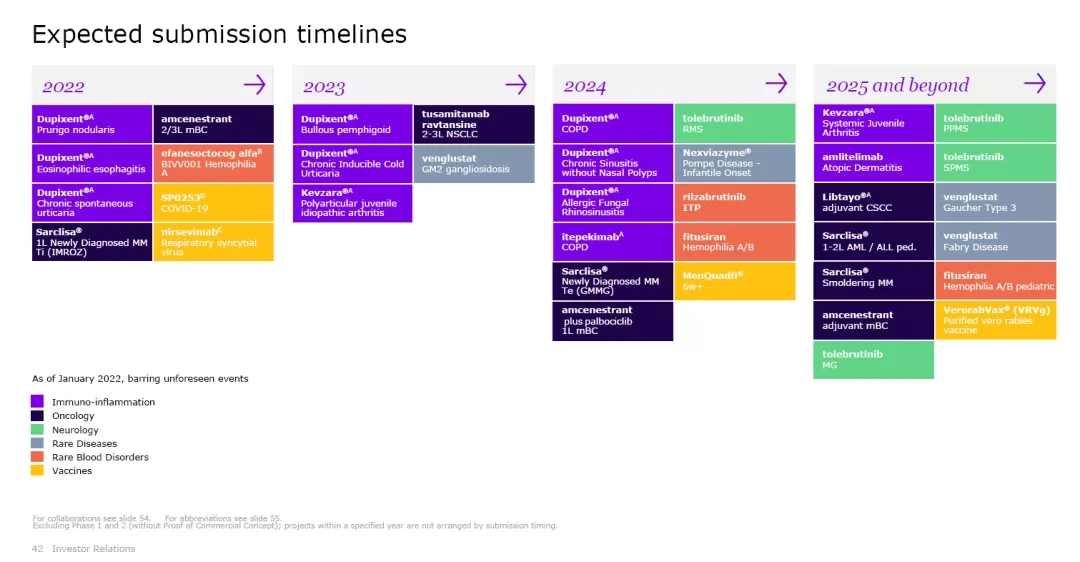
In the Phase III PRIME program for the key indication of prurigo nodularis, both the PRIME and PRIME 2 studies met their primary and secondary endpoints, showing a significant reduction in itch scores and skin lesion scores compared to placebo. Prurigo nodularis is a chronic skin inflammation with a large patient population and no targeted therapies currently approved; there are approximately 300,000 patients in the U.S., of which 74,000 have symptoms that cannot be controlled with topical steroids. Sanofi is expected to file for marketing approval for this indication in the U.S. and EU in the first half of 2022. Additionally, Dupixent’s Phase III study for eosinophilic esophagitis was also successful, with plans to submit for marketing approval in the U.S. and EU in the first half of 2022.
In the field of oncology, Sanofi's more notable products are Libtayo (anti-PD-1) and Sarclisa (anti-CD38). However, compared with competitors that have a first-mover advantage, the market share that these two products can capture based on their current indications remains relatively small, with revenues of €129 million and €176 million respectively in 2021. In the same year, the FDA granted priority review to the application for Libtayo + chemotherapy as a first-line treatment for NSCLC, while Sarclisa + lenalidomide + bortezomib + dexamethasone achieved the first positive Phase III study results for the first-line treatment of multiple myeloma. Subsequent regulatory progress will also be key to determining the market fate of these two drugs.
In the field of neurology, Sanofi's highly anticipated brain-penetrant BTK inhibitor tolebrutinib, in addition to continuing to lead clinical development in multiple sclerosis indications, also initiated a Phase III clinical trial for generalized myasthenia gravis in 2021.
Two of Sanofi's investigational products in the field of rare blood disorders are also worth noting, including the engineered factor VIII product efanesoctocog alfa (BIVV001) and the small interfering RNA therapy (siRNA) fitusiran, both of which are being developed for the treatment of hemophilia. BIVV001 contains an Fc dimer, the DʹD3 domain of VWF, and an XTEN polypeptide, and is expected to become the first long-acting factor VIII to break through the ceiling of the VWF half-life. Its marketing application is planned to be submitted by mid-2022. Fitusiran can be administered once a month via subcutaneous injection, improving thrombin generation potential and rebalancing hemostatic function in hemophilia patients regardless of inhibitor status. Phase III results were disclosed at ASH 2021, with market application expected in 2024.
Sanofi also disclosed some terminated clinical trials, including a Phase II study of Sarclisa for patients awaiting kidney transplantation, a Phase II study of complement C1s inhibitor SAR440588 for idiopathic thrombocytopenic purpura, a Phase I study of TGF-β monoclonal antibody SAR433459 for solid tumors, and a Phase I study of Fc-engineered CD38 monoclonal antibody SAR442085 for the treatment of solid tumors.
After bidding farewell to the glorious era of Lantus in its diabetes business, Sanofi is also striving to transform by focusing on cutting-edge technologies, including expanding its layout in immune-inflammatory and skin disease fields with Dupixent as the core. On December 21, Sanofi announced a $1.2 billion acquisition of Amunix Pharmaceuticals, a company specializing in the proprietary protease-releasing stealth Pro-XTEN technology platform, to expand its T-cell engager (TCE) and cytokine therapy pipelines. On December 1, Sanofi announced the acquisition of Origimm Biotechnology, an Austrian private biotech company, obtaining ORI-001, a recombinant protein-based therapeutic acne vulgaris vaccine candidate, and its technology for discovering toxic skin microbiome components and antigens from bacteria causing skin diseases like acne. On November 18, Sanofi announced an $180 million equity investment in Owkin, an artificial intelligence company, to help optimize clinical trial designs and discover more predictive biomarkers for treatment outcomes in lung cancer, breast cancer, and multiple myeloma.

While releasing the 2021 financial report, Sanofi also updated and released its new logo on February 3, conveying the company's new visual identity, new business focus, and representing a new starting point for the company.