

Amgen Reports 2021 Financial Results: Biosimilars Exceed $2 Billion, PCSK9 Inhibitor Generates $1.1 Billion, KRAS Inhibitor Reaches $90 Million

Amgen
Developer of Treatment Drugs for Serious Diseases
On February 7, Amgen announced its annual performance, with total annual revenue of $25.979 billion. The full-year product sales in the United States decreased by 4%, while the full-year product sales outside the United States increased by 12%, including a 36% growth in the Asia-Pacific region. Amgen's total annual R&D expenses were $4.819 billion (+15%), accounting for 18.5% of total revenue.
2021 Amgen Key Product Sales (USD billion)
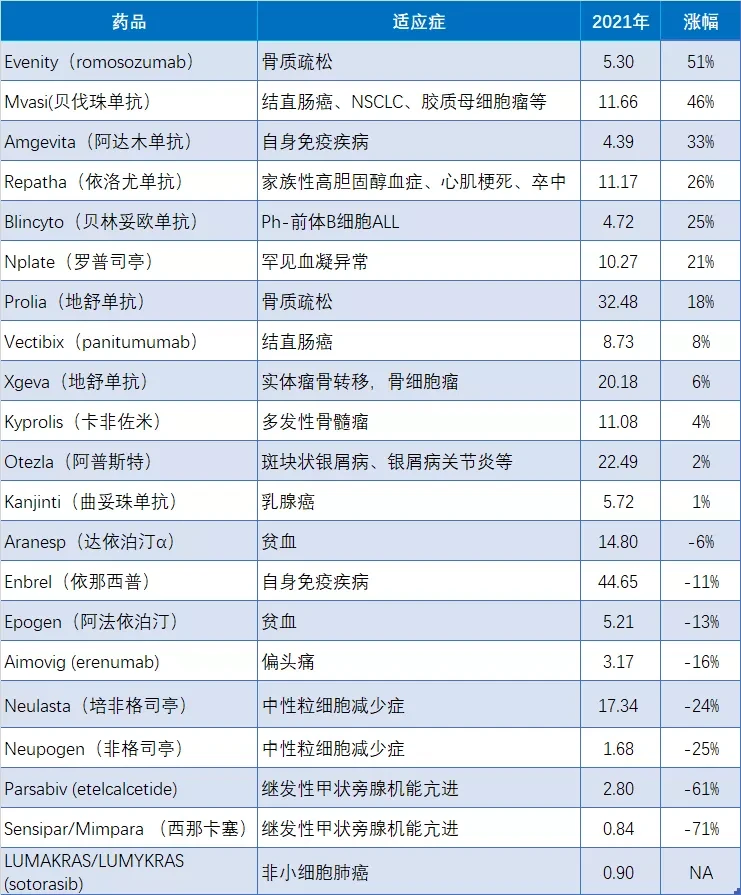
Amgen's business mainly includes biosimilars and innovative drugs. In terms of biosimilars, Amgen has launched five products to date, including: Amgevita (adalimumab), Mvasi (bevacizumab), Kanjinti (trastuzumab), Avsola (infliximab), and Riabni (rituximab). Among them, Amgevita and Mvasi are currently the best performers in the market, with revenues of $439 million (+33%) and $1.166 billion (+46%) respectively in 2021. Amgevita remains the largest prescribed adalimumab biosimilar in Europe. Additionally, according to an agreement reached between AbbVie and Amgen, the product is expected to debut in the United States on January 31, 2023. Meanwhile, Mvasi continues to maintain its leading position in the fourth quarter with a 49% market share of bevacizumab. At the JP Morgan Conference, Amgen CEO Robert Bradway stated that Amgen has positioned its biosimilar business as an "industry-leading franchise." By 2030, revenue from this segment is expected to more than double.
Due to the continuous erosion by generic drugs, decreased sales volume, and reduced net selling price, the total sales of Amgen's existing mature brand products, including the leukocyte enhancers Neulasta (pegfilgrastim) and Neupogen (filgrastim), the anti-anemia drugs Epogen (epoetin alfa) and Aranesp (darbepoetin alfa), as well as the secondary hyperparathyroidism drugs Parsabiv (etelcalcetide) and Sensipar/Mimpar (cinacalcet), dropped by 25% for the entire year.
In 2019, after losing exclusivity for Neulasta and Epogen, Amgen will face the loss of exclusivity for Prolia and Xgeva in the coming years. Both products contain the active ingredient denosumab and are used to treat osteoporosis or cancer-related bone diseases, respectively.
The patent validity period for Denosumab extends from 2021 to 2025. Multiple pharmaceutical manufacturers, including Sandoz under Novartis, are developing generic versions of denosumab. The biosimilar of this pharmaceutical manufacturer is currently undergoing Phase III clinical trials, which are expected to conclude in July 2022. Companies such as Samsung Bioepis and Taiwan’s JHL Biotech are also developing biosimilars for denosumab. These two drugs collectively contributed $5.266 billion to Amgen’s revenue in 2021, marking a 13% year-over-year increase.
For Amgen, the loss of billions of dollars in exclusivity is a significant event. Revenue from Prolia and Xgeva accounts for 20.3% of Amgen's total income. With patents nearing expiration, Amgen will inevitably seek to boost sales of new products to mitigate the impact of the patent cliff.
In 2019, Amgen's new osteoporosis drug Evenity (romosozumab) grew by 51% to reach $530 million ($5.3 billion), driven by the U.S. market, showing strong growth momentum.
Since the price reduction in 2019, with increased sales volume, market penetration, and the recent FDA approval in September this year for an expanded population of pediatric patients aged 10 years and above with heterozygous familial hypercholesterolemia (HeFH), Repatha (evolocumab) has evolved into a blockbuster drug with $1 billion in sales. However, at the end of last year, Repatha faced another competitor in the U.S. market—Novartis' siRNA lipid-lowering drug Leqvio (inclisiran). This medication is administered once every six months and holds an advantage over Repatha and Sanofi/Regeneron's Praluent (alirocizumab) in terms of production costs and pricing competition. Fortunately, Repatha has already captured a significant market share, and in the coming years, it may continue to be the global leader in PCSK9-targeted therapies.
Blincyto, the first drug born from Amgen's BiTE technology platform, is also the world’s first bispecific antibody cancer immunotherapy to reach the market. In 2021, it generated $472 million in revenue for Amgen with a 25% growth. Last year, this drug was officially commercialized in China and is currently sold by BeiGene in the Chinese market.
In 2021, Amgen received regulatory approvals for two new drugs. In May, the FDA granted accelerated approval to Lumakras (sotorasib), a KRASG12C inhibitor, for second-line treatment of patients with locally advanced or metastatic non-small cell lung cancer (NSCLC) harboring the KRASG12C mutation. This product is the world's first approved targeted therapy for tumors with KRAS mutations. In January this year, Lumakras received approvals in the EU and Japan. According to financial reports, Lumakras generated $90 million in sales in 2021 since its launch. As Amgen implements the most comprehensive global clinical development program for Lumakras, including combinations with anti-PDL1 monoclonal antibodies, RAF/MEK inhibitors, EGFR inhibitors for second-line NSCLC treatment, as well as combinations with PD-1 monoclonal antibodies, SHP2 inhibitors, and mTOR inhibitors for second-line treatment of NSCLC, CRC, and other solid tumors, Lumakras is expected to become a multibillion-dollar blockbuster.
Another new drug is Tezspire (tezepelumab), a first-in-class TSLP inhibitor jointly developed by Amgen and AstraZeneca. This new drug was approved by the FDA on December 17 for add-on maintenance treatment in children aged 12 years and older and adults with severe asthma. It is the first biologic that has been shown to consistently and significantly reduce exacerbations in a broad population of severe asthma patients.
In addition, external innovation has been and will continue to be an important part of Amgen's strategy. In July 2021, Amgen acquired Teneobio for $2.5 billion, committing to the development of novel human heavy chain bispecific/multispecific antibodies; in January this year, Amgen partnered with Generate Biomedicines to jointly develop protein therapies targeting five clinical targets.