

AbbVie's JAK Inhibitor Upadacitinib (Rinvoq) Approved in China for Moderate-to-Severe Atopic Dermatitis

AbbVie
Innovative Drug Developer
On February 24, the official website of the National Medical Products Administration (NMPA) showed that AbbVie's Upadacitinib Extended-Release Tablets received approval for marketing in China. The drug is indicated for adult and adolescent patients aged 12 years and older with moderate to severe atopic dermatitis who are candidates for systemic therapy.



Upadacitinib (brand name: Rinvoq) is a JAK1 inhibitor developed by AbbVie for once-daily oral administration. It was first approved in the United States in August 2019 for the treatment of rheumatoid arthritis, followed by approvals in Europe and Japan. Notably, in August 2021, upadacitinib received expanded approval in Europe for the treatment of atopic dermatitis, becoming the first JAK inhibitor approved in the EU for this condition. Currently, the approved indications for upadacitinib include atopic dermatitis, psoriatic arthritis, ankylosing spondylitis, and rheumatoid arthritis.
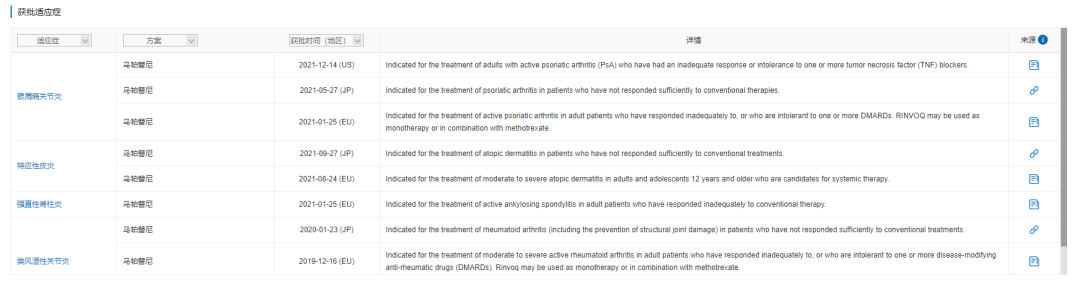
Source: PharmaCube NextPharma
Since its launch, Upadacitinib's sales have risen rapidly, reaching $0.47 billion, $7.31 billion, and $16.51 billion in 2019, 2020, and 2021 respectively, making it another key product for AbbVie. AbbVie expects Upadacitinib’s sales to exceed $7.5 billion by 2025.
AbbVie announced the phase IIIb clinical trial Heads Up (NCT03738397) data of upadacitinib. The results showed that after 16 weeks of treatment, the proportion of patients achieving EASI 75 was 71% for upadacitinib vs. 61% for dupilumab, reaching the primary endpoint. In addition, upadacitinib demonstrated statistically significant superiority in all secondary endpoints, including reduction in itching and improvement in skin clearance rate.
Currently, three JAK inhibitors have been approved for marketing in China: Baricitinib (Lilly), Tofacitinib (Pfizer), and Ruxolitinib (Novartis). In addition, Pfizer's Abrocitinib is already in the registration review stage and is expected to be approved in 2022 for use in atopic dermatitis.