

Evergreen Therapeutics Leverages AI to Pioneer Me-Only Drug EG-301 for Dry AMD, Entering Phase II Clinical Trials
Evergreen Therapeutics
Innovative Drug Developer

FDA
U.S. Food and Drug Administration
Good News for Patients with Dry Macular Degeneration is Coming.
Recently, ShenzhenEvergreen TherapeuticsEvergreen Therapeutics (hereinafter referred to as "Evergreen Therapeutics") announced,Evergreen Therapeutics' EG-301, an orally administered drug independently developed for the treatment of dry age-related macular degeneration, has received FDA approval for its IND application and has officially entered Phase II clinical trials.It is reported that this is the world's first Phase II ophthalmic clinical study targeting this site, aiming to confirm the clinical efficacy of EG-301 for Dry AMD.
Evergreen Therapeutics is an innovative pharmaceutical company with artificial intelligence (AI) as its core technology. According to reports, EG-301 is an oral medication for treating dry age-related macular degeneration in individuals over 50 years old. It currently has comprehensive human safety data and has demonstrated effectiveness in animal experiments.
Dry Age-Related Macular Degeneration (Dry AMD) is one type of Age-Related Macular Degeneration (AMD), with the other type being wet AMD. AMD is a chronic and irreversible eye disease that predominantly affects individuals over 50 years old, causing damage and death to retinal cells, which leads to vision loss. According to statistics, there were approximately 100 million people worldwide affected by macular degeneration in 2020, with dry AMD accounting for about 90% of all cases.
However, there are currently no specific drugs available for treating dry macular degeneration. The condition can only be managed by having patients take vitamins and zinc to slow its progression, making it "an untouched frontier with unlimited market potential." Wet macular degeneration, on the other hand, can be improved through anti-VEGF medications and surgeries that reduce blood vessel formation.
Notably, EG-301 was developed based on Evergreen Therapeutics' proprietary AI-driven drug mechanism evaluation platform. The platform conducted in-depth exploration and prediction of EG-301’s novel target, pathogenesis, intraocular efficacy, lysosomal pharmacokinetics, and development risks. It demonstrated that EG-301 enhances the anti-inflammatory and antioxidant functions of retinal pigment epithelial cells, improves autophagosome transport function in epithelial cells, inhibits complement activation in epithelial cells, and exhibits mitochondrial protective effects.
It has been proven by the industry that AI has significant advantages in improving the efficiency of new drug research and development. With this idea in mind, Evergreen Therapeutics has currently established a drug innovation platform in the United States centered on AI and pharmaceutical research. This platform is mainly used to support the deep application of AI technology in the design and screening of new drug molecules, the research and optimization of new formulations, and drug development.
According to Dr. Tao Du, co-founder and chairman of Evergreen Therapeutics,Unlike the AI technology platforms of third-party companies on the market that mainly focus on the preclinical stages such as target discovery and chemical synthesis, Evergreen Therapeutics has applied its AI to the development stage, including regulatory toxicology studies, pharmacokinetics, and clinical trial design.
However, this is just one part of Evergreen Therapeutics' "efficient R&D" strategy. Previously, Evergreen Therapeutics also developed innovative drugs using the approach of "repurposing old drugs." A typical achievement is that within less than two years of the company's establishment, an innovative candidate drug, EG-007, received approval from the U.S. FDA to conduct a Phase III pivotal clinical trial in combination with targeted therapies and anti-PD-1 antibody drugs for the treatment of advanced endometrial cancer. The primary goal of this clinical trial is to improve the response rate/effectiveness of immunotherapy in patients with advanced endometrial cancer through the combination with EG-007.
36Kr learned during the interview that Dr. Du Tao has extensive experience in the medical field. A medical doctor by training, he served as a new drug reviewer at the U.S. FDA for seven years. Later, he held senior executive positions at large CROs and international pharmaceutical companies. He has also been involved in pharmaceutical investment and provided consulting services related to pharmaceutical development and regulations. These professional experiences have given him rich expertise and deep insights into capital markets, innovative development, and new drug applications.
The 2015 reform of the China Food and Drug Administration (CFDA) and the introduction of Hong Kong Stock Exchange's Policy 18A in 2018 made innovative drugs a highly sought-after opportunity in the eyes of investors and entrepreneurs. After several years of observation and evaluation, Du Tao also believed that the current state of the industry had reached an "unprecedented level of prosperity," noting that "all key factors—talent, capital, and technology—are now in place. To bridge the gap between China and the U.S. pharmaceutical industries, it’s time to take action." Thus, Evergreen Therapeutics was officially founded in 2019.
Unlike general innovative drug companies that chase popular targets (such as clustering around PD-1) or major indications (such as betting on the oncology track), Evergreen Therapeutics has formulated four development strategies: focusing on clinical needs, targeting the international market, efficient development, rapid entry into clinical trials, and has locked onto two major fields: immunology (including cancer immunotherapy) and ophthalmic drugs.
Focusing on clinical needs, Dr. Du Tao and the team have targeted the field of first-line treatments "where no drugs have been approved so far," which can be通俗ly understood as "untreatable." This can be glimpsed from Evergreen Therapeutics' current areas of interest.
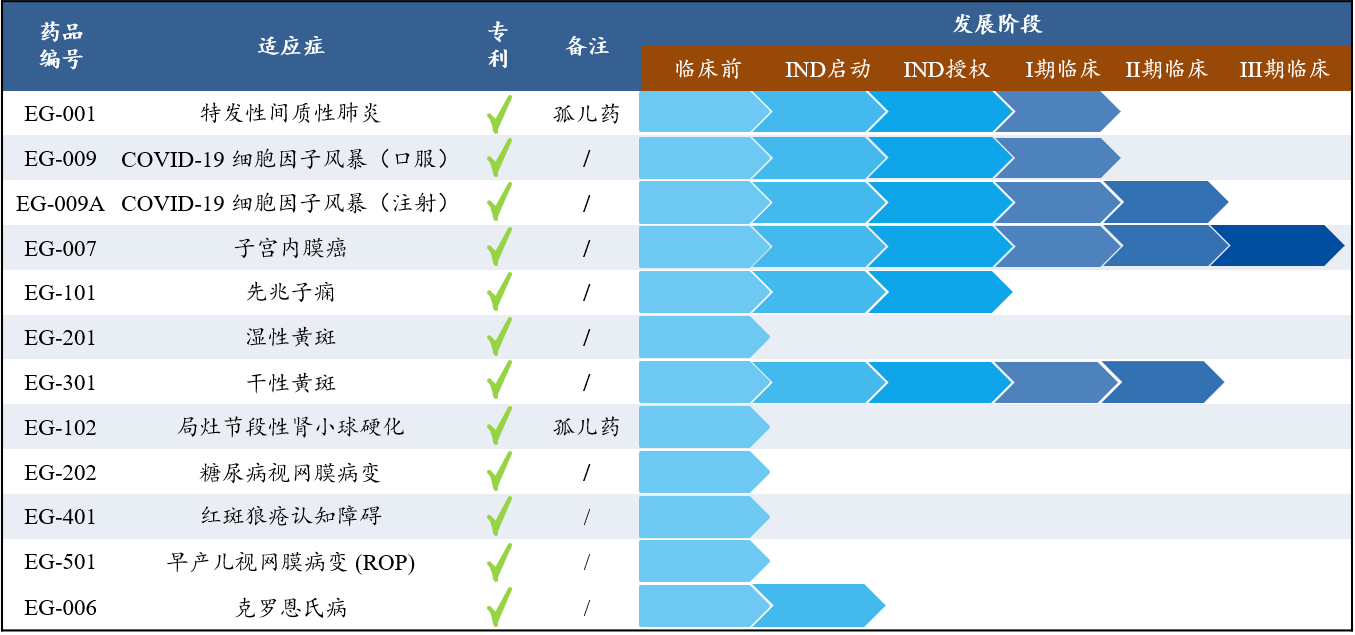
Evergreen Therapeutics R&D Pipeline
Taking EG-007, a treatment for endometrial cancer, as an example, although immunotherapy drugs account for more than 60% of clinical trials in endometrial cancer, they still generally face the issue of low response rates to immune checkpoint drugs. According to reports, animal experiments have shown that EG-007 can enhance the therapeutic effects of anti-PD-1/L1 antibodies. The combination of EG-007 and immunotherapy is expected to become a first-line treatment for advanced endometrial cancer.
Another example is the company's self-developed EG-009A for targeting the COVID-19 cytokine storm. According to Dr. Tao Du, cytokines secreted by human leukocytes are one of the important weapons against viruses, but sometimes they can become "uncontrollable," attacking the body’s own organs and tissues. During the middle stage of coronavirus infection, the virus has generally stopped replicating, while moderate to severe patients exhibit an overactive immune response, which may lead to a harmful "cytokine storm" that endangers the patient. EG-009A can suppress this reaction, thereby treating moderate to severe COVID-19.
Currently, globally, there are no approved drugs, including those under the US EUA, that treat the "cytokine storm" caused by COVID-19. Currently, EG-009A has two formulations: oral and intramuscular injection, which can be used separately or in combination. For example, the fast-acting injectable can be administered first to quickly increase blood drug concentration, followed by the oral formulation to maintain the blood drug level, making it convenient for patients to use.
In addition, Dr. Du Tao introduced that pipelines targeting idiopathic interstitial pneumonia, preeclampsia, dry age-related macular degeneration, and Crohn's disease all align with the current status of having "no available treatment." Even though there are treatments for wet age-related macular degeneration, the current method of intravitreal injections provides a very poor medication experience, significantly impacting patient compliance.
As for the international market, this also aligns with the current trend of innovative pharmaceutical companies expanding overseas. Dr. Du Tao introduced that restricted by the current medical insurance payment system in China, the pricing of innovative drugs will inevitably be constrained and could easily fail under the normalization of bulk procurement. However, these issues can be resolved with a global business layout. Therefore, since its establishment, Evergreen Therapeutics has formulated an international R&D and market strategy and has taken the initiative to start the corresponding application procedures and clinical trials with the U.S. FDA.
Dr. Du Tao believes that in the process of capturing international markets, efficient development is particularly important, "which can directly determine whether your drug is a first-line or second-line treatment for many diseases."
How to achieve efficient development and clean execution, apart from using AI technology to quickly discover new molecules, he believes there are mainly two other points:First, focus on the strategy of "highly regulated" markets to ensure full recognition during the subsequent registration and approval process, achieving rapid approval."For example, in Hong Kong, if a drug is approved in the United States or major European countries, its registration and application process in Hong Kong will be very simple, taking only a few weeks before it can be marketed."Have a deep understanding of policies and regulations to ensure no detours.It is reported that the current Evergreen Therapeutics team includes five former FDA reviewers, and their accumulated knowledge in regulatory affairs can support the team to move forward quickly under the “highly regulated” approach.
In the process of researching existing drugs, the Evergreen Therapeutics team discovered several novel targets associated with significant diseases. Targeting these novel sites and leveraging AI technology, entirely new drug molecules were synthesized. "These new drug molecules exhibit higher activity and lower toxicity compared to the existing drug molecules." The previously mentioned EG-301 is a typical outcome of this approach.
On this basis, Dr. Du Tao emphasized the importance of rapidly advancing clinical trials: "No matter how perfect the laboratory research is, it can still fall apart in subsequent clinical studies, easily wasting several years. Advancing clinical trials quickly not only helps to...Schedule Time,which can further reduce the subsequent cost of silence." It is precisely because of such execution that Evergreen Therapeutics has currently advanced multiple drugs into clinical trials and is collaborating with major research institutions worldwide for co-development. Among innovative pharmaceutical companies in the same tier, its speed is astonishing.
He said, "This era isChina Medicine"In this era of rapid industrial development and globalization, I hope to live up to the privilege of being in this time and contribute to China's pharmaceutical industry. Following the clinical value chain, we aim to continuously make breakthroughs in therapeutic areas that remain unmet."
36Kr has also learned that Evergreen Therapeutics has completed its Pre-A and A rounds of financing and is currently undergoing a new round of financing to meet the capital demands for new drug development and clinical trials.