

Is Mersana's Dolasynthen ADC Platform Worth the Hype? Johnson & Johnson Bets Over $1 Billion

Johnson & Johnson
Healthcare Product Manufacturers, Health Service Providers

Mersana Therapeutics
Antibody-Drug Conjugate (ADC) Therapy Developer
Johnson & Johnson announced a collaboration with Mersana Therapeutics on February 3. Johnson & Johnson will provide proprietary antibodies for three targets, while Mersana will apply its exclusive Dolasynthen platform to discover new ADC candidates. Johnson & Johnson paid $40 million upfront, with potential milestone payments totaling over $1 billion. This deal has also drawn significant attention.
Probably due to DS-8201, the ADC concept has been very popular in recent years, but there are not many truly interesting ones—Mersana Therapeutics is one of them.
The ADC Craze Brought by DS-8201

ADC drugs, as a combination of large-molecule and small-molecule drugs, actually have a long history of development: Mylotarg was first launched in 2000 but experienced a story of withdrawal and re-launch in 2017; subsequently, other ADCs such as Adcetris, Kadcyla, and Besponsa were successively launched starting from 2011.
However, the real ADC craze seems to be brought by HER2 ADC Enhertu (DS-8201). HER2 is an old target, even when DS-8201 was developed it was already an old target, with not only the monoclonal antibodies trastuzumab and pertuzumab preceding it, but also the ADC kadcyla. Despite this, Daiichi Sankyo still clearly developed DS-8201.
The design concept of DS-8201 is clear: to use a small-molecule payload with a bystander effect to overcome tumor heterogeneity and address the issue where most tumor cells in HER2-low patients lack targets; at the same time, the shorter half-life of the small-molecule payload prevents excessive bystander effects, avoiding over-attack on normal cells and potential safety issues. In preclinical efficacy models, DS-8201 obtained sufficient efficacy and safety validation data. Therefore, in subsequent multiple clinical trials, DS-8201 has consistently shown impressive results: a perfect patient survival curve and efficacy even in patients with HER2 1+ or HER2 0 status, making DS-8201 an unparalleled option.
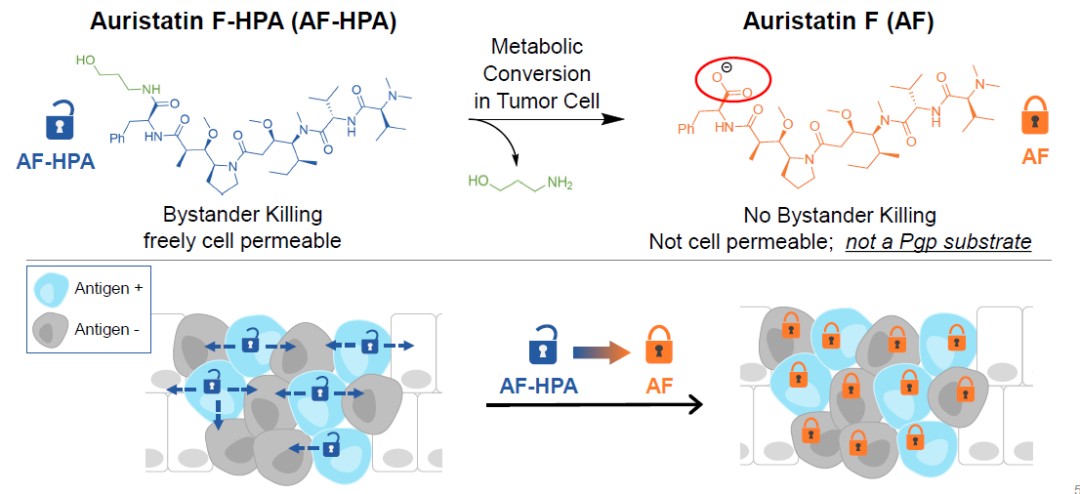
Some say the bystander effect is good, haven’t you seen DS-8201 take the lead; others still adhere to avoiding the bystander effect, believing it brings efficacy but also side effects (ARX-788 and DAC-001, HER2 ADCs without the bystander effect, are still under clinical development). Mersana Therapeutics, however, has found its own balance by promoting the concept of a "controlled bystander" effect with its warhead technology named Dolalock, striving to balance efficacy and safety.
Mersana, 2019, World ADC
The ADC era dominated by DAR has passed.

Mersana's first-generation ADC technology is called Dolaflexin. At this point, Mersana is pursuing a high payload capacity. Historically, apart from SN38 and its derivative Dxd, most other ADCs have a DAR value not exceeding 4. The hydrophilic small molecule payload makes it possible to achieve a high DAR value of over 10, ensuring the pharmacokinetics and efficacy of the ADC. Mersana believes that a high DAR value allows Dolaflexin ADCs to potentially remain effective against tumor targets with low antigen expression levels. Among Mersana’s pipeline, the NaPi2b ADC—UpRi based on Dolaflexin—is one of the more advanced candidates.
UpRi treats platinum chemotherapy-insensitive ovarian cancer by targeting NaPi2b. The prognosis of ovarian cancer is not good, with high recurrence rates (80%-85%), low cure rates (<40%), and a five-year survival rate of approximately 46.5%. Recurrent patients who are platinum-sensitive mainly rely on platinum-based drugs combined with doxorubicin/paclitaxel/gemcitabine or PARP inhibitors; prolonged use can lead to platinum insensitivity. Recurrent patients who are platinum-insensitive mainly depend on cyclophosphamide/etoposide/doxorubicin/paclitaxel/topotecan or PARP inhibitors. NaPi2b is one of the TAAs highly expressed in ovarian cancer and is only expressed in limited normal tissues (such as the lungs).
Genetech's NaPi2b ADC lifastuzumab vedotin, with an MMAE payload, showed the following Phase II data in ovarian cancer: ORR improved, with LIFA group vs pegylated liposomal doxorubicin (PLD) group at 34% vs 15% (p=0.03) or 36% vs 14% (p=0.02, high NaPi2b expression), but mPFS showed no significant change, reaching only 5.3 vs 3.4 months even in the high NaPi2b expression population.
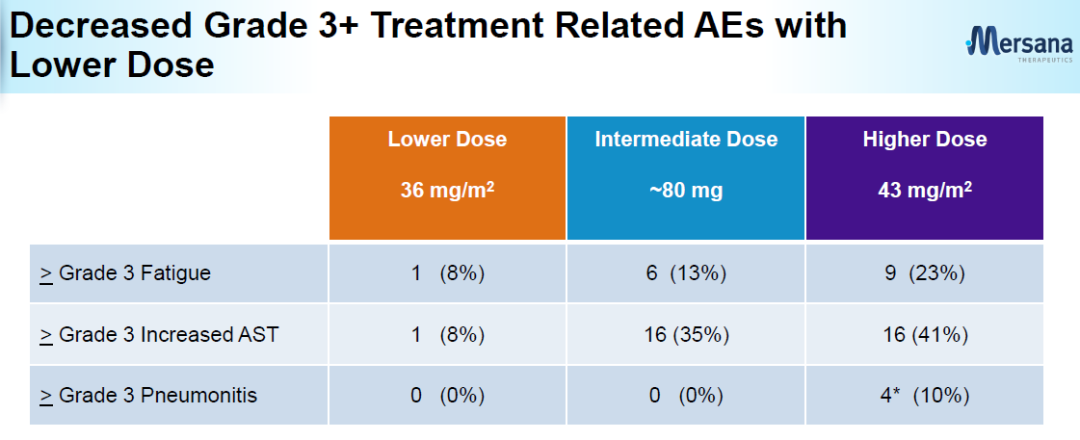
In September 2021, the Phase I clinical data of UpRi published by Mersana Therapeutics (involving 97 ovarian cancer patients who were previously treated with 1-3 lines of platinum-insensitive therapy or had undergone 4 lines of treatment) caused a sharp drop in the company’s stock price: side effects were not as mild as indicated in preclinical data, and efficacy showed no dose correlation. However, in the Napi2b high-expression population, the ORR in the low-dose group was 50%, which still raises some expectation for the PFS data. Mersana also reflected at the time that the medium- and high-dose groups did not bring additional efficacy benefits but instead resulted in greater side effects; therefore, adjustments to the dosage would be made in subsequent clinical trials.
Mersana, 2021
Why Is the Second-Generation Technology Platform Favored?

But this deal by Johnson & Johnson is based on Mersana's second-generation ADC platform, Dolasynthen.
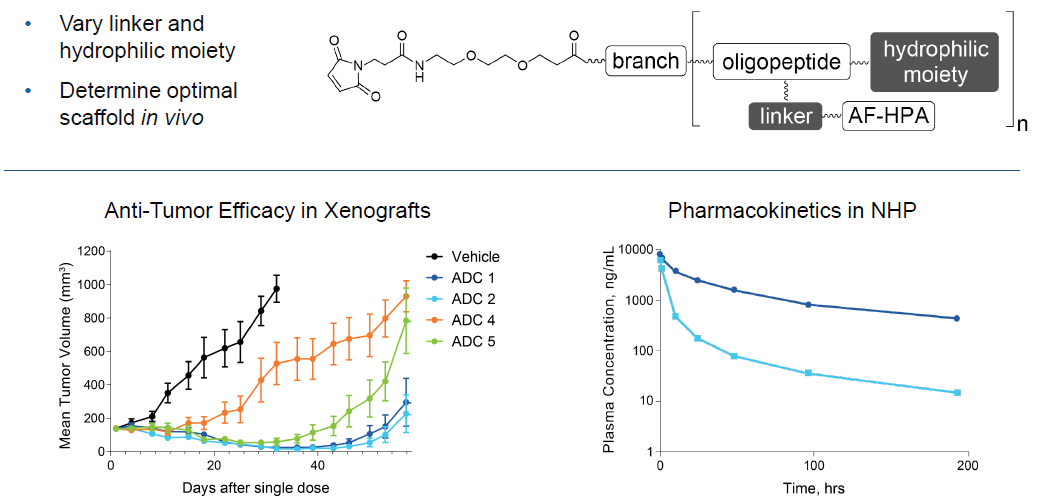
The concept of Dolasynthen has changed, no longer blindly pursuing a high DAR value but instead placing more emphasis on the balance between efficacy and safety. First, it optimized the small-molecule scaffold. Mersana designed a series of ADCs containing different linkers and hydrophilic groups, evaluating their efficacy and PK in vivo to select the optimal scaffold.
Mersana, AACR, 2019
Secondly, site-specific conjugation technology was adopted. Such ADCs have a more stable and homogeneous DAR value, and better stability.
XMT-1592 is a second-generation ADC (DAR=6) based on the Dolasynthen platform targeting NaPi2b technology. According to preclinical data, the therapeutic window of Dolasynthen may be more favorable. As shown in the figure below, Mersana compared the preclinical therapeutic windows of Dolasynthen with DAR values of 6 and 12, as well as an ADC with the same payload using non-site-specific conjugation. It can be seen that Dolasynthen with a DAR value of 6 significantly outperformed in both efficacy and safety.
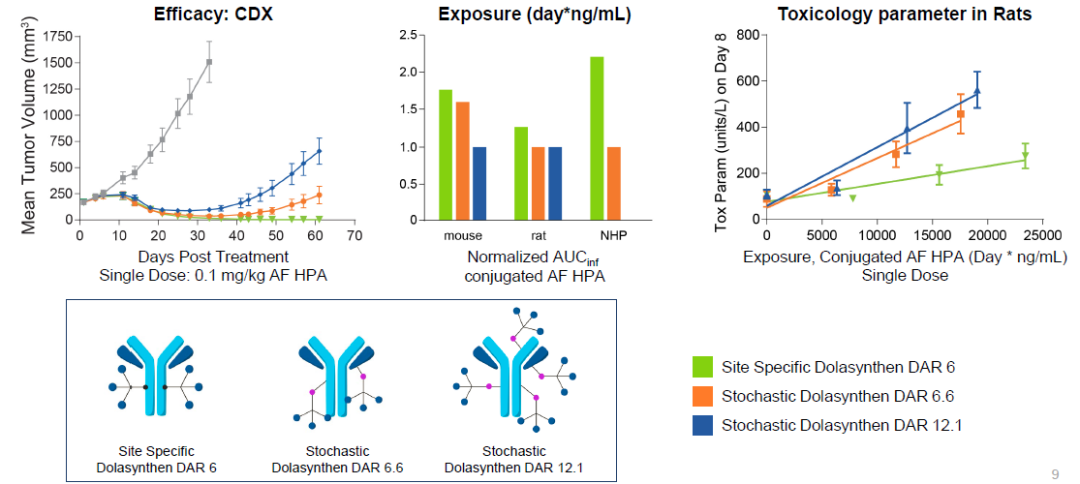
Mersana, AACR, 2019
But of course, one of the side effects of UpRi is pneumonia, which may be related to the expression of NaPi2b in normal alveolar cells. Whether target-related toxicity will limit XMT-1592 remains an unknown.
Summary

In the midst of the ADC boom in recent years, DS-8201 continues to create an unsurpassable legend. The bystander effect and small-molecule payloads with short half-lives form the foundation of Daiichi Sankyo's narrative. However, whether different targets are suitable for different ADC designs, and whether there are other paths to explore a better therapeutic window, still remain uncertain.
Mersana has told a compelling preclinical story, with a decade-long dedication and commitment to practicing across multiple ADC platforms and multiple ADC targets. The results remain to be seen and are worth looking forward to.
References: 1. Mersana Therapeutics Official Website 2. Interim Data from the Ovarian Cancer Expansion Cohort and Next Steps for UpRi. 2021 3. The DolaLock-based ADC Platforms: Dolaflexin & Dolasynthen. 2019 4. Dolasynthen: A Novel, Homogeneous Auristatin F Hydroxypropyl Amide Antibody-Drug Conjugate Platform. 2019 5. Anti-NaPi2b antibody–drug conjugate lifastuzumab vedotin (DNIB0600A) compared with pegylated liposomal doxorubicin in patients with platinum-resistant ovarian cancer in a randomized, open-label, phase II study. 2018