

Novartis Invests $6 Billion in Radiopharmaceuticals, Nears FDA Approval for Next-Generation Cancer Therapy

Novartis
Drug Development and Manufacturing
Cancer poses a serious threat to human health. According to the World Cancer Report 2020 released by the International Agency for Research on Cancer (IARC) of the World Health Organization, there were approximately 19.3 million new cancer cases and about 10 million cancer-related deaths globally in 2020.
Nuclear medicine, as a novel medical approach, plays a significant role in the clinical diagnosis and treatment of cancer. Nuclear medicine refers to a special type of drug containing radionuclides used for medical diagnosis and treatment. Nuclear medicines can be divided into two major categories: diagnostic and therapeutic. Diagnostic nuclear medicines, also known as imaging agents or tracers, when combined with corresponding imaging equipment, can obtain images or functional parameters of target organs and diseased tissues within the body; therapeutic nuclear medicines can specifically eliminate tumor cells at designated points, thereby reducing damage to normal tissues.
According to MEDraysintell data, the global nuclear medicine market size was approximately USD 6 billion in 2019, with diagnostic nuclear medicines occupying the main market. However, as more therapeutic nuclear medicines come to market, it will drive the global nuclear medicine market to reach around USD 30 billion by 2030.
As one of the world's top three pharmaceutical companies, Novartis has also been actively expanding into the radiopharmaceuticals market in recent years: investing $6 billion to build a Radioligand Therapy (RLT) platform, owning multiple marketed radiopharmaceutical products and more than ten R&D pipelines, while actively establishing extensive partnerships...This article will provide a detailed introduction to this.
Novartis, formed in 1996 from the merger of Ciba-Geigy and Sandoz, is a global leading healthcare enterprise headquartered in Switzerland, with operations spanning over 150 countries and regions worldwide. Novartis has a diversified business portfolio, covering innovative patented drugs, ophthalmic care, generic drugs, consumer health, and vaccines, holding leading positions in these fields globally.
After spinning off Alcon (ophthalmology) in 2019, Novartis further focused on its pharmaceuticals business. The current overall business can be divided into two main lines: Innovative Medicines and Sandoz.
Innovative drugs are Novartis' leading business and main source of income. In the first three quarters of 2021 (January to September), the net sales of Novartis' innovative drug business reached $31.3 billion, increasing by 9% year-on-year (or 6% at constant exchange rates), accounting for approximately 82% of Novartis’ total net sales.
Under the innovative drug business, there are two major business units: Novartis Oncology and Novartis Pharmaceuticals. Novartis believes that there is no single method to completely cure cancer, so its oncology business unit has developed four different treatment platforms in order to achieve comprehensive cancer care.Radioligand therapy belongs to one of Novartis Oncology's four treatment platforms.。
Radioligand Therapy Combines Targeted Compounds (Ligands) with Radioactive Isotopes to Form Radioligands. Once in the Bloodstream, Radioligands Bind to Specific Markers or Receptors on Cancer Cells, Releasing Radioactive Isotopes Upon Binding to Destroy and Kill Cancer Cells.
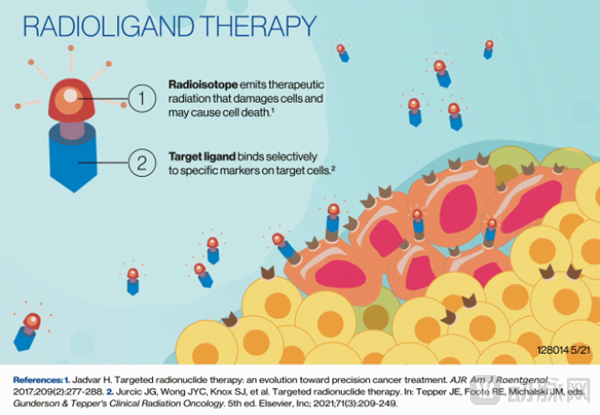 Schematic diagram of radioligand therapy (Source: Novartis official website)
Compared with traditional tumor treatment methods, radioligand therapy has the advantages of precise targeting, powerful killing, and limited damage, playing a crucial role in the clinical treatment of tumors.
Novartis' radioligand therapy platform was primarily established through the acquisition of the French innovative pharmaceutical public company Advanced Accelerator Applications (AAA).In October 2017, Novartis acquired AAA for $3.9 billion, including its key product Lutathera and technology platform, further expanding its oncology R&D pipeline.
Let's rewind to 2002. In this year, physicist Stefano Buono, inspired by his work at the European Organization for Nuclear Research (CERN), founded AAA in France. Since its establishment, AAA has focused on the research and production of radiopharmaceuticals, gradually building a rich product pipeline and actively expanding its global business.
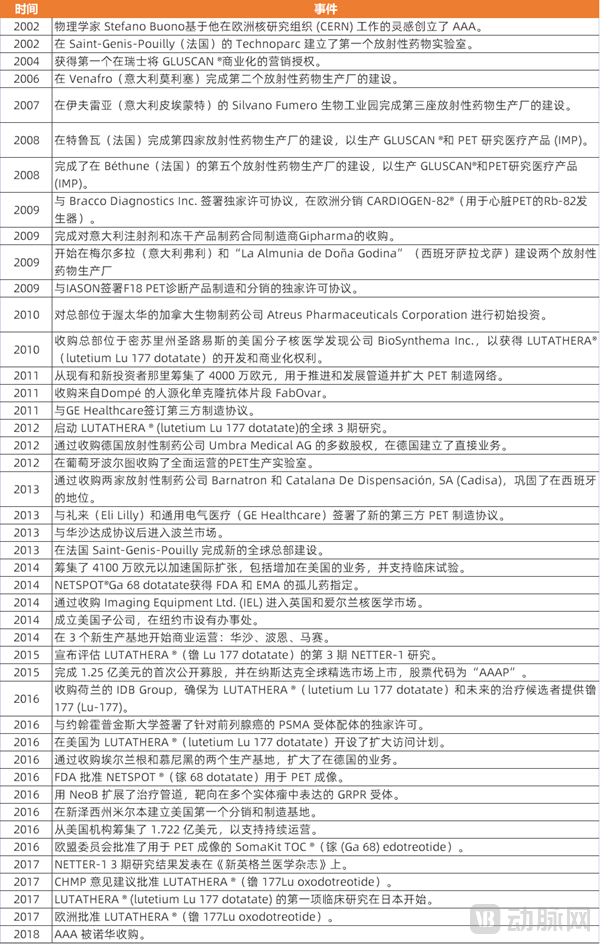
The Development History of AAA Before Being Acquired by Novartis (Data Source: AAA Official Website)
After acquiring AAA, Novartis continued to expand its radioligand therapy platform by spending another $2.1 billion in 2018 to acquire biopharmaceutical company Endocyte, gaining more RLT candidate drugs., including those used for the treatment of prostate cancer177Lu-PSMA-617 and255Ac-PSMA-617. Nowadays, Endocyte has been merged into AAA.
Through these two acquisitions, Novartis has established and expanded its radioligand therapy platform, with one marketed product: Lutathera (177Lu-DOTATATE), and five R&D products:177Lu-PSMA-617、177Lu-PSMA-R2、177Lu-NeoB、177Lu-FF58、255Ac-PSMA-617。
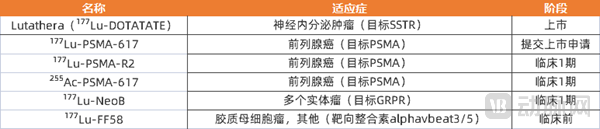 AAA Radioligand Therapy Platform
At the same time, in addition to radioligand therapy, Novartis has also developed a rich portfolio of precision imaging products and a robust R&D pipeline. As shown in the figure below, Novartis currently markets several precision imaging products primarily used in clinical oncology, cardiology, neurology, infectious diseases, and inflammatory diseases, such as NETSPOT(68Ga-DOTATATE Solution Preparation Kit), GLUSCAN/BARNASCAN (FDG Tracer). The precision imaging R&D pipeline mainly consists of five lines, such as68Ga-PSMA-11、68Ga-PSMA-R2、18F-CTT1057、68Ga-NeoB、68Ga-FF58。
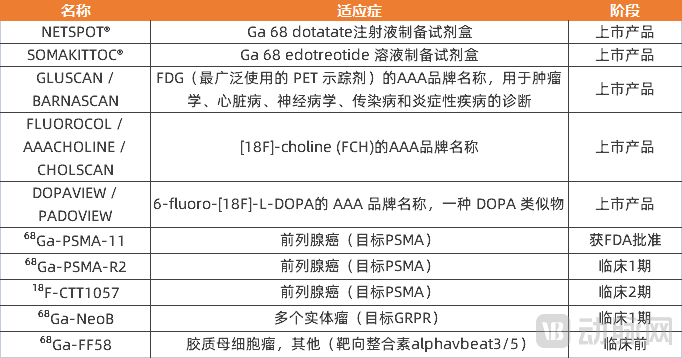 AAA Precision Imaging Products and R&D Pipeline
According to the Novartis annual report, the full-year sales of all AAA brands (including Lutathera and radiopharmaceutical diagnostic products) in 2019 were US$679 million, increasing by 91% year-on-year. The full-year sales in 2020 were US$681 million, basically flat compared with the previous year.
Novartis, with its global expertise in RLT commercialization, has established partnerships with over 400 centers across 17 countries, and its distribution network covers more than 30 countries.Its subsidiary AAA has a total of 31 sites across 12 countries, including 19 production facilities in 8 countries for the manufacturing of targeted radioligand therapies and precision imaging radioligands.
Novartis currently has six main radioligand therapies, five of which are labeled with Lu-177. The following will focus on two key products labeled with Lu-177.
Lutathera(177Lutetium Lu 177 dotatate: The first FDA-approved peptide receptor radionuclide therapy
Lutathera(177Lu-DOTATATE is a radiolabeled somatostatin analog that can be used to treat somatostatin receptor-positive gastroenteropancreatic neuroendocrine tumors (GEP-NETs), including foregut, midgut, and hindgut neuroendocrine tumors in adults.
The octreotide within the Lutathera molecule can bind to somatostatin receptors on the surface of tumor cells, delivering the radioactive isotope Lu-177 into the cells, which then emits beta rays to damage the tumor cells.
Lutathera was approved by the U.S. Food and Drug Administration (FDA) in 2018 and is also the first FDA-approved peptide receptor radionuclide therapy (PRRT).The approval of Lutathera was supported by two studies. The first pivotal randomized Phase III clinical trial, NETTER-1, demonstrated that Lutathera significantly reduced the risk of disease progression or death by 79% compared to double-dose long-acting octreotide (Sandosatin). The second study, part of the FDA's Expanded Access Program, showed that in a subgroup of 360 patients with GEP-NETs, 16% experienced partial tumor shrinkage with Lutathera.
The preliminary analysis of the latest Phase III NETTER-1 trial (2021) for Lutathera showed that, in patients with advanced midgut neuroendocrine tumors,177Lu-DOTATATE plus long-acting octreotide significantly improved progression-free survival compared to high-dose long-acting octreotide alone.
After Lutathera was launched, its sales grew rapidly. In 2018, the sales reached 167 million US dollars, and in 2019, the sales amounted to 441 million US dollars, increasing by 167% year-on-year. Affected by the COVID-19 pandemic, Lutathera achieved net sales of 445 million US dollars throughout 2020, increasing by 1% year-on-year, which was basically flat compared with the previous year, accounting for approximately 65% of AAA's brands on sale that year.
The number of medical centers using Lutathera for treatment has increased from over 100 in 2018 to 384 in 2020.
177Lu-PSMA-617: A Novel Targeted Drug for Prostate Cancer, Marketing Application Submitted
177Lu-PSMA-617 is mainly used to target prostate-specific membrane antigen (PSMA), which is highly specific to benign and malignant prostate epithelial cells and is present in approximately 80% of patients with metastatic castration-resistant prostate cancer (mCRPC), making it a potential target for the diagnosis and treatment of this disease.
177Lu-PSMA-617, after entering the bloodstream, binds to prostate cells expressing PSMA, resulting in a higher uptake rate of the drug by tumors compared to normal tissues. Once bound, radiation from the radioactive isotope damages tumor cells, preventing their proliferation or harming normal cells. The radiation from the radioactive isotope acts over a very short distance, thereby minimizing damage to surrounding cells.
Novartis recruited a total of 831 patients and conducted177Lu-PSMA-617 Treatment in PSMA-Positive mCRPC: Phase III VISION Study. The latest results (2021) show177Lu-PSMA-617 can significantly improve the survival of mCRPC patients. Experimental data shows that, compared with the best standard treatment alone, receiving177Lu-PSMA-617 Combined with Best Standard of Care Reduces Risk of Death by 38% (Median Overall Survival Benefit of 4 Months) and Risk of Radiographic Progression or Death by 60% (Median Radiological Progression-Free Survival Benefit of 5 Months).
In addition, Novartis has two projects about177Trials of Lu-PSMA-617 are currently underway, with these two trials respectively studying177Clinical efficacy of Lu-PSMA-617 in CRPC未经紫杉类治疗 (PSMAfore) and metastatic hormone-sensitive prostate cancer (PSMAddition) for the goal of initiating intervention treatment at an earlier stage of the disease.
177Lu-PSMA-617 was granted Breakthrough Therapy Designation (BTD) by the FDA in 2021 for the treatment of mCRPC. Additionally,Novartis has submitted to the FDA177The marketing application for Lu-PSMA-617 has been granted priority review.
Novartis is advancing the development of therapeutic radiopharmaceuticals while actively promoting the integrated development of diagnosis and treatment. It has developed multiple diagnostic radiopharmaceuticals matched with specific indications to achieve the dual purpose of visualized diagnosis and precise treatment.
68Ga-DOTATATE: An Approved Diagnostic Radiopharmaceutical for NET
Netspot(68The kit for Ga-DOTATATE Injection is a radioactive diagnostic agent used for positron emission tomography (PET) imaging, suitable for adult and pediatric patients with somatostatin receptor-positive neuroendocrine tumors (NET).
In June 2016, the FDA approved Netspot, which was based on three studies of Netspot. The first study compared68Ga-DOTATE and the images of approved drugs, then confirmed by CT/MRI; the second item uses histopathology or clinical follow-up as the reference assessment.68Ga-DOTATE Images; The Third Study Uses68Ga-DOTATE Imaging Evaluation of NET Recurrence Patients. All Three Study Results Confirmed68Usefulness of Ga-DOTATE Images in Confirming NET Location.
68Ga-PSMA-11: FDA-approved, the first drug for PET imaging of PSMA-positive lesions
68Ga-PSMA-11 is a radioactive diagnostic agent applicable to patients suspected of having metastatic prostate cancer, as well as patients suspected of prostate cancer recurrence based on elevated serum prostate-specific antigen (PSA) levels.
68Ga-PSMA-11 is administered intravenously, and once injected, it binds to PSMA and indicates PSMA-positive prostate lesions in body tissues through PET imaging.
68Ga-PSMA-11 was approved by the FDA in December 2020, becoming the first drug for positron emission tomography (PET) imaging of prostate-specific membrane antigen (PSMA)-positive lesions.
In recent years, Novartis has been accelerating its pace in the nuclear medicine market. In addition to two major acquisitions, Novartis has continued to expand its targeted radioligand therapy pipeline by establishing partnerships and intensifying the research and development of new therapeutic candidates, exploring novel targeted therapies for cancer.
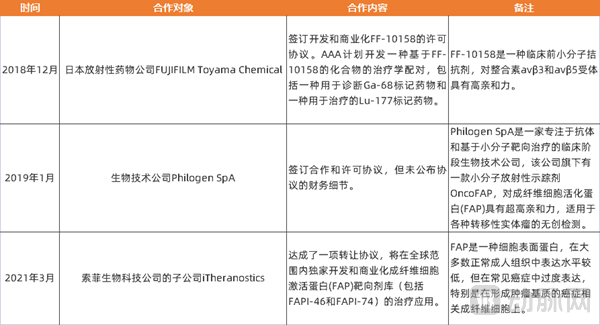 Novartis Cooperation Incident
By establishing partnerships with Japanese radiopharmaceutical company FUJIFILM Toyama Chemical, Sofie subsidiary iTheranostics, and others, Novartis has obtained the development and commercialization rights for FF-1058, FAPI-46, and FAPI-74. This will help Novartis expand its radioligand therapy pipeline and enhance market competitiveness.
At the same time, Novartis actively invests in nuclear medicine companies.In March 2021, Novartis invested in the biotechnology company Aktis Oncology. The company is developing novel alpha-radiotherapies to enhance the efficacy of traditional solid tumor treatments while limiting toxicity.
Novartis' emphasis on the nuclear medicine market can also be seen through two high-value strategic partnerships it reached in 2021.
In April 2021, Novartis launched a global collaboration with Artios Pharma Limited, a DNA Damage Response (DDR) company., develop and validate the next generation of DDR targets to expand Novartis' Radioligand Therapy (RLT) pipeline. Over a three-year collaboration, Artios and Novartis will conduct target discovery and validation. Thereafter, Novartis will select three exclusive DDR targets and obtain global rights for these targets for use in its RLT. Under the terms of the agreement, Novartis will pay a $20 million upfront payment and provide short-term research funding to support the collaboration. Artios Pharma is eligible to receive up to $1.3 billion in discovery, development, regulatory, and sales-based milestones, as well as royalties.
In December 2021, Novartis entered into a strategic collaboration with Molecular Partners, a clinical-stage biotechnology company.The two parties plan to organically combine Molecular Partners' self-developed DARPin technology platform with Novartis' unique Radioligand Therapy (RLT), aiming to directly target tumor cells in any part of the body with radioligands, exploring novel targeted therapies for cancer. According to the collaboration terms, Novartis will pay an upfront fee of $20 million, with potential development, regulatory, and sales milestone payments of up to $560 million.
Novartis Increases Investment in the Radiopharmaceuticals Market Through Acquisitions, R&D, Investments, and Strategic Collaborations, Demonstrating Its Determination to Become a Leading Player in the Field.