

ExoRNA Bio Files IPO Prospectus: Pioneering exRNA-Based Therapeutics with Third-Generation In Vivo RNAi Delivery Platform Targeting Neurological Disorders

ExoRNA
miRNA Nucleic Acid Drug Developer
In the past two years, the outbreak of the COVID-19 pandemic has been a tremendous shock to the global medical community, but it has also brought about a great revolution.
In this epidemic, mRNA technology has emerged as a powerful tool for humanity to combat the coronavirus, providing a vast stage for nucleic acid drugs to showcase their potential. After a long period of dormancy, nucleic acid drugs have demonstrated astonishing developmental potential, gaining widespread recognition not only for their therapeutic efficacy but also attracting fervent attention from investors.
Currently, in addition to mRNA technology, nucleic acid drugs related to siRNA, microRNA, circRNA, and exRNA have successively entered the research and development phase. Among these, pharmaceutical technologies focusing on extracellular RNA (exRNA) are particularly eye-catching, sparking a revolution in the nucleic acid drug field with an entirely new model. ExoRNA Bio is a pioneer in this technological field.
ExoRNA Founder Zhang Chenzhong: Dare to Question, Constantly Explore
ExoRNA was founded in September 2021, dedicated to the development of a third-generation RNAi drug in vivo delivery platform and small nucleic acid drugs. Professor Zhang Chenzhong, the founder of the company, is the core and soul of the team. He currently serves as a professor of biochemistry at Nanjing University and the dean of the School of Life Sciences.

Zhang Chenyu, Founder of ExoRNA, Professor of Biochemistry at Nanjing University, and Dean of the School of Life Sciences
Professor Chenyu Zhang focuses on the fields of microRNA, mitochondrial function, and human and cellular energy metabolism, and has pioneered a new area of research and application for extracellular RNA. This research not only shocked the academic community at the time but also became the solid theoretical foundation for the establishment of ExoRNA.
Looking back at Professor Zhang Chenyu's academic career, there have been highlights everywhere. As a pioneer in miRNA research in China, Professor Zhang Chenyu has been deeply involved in the miRNA field for more than 20 years.Achieved a series of groundbreaking discoveries and technical results represented by "circular miRNA biomarkers," "secreted miRNA communication systems," and "exogenous plant miRNA cross-boundary regulation," forming an academic system called the "Nanjing School" by the internationally renowned academic journal Nature, which focuses on "extracellular RNA-mediated inter-species co-evolution and adaptation." At the same time, he has also been hailed as the "first person in extracellular RNA research."
Based on the original discovery of extracellular RNA, Professor Zhang Chenyu's team has established and invented a series of miRNA biotechnology and drug technology platforms, such as:
The team was the first to discover that miRNAs can exist completely and stably in extracellular environments such as serum and can serve as novel biomarkers for diseases. Based on this, the team pioneered a core technology for trace miRNA detection and independently developed the world's first circulating miRNA diagnostic kit, increasing the accuracy of early pancreatic cancer diagnosis from less than 40% to 87.6%.
It was discovered that miRNA can be secreted as a novel signaling molecule outside the cell to regulate homeostasis in the human body. Based on this, the third-generation RNAi drug in vivo delivery platform was invented, and several drugs have now entered preclinical research.
It can be said that Professor Zhang Chenyu and his team are leading the development of the nucleic acid field, and the theoretical cornerstone of this series of inventions and applications is the discovery of extracellular RNA.
Discovery of Extracellular RNA ——颠覆经典教科书理论
What is extracellular RNA? What role does it play?
In the classical biochemistry theory of nearly a century, RNA could only stably exist within cells and perform biological functions, while outside the cells, RNA could not remain stable and existed merely as non-functional degradation fragments. However, this theory was overturned with Professor Zhang Chenyu’s discovery of extracellular RNA.
In 2008, Professor Zhang Chenyu in the journalCell ResearchPublished for the first time research results on extracellular RNA. This study shows,miRNA can stably exist in serum and play a role in signal transmission between cells and tissues.。Meanwhile,This extracellular RNA can also become a novel biomarker for diseases., non-invasive diagnosis of tumors and other diseases can be performed by detecting the quantity of specific miRNAs in the serum.
This research has caused a stir in the academic community, challenging established classical theories and sparking controversy. However, Professor Zhang Chenyu has once again used different sequencing methods to more deeply and accurately demonstrate that miRNAs can stably exist outside of cells and can be found in various bodily fluids such as breast milk, urine, and amniotic fluid. These miRNAs are now referred to as circulating miRNAs in the academic community. Of course, Professor Zhang Chenyu also mentioned that there are other types of RNA, besides miRNA, that can stably exist outside of cells.
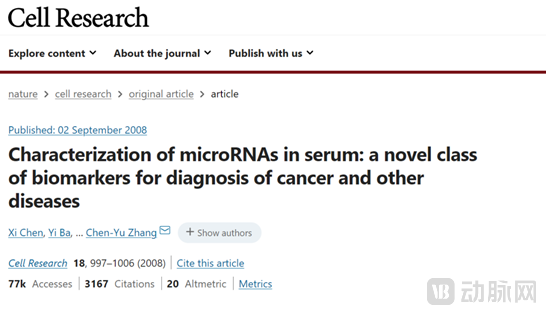
Professor Chenyu Zhang's research成果 on extracellular RNA published in Cell Research
Based on the discovery of circulating miRNAs, Professor Chenyu Zhang further advanced research on "why miRNAs can exist in serum and plasma."
In Professor Zhang Chenyu's view, there are two possibilities for the presence of extracellular miRNA: one is due to cell rupture, and the other is that cells actively secrete large amounts of miRNA. Professor Zhang Chenyu explained: "If extracellular miRNA is released due to cell rupture, then changes in intracellular and extracellular miRNA should be consistent, and there would not be differences in expression levels; if it is active secretion, there will be a phenomenon where cells release specific miRNAs. This release is purposeful and selective, leading to differences between the quantities of extracellular and intracellular miRNA, and this active secretion must involve a selective packaging mechanism."
In 2010, Professor Zhang Chenyu and his teamMolecular CellThe latest research findings were published on VCBeat, presenting what would later become well-known as secreted miRNAs. These results indicate,When cells are stimulated, they can selectively encapsulate miRNA into cellular microvesicles. This selective encapsulation forms the basis for the active and specific secretion of miRNA by cells."We found that microvesicles not only carry miRNA but also the corresponding protein machinery. To use an analogy, microvesicles act as both a navigation system and a delivery system, carrying not only miRNA as the 'bullet' but also functional protein complexes as the 'gun,' ensuring the release of miRNA within the target cells to exert its effects at extremely low concentrations."
This research has also enabled Professor Chenyu Zhang to prove the communication mechanism of secreted miRNAs.miRNAs secreted from cells can be transported into target cells, where they regulate the biological functions of the target cells by inhibiting the translation of target genes corresponding to the miRNAs.This secreted miRNA has a unique characteristic: it acts rapidly and targets multiple sites, which can directly affect functional genes. This feature provides new inspiration for disease treatment.
The long-term persistence and dedication have gradually led to the recognition of Professor Zhang Chenyu's extracellular RNA theory by the scientific community. Nowadays, more scholars have joined the research行列,正如NatureThe editor once said, "The discovery and research of extracellular RNA have led a quiet revolution in biology." Professor Zhang Chenyu's discovery is also another milestone in the history of nucleic acid research, following the discoveries that "nucleic acids store genetic information" and "RNA has protein-like functions."
At the same time, based on the characteristics and communication mechanisms of secreted miRNAs, Professor Zhang Chenyu's vision for the third-generation RNAi drug in vivo delivery platform has gradually moved from conception to reality.
Focus on Nobel Prize-level Technology, Build the Third Generation RNAi Drug In Vivo Delivery Platform
RNAi (RNA interference) refers to a highly conserved phenomenon in evolution, triggered by double-stranded RNA, which leads to the efficient and specific degradation of homologous mRNA. This process is primarily mediated by siRNA (small interfering RNA). It has been confirmed that RNAi technology can specifically knock out or silence the expression of particular genes, showing extensive application value in the treatment of infectious diseases and malignant tumors. This discovery was awarded the Nobel Prize in Physiology or Medicine in 2006.
Currently, four RNAi drugs have been approved for marketing globally, three of which come from the RNAi pharmaceutical company Alnylam, and the most recently approved one is from Novartis. Data shows that the global market size of RNAi therapies has increased from $12 million in 2018 to $362 million in 2020. It is estimated that by 2030, the market for this therapy will reach $21 billion.
Although RNAi has tremendous therapeutic potential and a bright market outlook, its traction in achieving clinical success is limited, with one of the biggest challenges being:Due to technical limitations, it is impossible to stably deliver siRNA molecules to the target tissues and cells to exert their effects.
According to Professor Zhang Chenyu, RNAi therapy can be divided into three generations. The four RNAi drugs currently on the market all belong to the first generation, which mainly work by artificially synthesizing RNAi, stabilizing it, and then injecting it into the body to counteract degradation by RNAi enzymes. Due to limitations in the targeting of delivery carriers, these four drugs are all used for treating liver diseases, and current research has not been able to further optimize the stability of RNA after it enters the body.
The second generation involves in vitro assembly, achieving delivery by loading RNAi into nanoparticles, proton particles, and exosomes. However, each of the three carriers has its drawbacks: exosomes face issues of insufficient yield; while in vitro assembly using nanoparticles and proton particles, even after stabilization and reaching the target tissue, requires binding with specific proteins to take effect. Factors such as high dosage requirements, safety concerns, and the potential for off-target effects have led to no second-generation drugs being approved for the market to date.
Based on the previous groundbreaking discovery of secreted miRNAs, Professor Zhang Chenyu first thought of applying this theory to clinical trials of RNAi therapy. He choseBy utilizing human body's own organ tissue cell microvesicles as bioreactors to produce medicinal RNAi in vivo, and self-assembling them into cell microvesicles as an RNAi delivery system. These natural vesicles secreted by endogenous cells can not only protect small RNAs during transcellular and biological barrier transport but also exhibit excellent biocompatibility.Thus, the bottleneck problem of "no effective in vivo delivery system for nucleic acid drugs" has been greatly突破, and the third-generation RNAi drug in vivo delivery platform was born.
Currently, the small RNA nucleic acid drug developed by Professor Zhang Chenyu based on the third-generation RNAi drug in vivo delivery platform has undergone clinical validation. According to reports, the advantages of the third-generation RNAi therapy technology are: it not only solves the problem of insufficient RNAi quantity in vitro but also avoids the issues of the carrier being difficult to deliver outside the liver in vivo, instability, susceptibility to degradation, and high dosing requirements. Even at extremely low RNAi concentrations, it can still function properly.
In addition, Professor Zhang Chenyu said that the third-generation RNAi treatment technology would have a good therapeutic effect on some neuro-specific diseases, including Huntington's disease and hereditary Parkinson's disease. According to Professor Zhang Chenyu, an important research direction of ExoRNA Bio is neuro-specific diseases. With the support of the third-generation RNAi drug in vivo delivery platform, several drugs are currently undergoing preclinical research.
In the future, we will strive to build a "launch vehicle + navigation satellite" combination platform.
Looking back on more than two decades of various breakthroughs in scientific research, when talking about the establishment of ExoRNA Bio, Professor Zhang Chenyu couldn't help but remark: "When I first started doing related research, I never thought it would go this far." From working as a doctor to engaging in academic research and the transformation of scientific and technological achievements, Professor Zhang Chenyu's desire to address clinical needs and benefit patients has never changed.
"Actually, whether it is the discovery and research of extracellular RNA or the current development of the third-generation RNAi drug in vivo delivery platform technology, I can say that these are one of the most original discoveries by Chinese researchers in the biopharmaceutical field. At the same time, it is also a cutting-edge technology that can lead the development of nucleic acid drugs. Initially, because this research was discovered by Chinese researchers, it was relatively difficult for the academic community to accept as a whole. With the establishment of ExoRNA Bio, we also hope to further increase the industry’s acceptance of this technology, thereby providing more innovative options for patients suffering from currently untreatable diseases."
For the future development of ExoRNA, Professor Zhang Chenzhu hopes to create a "launch vehicle + navigation satellite" combination platform, with the "launch vehicle" being cell microvesicles produced in vivo, and the "navigation satellite" being signal peptides that can be self-loaded on the exosome membrane.
According to Professor Zhang Chenyu, in the next phase, ExoRNA Bio will mainly focus on neurological diseases and anti-superbug fields. By utilizing the world's first independently developed third-generation RNAi therapeutic technology, the company aims to create a novel "carrier rocket + navigation satellite" combination platform. Based on this, and building on preliminary trial validations, ExoRNA Bio will develop a series of RNAi new drug pipelines to bring innovative treatment solutions to unmet clinical needs.