

35 Global Pharma Companies, Including Five from China and One from Ukraine, Authorized to Manufacture Pfizer's Paxlovid Component Nirmatrelvir
Pfizer
Pharmaceutical R&D Developer
Huahai Pharmaceutical
Medical and Health Product Provider
Apeloa
Large comprehensive pharmaceutical manufacturer
Fosun Pharmaceutical
Healthcare Industry Group
Jiuzhou Pharma
Innovative Drug CDMO and Generic Drug Manufacturer
Medicines Patent Pool
The Medicines Patent Pool (MPP) is a UN-backed public health organization dedicated to increasing access to life-saving medicines and fostering their development in low- and middle-income countries. It collaborates with international organizations, civil society, patient groups, industry, and other stakeholders to prioritize, forecast, and license needed medicines, while pooling intellectual property to encourage generic production and the development of new formulations. To date, the MPP has signed agreements with 10 patent holders covering 13 HIV medicines, one HIV technology platform, three direct-acting antivirals for hepatitis C, and one tuberculosis treatment. The organization was founded and continues to be funded by Unitaid. The mission of the Medicines Patent Pool is to accelerate the provision of affordable, high-quality treatment for patients with HIV, hepatitis C, and tuberculosis, as well as HIV-related comorbidities. Since 2018, the MPP has expanded its mandate to include other patented essential medicines on the World Health Organization (WHO) Model List of Essential Medicines (EML), as well as medicines highly likely to be added to the EML in the future. In 2020, we temporarily expanded the MPP’s mandate to include treatments for COVID-19.
Latest News: The Medicines Patent Pool (MPP) in Geneva has announced agreements with 35 pharmaceutical companies allowing them to produce nirmatrelvir, one of the key components of Pfizer’s new oral medication Paxlovid, either as an active pharmaceutical ingredient (API) or as a finished product. Among these companies are five from China, namely Shanghai Desano Pharmaceutical Limited By Share Ltd, Huahai Pharmaceutical, Apeloa Pharmaceutical Co.,Ltd., Fosun Pharmaceutical, and Jiuzhou Pharma. Apeloa and Jiuzhou Pharma will only manufacture the API, while the other three can produce both the API and the finished product.
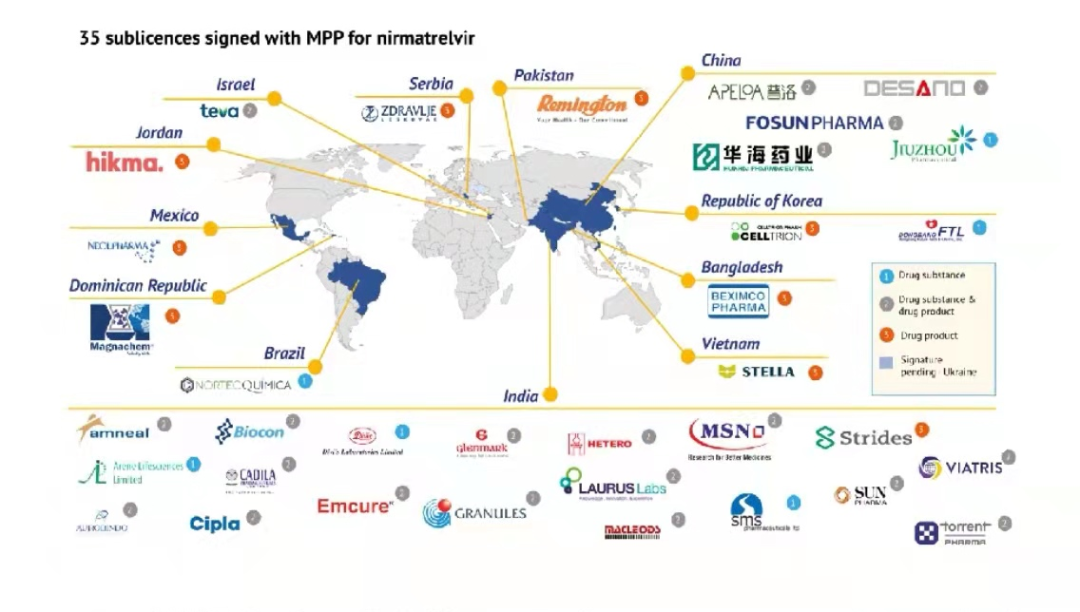
Non-exclusive sublicense agreements allow generic drug companies to produce the active pharmaceutical ingredient nirmatrelvir and/or formulations for the oral COVID-19 treatment. Companies that have obtained sublicenses have successfully demonstrated their ability to meet MPP's requirements for production capacity, regulatory compliance, and adherence to international quality assurance standards for pharmaceuticals.
Of these 35 companies, six will focus on producing active pharmaceutical ingredients (APIs), nine will be responsible for manufacturing formulations, and the remaining 20 enterprises will produce both APIs and formulations. They are spread across 12 countries: Bangladesh, Brazil, China, Jordan, India, Israel, Mexico, Pakistan, South Korea, Vietnam, Serbia, and the Dominican Republic. One Ukrainian company was unable to sign the agreement due to war conflicts, but the license remains valid.
In November 2021, Pfizer announced that it had reached an agreement with the MPP organization supported by the United Nations, allowing other generic drug manufacturers to produce its COVID-19 oral medication Paxlovid. This agreement will enable the MPP to facilitate additional production and distribution of the investigational antiviral drug by granting sub-licenses to qualified generic drug manufacturers, pending regulatory authorization or approval, thereby increasing the drug's accessibility to global populations.
According to the terms of the agreement, qualified generic drug companies with authorized licensing globally will be able to provide Paxlovid combination therapy to 95 countries and regions, covering approximately 53% of the global population. This includes all low-income and lower-middle-income countries in sub-Saharan Africa, some upper-middle-income countries, as well as countries that have transitioned from lower-middle-income to upper-middle-income status in the past five years.
While COVID-19 is still categorized by the World Health Organization as a Public Health Emergency of International Concern, Pfizer will not charge royalty fees on sales in low-income countries and will further waive royalty fees on sales in all countries/regions covered by the agreement. For the public sector in lower-middle-income and upper-middle-income countries/regions, Pfizer will charge a 5% royalty fee on sales, while for the private sector, it will charge a 10% royalty fee on sales.