

Roche's PD-L1 Inhibitor Tecentriq Becomes China's First Adjuvant Immunotherapy Approved for Early-Stage NSCLC

Roche
Oncology Drug Research, Development, and Manufacturing
On March 18, Roche announced that the National Medical Products Administration (NMPA) had officially approved its PD-L1 monoclonal antibody atezolizumab (trade name: Tecentriq®) as a monotherapy for adjuvant treatment in patients with stage II-IIIA non-small cell lung cancer whose tumor cells (TC) show PD-L1 staining in ≥1% of cells, following surgical resection and platinum-based chemotherapy.
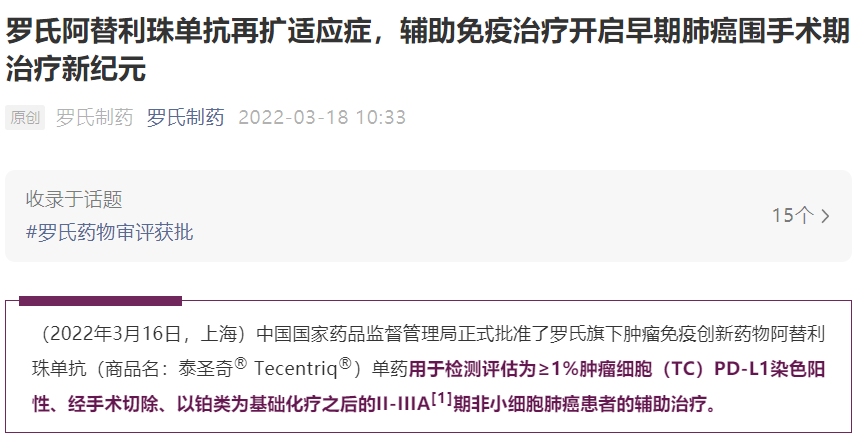
This is the first and only approved indication for adjuvant immunotherapy in non-small cell lung cancer post-surgery in China. This indication was approved by the FDA on October 15, 2021, and has been included in the NCCN Guidelines for Lung Cancer (Version 7) 2021.
Early-stage NSCLC patients can undergo surgical resection of the lesion, but more than 50% of patients who receive surgery alone will experience recurrence or metastasis within five years, ultimately leading to treatment failure. Adjuvant chemotherapy is currently the most widely used adjuvant treatment method, but the side effects of chemotherapy drugs are significant, and the survival benefits they provide to patients are relatively limited, improving the five-year survival rate by only an average of 4-5%. Compared with traditional chemotherapy, adjuvant immunotherapy has the potential to further improve patient outcomes and reduce the risk of disease recurrence, marking a new milestone in perioperative treatment.
The approval of this new indication is mainly based on the results of the randomized, open-label global multicenter Phase III IMpower010 study, which explored the efficacy and safety of atezolizumab compared to the current best supportive care (BSC) as adjuvant therapy for perioperative NSCLC patients who have undergone surgery and platinum-based chemotherapy.
IMpower010 Study Results Show that in Patients with Stage II-IIIA NSCLC Expressing PD-L1≥1%, Using Atezolizumab as Adjuvant Therapy After Surgery and Chemotherapy Prolongs Disease-Free Survival (DFS) Compared to Current Best Practices, Reducing the Risk of Disease Recurrence or Death by 34% (HR=0.66; 95% CI: 0.50-0.88; p=0.004), with 60% of Patients Remaining Disease-Free or Alive at 3 Years. These Findings Provide New Treatment Strategies for Clinical Practice and Will Benefit More Patients with Early-Stage NSCLC in the Future.
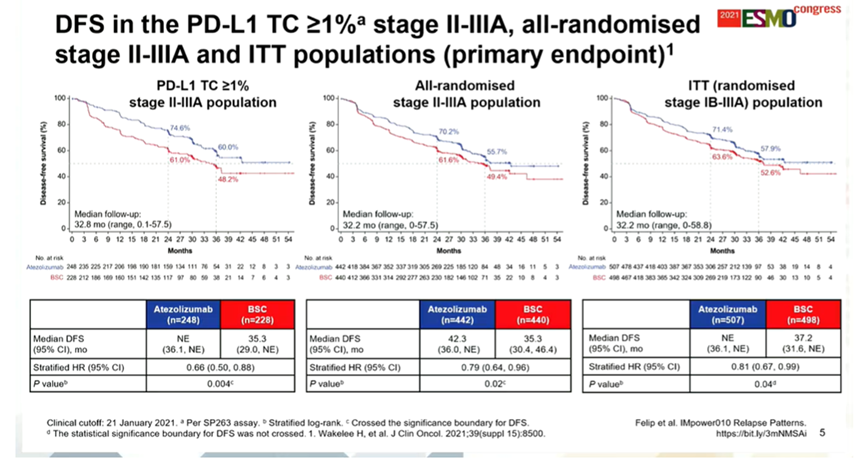
Key Results of the IMpower010 Study (Source: ESMO2021)
Currently, immunotherapy has gradually become a later-line and even first-line treatment for various types of cancer. Earlier and longer clinical use has become a new battleground for companies developing PD-1/PD-L1 drugs. Roche's Atezolizumab was approved for adjuvant treatment of early-stage NSCLC based on the IMpower010 study, making it the first immunotherapy approved for adjuvant treatment of NSCLC.
The CheckMate-816 study of Opdivo in combination with chemotherapy is the first Phase III study of an immune checkpoint inhibitor-based combination therapy to achieve EFS and pathological complete response (pCR) in the neoadjuvant treatment of NSCLC.
Merck's Keytruda, as an adjuvant therapy for patients with stage IB-IIIA non-small cell lung cancer post-surgery, also met one of the dual primary endpoints, disease-free survival (DFS), in the phase III KEYNOTE-091 study.