

Eli Lilly's Ramucirumab Approved in China for Second-Line Treatment of Advanced Gastric or Gastroesophageal Junction Adenocarcinoma

Eli Lilly
Global Pharmaceutical R&D and Production Company
On March 18, the official website of the National Medical Products Administration (NMPA) showed that the marketing application for Eli Lilly's VEGFR2-targeted monoclonal antibody Ramucirumab has been approved by the NMPA. The expected indication is second-line treatment for advanced gastric or gastroesophageal junction adenocarcinoma. Ramucirumab is the world’s first and, to date, the only approved second-line therapy for gastric cancer/gastroesophageal junction cancer.


Ramucirumab is a human vascular endothelial growth factor receptor 2 (VEGFR2) antagonist that specifically binds to VEGFR2, blocking the receptor's interaction with VEGF-A, C, and D, thereby inhibiting angiogenesis and preventing tumor growth or spread.
On January 12, 2021, Eli Lilly and Company announced that the latest Asian Phase III study RAINBOW-Asia of ramucirumab, with or without paclitaxel, for the treatment of advanced gastric or gastroesophageal junction adenocarcinoma patients who were resistant or had disease progression after first-line treatment with platinum-based combined with fluorouracil drugs, had reached the pre-specified endpoint. The study results showed that the progression-free survival (PFS) of patients in the ramucirumab plus paclitaxel group was significantly prolonged compared to placebo (4.14 months vs. 3.15 months), demonstrating a median overall survival (OS) benefit consistent with the global pivotal registration clinical trial RAINBOW (HR=0.963). Patients generally tolerated the treatment well, with no new safety signals observed.
In 2014, Ramucirumab was approved in the United States for the treatment of advanced or metastatic gastric or gastroesophageal junction adenocarcinoma. Currently, it has received six FDA approvals for the treatment of specific types of tumors, including lung cancer, liver cancer, gastric cancer, and colorectal cancer.
According to the NextPharma database by PharmaCube, the cancer types currently in the development phase for Ramucirumab include melanoma, ovarian cancer, castration-resistant prostate cancer, etc.
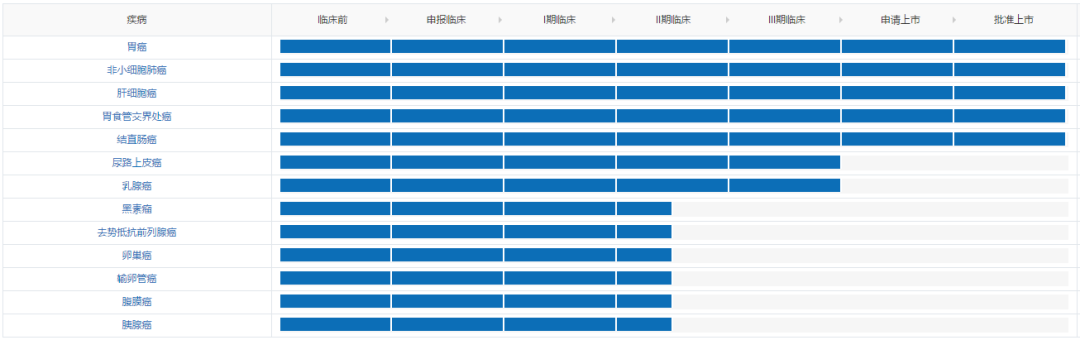
According to the PharmaGo database by Medicine Square, the domestic companies Zhengda Tianqing, Fosun Henlius, and Sichuan Kelun are all in Phase I clinical trials for the development of biosimilar ramucirumab.
Gastric cancer is the third most common malignant tumor in China, with approximately 480,000 new cases in 2020, accounting for about 44% of the global total. In the same year, gastric cancer caused 370,000 deaths in China, nearly half of the global mortality from this disease.