

Nature Milestone: HER2/CD3×CD28 Trispecific Antibody Emerges as a Novel Therapeutic for Breast Cancer

Sanofi
Pharmaceutical R&D Developer
Bispecific, Trispecific, and Multispecific Antibodies Emerge as Rising Stars in the Antibody Field
Source: Nature
On February 23, a paper published in the journal Nature reported a milestone breakthrough in tri-specific antibody development by scientists from Sanofi R&D. The study confirmed that a tri-specific antibody targeting HER2 effectively induced breast cancer regression in humanized mouse models.
Source: Nature
Specifically, in this study, the scientists designed a HER2/CD3×CD28 trispecific antibody (which stimulates T-cell activation and proliferation through the CD3 and CD28 dual signaling pathways) and investigated the potential of this trispecific antibody against breast cancer.
Knowledge Card: CD3 is part of the T-cell receptor (TCR), which normally recognizes abnormal cells by binding to antigen molecules. The HER2/CD3×CD28 trispecific antibody can bind to CD3 to drive T-cell activation, leading to cancer cell killing as well as the production and release of cytotoxic cytokines. CD28 is also expressed on T cells, and the HER2/CD3×CD28 trispecific antibody binding to this protein can drive the expression of a protein named Bcl-xL (which blocks T-cell death), thereby enhancing the persistence of T-cell cancer cell killing.
The study first confirmed the role of the HER2/CD3×CD28 trispecific antibody in stimulating CD8 T cell cytotoxicity. After using this trispecific antibody, the expression of granzyme in CD8 T cells increased 6.8-fold. Subsequently, the scientists investigated the anti-tumor effects of this trispecific antibody in humanized mice, evaluating the ability of the HER2/CD3×CD28 trispecific antibody to inhibit tumor growth in immunodeficient NSG mice reconstituted with primary human CD3+ T cells.
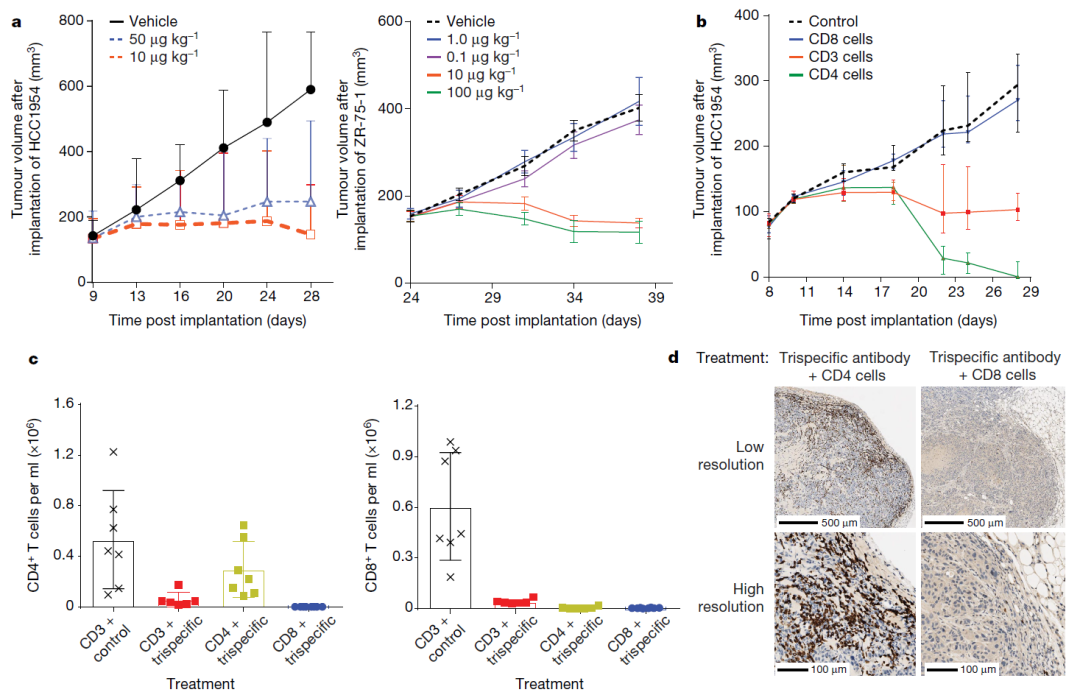
Impact of HER2 Trispecific Antibody on Tumor Growth in Humanized Mouse Models (Source: Nature)
The study results showed that at a dose as low as 10 μg kg−1, the HER2/CD3×CD28 trispecific antibody completely inhibited HER2-high HCC1954 breast cancer cells (453,780 molecules per cell). The study also tested the efficacy of the HER2/CD3×CD28 trispecific antibody in HER2-low ZR-75-1 cell lines (52,045 molecules per cell), and the results indicated that at a dose as low as 10 μg kg−1, the HER2/CD3×CD28 trispecific antibody was still able to induce tumor regression. These results suggest that the HER2/CD3×CD28 trispecific antibody can mediate effective tumor regression in both HER2 high-expression and low-expression tumors.
Further, the scientists wanted to investigate the role of T-cell subsets in HER2/CD3×CD28 trispecific antibody-mediated tumor regression. The research team adoptively transferred purified CD3, CD4, or CD8 cells into humanized mice transplanted with HCC1954 breast cancer cells. The results showed that the adoptive transfer of purified human CD3 or CD4 cells could stimulate near-complete tumor regression in vivo. In contrast, the adoptive transfer of human CD8 cells alone exhibited minimal anti-tumor effects. The researchers believed this might be due to poor survival of CD8 cells in the absence of helper T cells. These results highlight the importance of CD4 cells in mediating tumor regression.
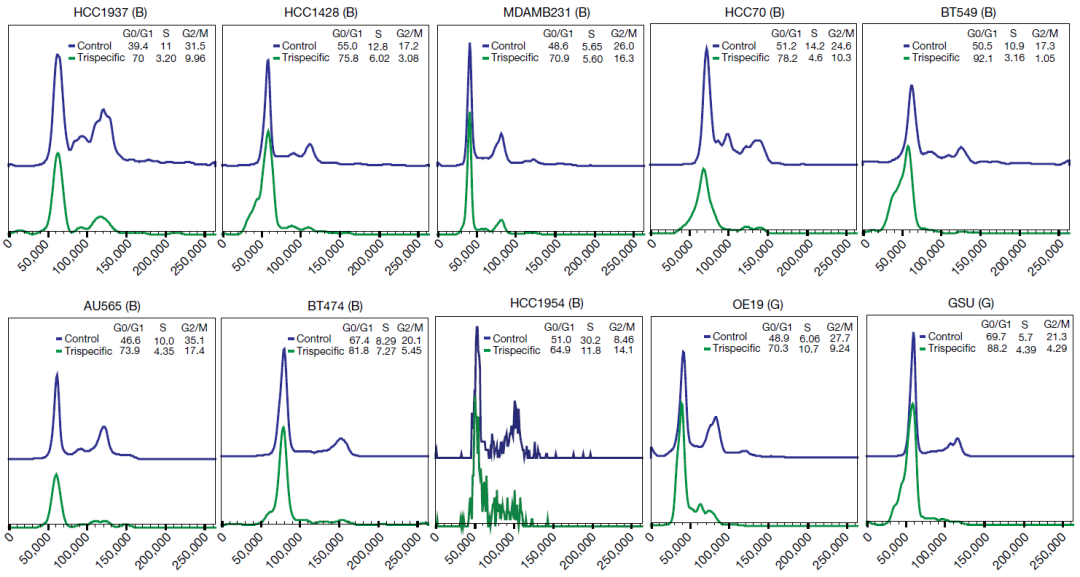
HER2 trispecific antibody-stimulated CD4+ T cells inhibit cell cycle progression and/or proliferation of HER2+ breast and gastric cancer cells (Source: Nature)
To further explore the mechanism by which CD4 cells exert anti-tumor effects, scientists investigated whether human CD4 cells would directly inhibit HER2+ human breast cancer and gastric cancer cell lines. They incubated CD4 cells with tumor targets and HER2/CD3×CD28 trispecific antibody or negative control IgG in vitro for 24 hours, then measured the cell cycle distribution. The results showed that compared to the control group, all 10 cell lines in the trispecific antibody-treated group significantly accumulated in the G0/G1 phase, indicating G1/S phase growth arrest. In contrast, when tumor cell lines were incubated with HER2/CD3×CD28 trispecific antibody and CD8 cells, there was minimal change in cell cycle distribution, suggesting that it is CD4 cells, rather than CD8 cells, that promote tumor growth arrest. These data indicate that the HER2/CD3×CD28 trispecific antibody stimulates CD4 and CD8 cells to lyse human breast cancer cells through a unique complementary effector mechanism.
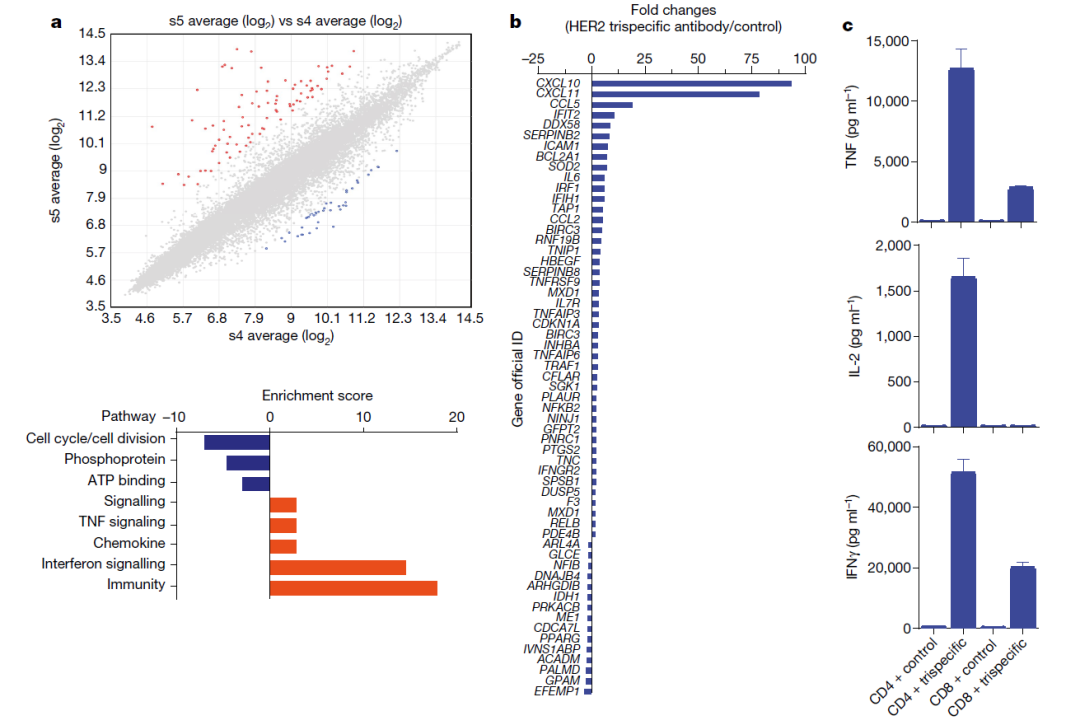
HER2-Trispecific Antibody-Stimulated CD4+ T Cells Inhibit Cell Cycle Progression and/or Proliferation and Stimulate Pro-Inflammatory Pathways in Breast Cancer Cell Line HCC1954 (Source: Nature)
Gene expression analysis showed that, as expected, when exposed to trispecific antibodies and CD4 cells, gene clusters related to the cell cycle/cell division pathway in breast cancer cells (HCC1954 cells) were significantly downregulated. Notably, pro-inflammatory responses such as TNF and IFNγ pathways were markedly upregulated. Consistent with this effect, numerous genes downstream of the TNF signaling pathway were significantly upregulated, including CXCL10, CXCL11, and CCL5. CXCL10 is a major chemokine for monocytes/macrophages, T cells, natural killer cells, and dendritic cells, while CXCL11 and CCL5 are chemokines for T cells. High levels of TNF and IFNγ were also detected in the supernatant when CD4 cells were incubated with tumor target cells and trispecific antibodies. In contrast, exposure to CD8 cells, despite observing the upregulation of innate immunity–IFNγ–type I interferon pathways, did not result in reduced expression of the tumor cell cycle/cell division pathways.
Next, the scientists conducted cytokine neutralization experiments using neutralizing antibodies. The results showed that anti-TNF (but not anti-IFNγ or IFNα) neutralizing antibodies significantly blocked the killing activity of trispecific antibodies on the HER2-high MDA-MB-453 breast cancer cell line in the presence of CD4 cells. In contrast, the anti-TNF neutralizing antibody had no effect on the killing activity of trispecific antibodies in the presence of CD8 cells. The importance of TNF for the anti-tumor activity of CD4 cells was also confirmed in both the HER2-high MD-MB-453 cell line and the HER2-low ZR-75-1 cell line. These data indicate that CD4 and CD8 T cells exert their anti-tumor activities through different mechanisms. Furthermore, these findings confirm that CD4 cells can directly influence tumor cell cycle progression, representing a previously unrecognized mechanism of immune control in malignancies.
To investigate the potential toxicity of the HER2/CD3×CD28 trispecific antibody, researchers conducted an exploratory non-human primate (NHP) toxicology study. The results showed that in the NHP preclinical toxicity study, the HER2/CD3×CD28 trispecific antibody was well-tolerated, with the first dose triggering a transient release of inflammatory cytokines, and the cytokine release diminishing after multiple doses.
In summary, the study confirmed that the HER2/CD3×CD28 trispecific antibody can stimulate T-cell activation and provide survival signals that induce T-cell proliferation. These activated T cells not only inhibit HER2-overexpressing breast cancer cells but also effectively lyse HER2-negative breast cancer cell lines (expressing low to moderate levels of HER2), indicating that the HER2/CD3×CD28 trispecific antibody may represent a potential hope for the majority of breast cancer patients who do not respond to HER2-based therapies.
Moreover, studies have confirmed that tumor regression induced by HER2/CD3×CD28 trispecific antibodies involves previously unrecognized mechanisms, including CD4 cell-mediated tumor cell cycle arrest and pro-inflammatory responses, which warrant further investigation.
References:
[1] Edward Seung et al. A trispecificantibody targeting HER2 and T cells inhibits breast cancer growth via CD4cells. Nature(2022).
[2] Nature: New Breakthrough in Cancer Immunotherapy - Trispecific Antibodies (Source: PharmaCube Pro)