

Baricitinib Demonstrates Up to 90% Scalp Hair Regrowth in Severe Alopecia Areata Patients, Lilly Reports

Eli Lilly
Global Pharmaceutical R&D and Production Company

Incyte
Small Molecule Drug Developer
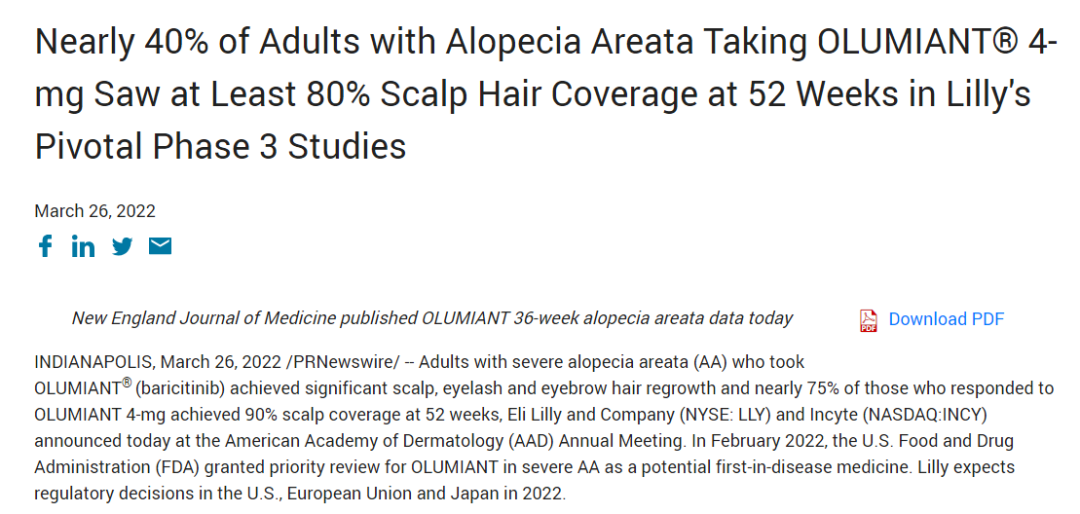
Recently, Eli Lilly announced that adult patients with severe alopecia areata (AA) achieved significant scalp, eyelash, and eyebrow regrowth after being treated with baricitinib (brand name: Olumiant). Among patients who responded to the 4mg baricitinib treatment, approximately 75% reached 90% scalp hair coverage by week 52.
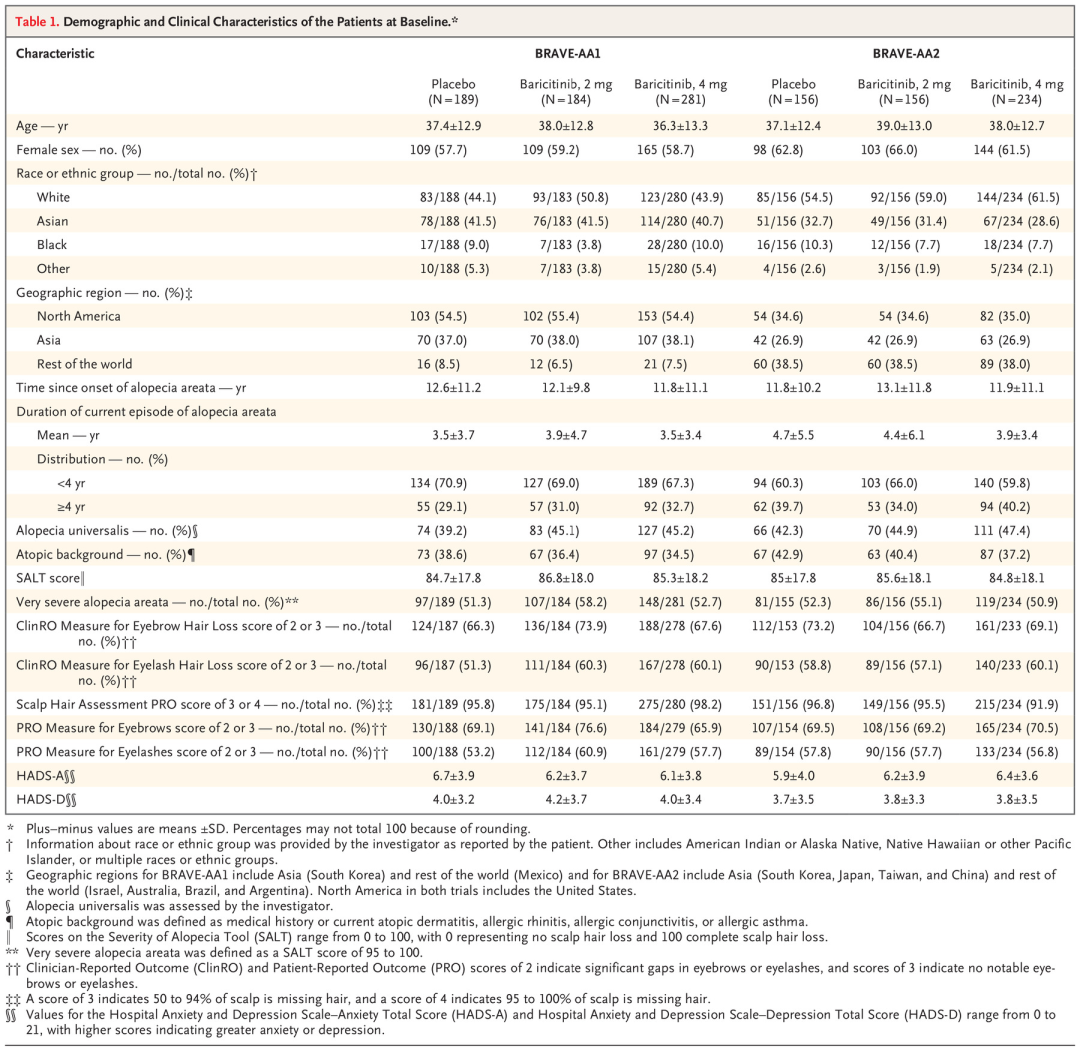
Eli Lilly conducted two key Phase III clinical trials of baricitinib for the treatment of AA, BRAVE-AA1 and BRAVE-AA2, with 654 and 564 patients respectively completing 52 weeks of treatment. Both studies included adult patients with severe AA, defined as having a SALT score ≥50 (scalp hair loss ≥50%). At baseline, the average SALT score of participants was 85.5 (85.5% scalp hair loss). Additionally, 69.4% and 57.9% of participants experienced significant eyebrow and eyelash hair loss, respectively. The average age of participants was 37.6 years, with hair loss beginning at approximately 25 years of age.
In patients taking 4mg of baricitinib, 39% (n=201/515) achieved significant scalp hair regrowth, reaching 80% or more scalp hair coverage. Of these patients, approximately 74.1% (n=149/201) achieved 90% hair coverage by week 52. Additionally, over 40% of patients (eyebrows: 44.1%, n=154/349; eyelashes: 45.3%, n=139/307) experienced small hair growth in eyebrow and eyelash gaps.
In patients taking 2mg of baricitinib, 22.6% (n=77/340) achieved significant scalp hair regrowth, with 67.5% of these patients (n=52/77) achieving 90% or greater hair coverage at week 52. Eyebrow regrowth was observed in 22.9% (n=55/240) of patients, and eyelash regrowth was observed in 25.5% (n=51/200) of patients.
Baricitinib is an orally administered JAK inhibitor taken once daily, initially developed by Incyte. In December 2009, Eli Lilly and Company reached an agreement with Incyte to co-develop and commercialize the product in a deal worth up to $755 million, including a $90 million upfront payment and up to $665 million in milestone payments.
Currently, Baricitinib has been launched in over 75 countries including the United States and the European Union for the treatment of moderate to severe rheumatoid arthritis (RA) in adults; it has been approved in more than 40 countries, including the European Union and Japan, for the treatment of moderate to severe atopic dermatitis (AD) in adults; and it has been approved in multiple countries, including Japan and Switzerland, for the treatment of hospitalized COVID-19 patients. In March 2020, Baricitinib received FDA Breakthrough Therapy designation for the treatment of severe alopecia areata in adults; in February 2022, it received FDA Priority Review.
In June 2019, baricitinib tablets were approved for marketing in China, indicated for adult patients with moderately to severely active rheumatoid arthritis who have had an inadequate response or intolerance to one or more disease-modifying antirheumatic drugs (DMARDs). The phase III study of baricitinib for the treatment of severe and very severe adult alopecia areata (AA) is also ongoing in China, and patient recruitment has recently been completed.
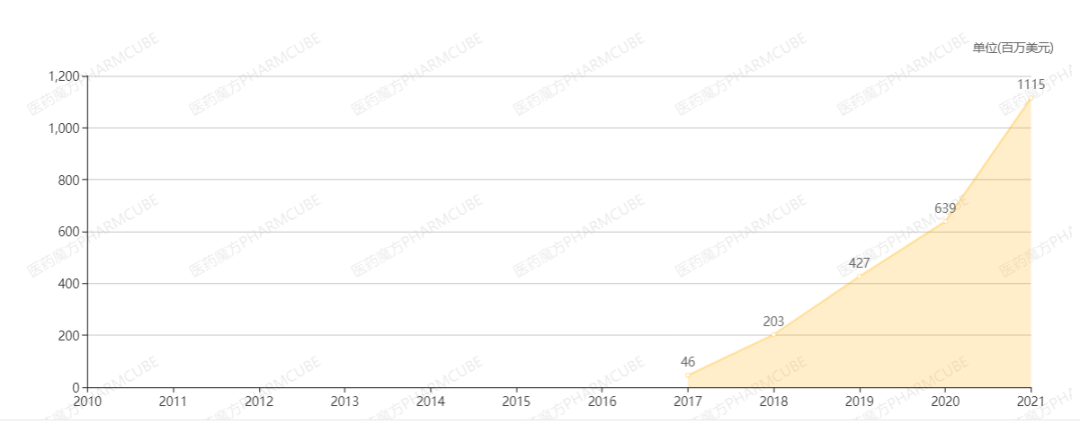
Since its launch, the sales of Baricitinib have continued to grow. According to the PharmaCube NextPharma database, this drug generated $1.115 billion in revenue for Eli Lilly in 2021, a year-on-year increase of 74.5%, demonstrating excellent market performance.
Alopecia Areata (AA) is a common inflammatory non-scarring hair loss condition, clinically characterized by sudden onset of well-defined round patches of hair loss on the scalp. Most patients with mild conditions can self-heal, while about half of the patients experience recurrent episodes that may persist for years or even decades; a few patients have severe conditions where hair loss can affect the entire scalp or even all body hair. The exact cause of AA is not fully understood, but it is currently believed to be an autoimmune disease specific to hair follicles resulting from the interaction of genetic and environmental factors. It can occur at any age, is more common in young and middle-aged individuals, and shows no significant gender difference.