

Boston Scientific Doubles Down on Electrophysiology with Over $2 Billion in Strategic Acquisitions

Boston Scientific
Medical Device Manufacturer
On February 15, 2022, which was the Lantern Festival in China, Boston Scientific announced that it had completed the acquisition of Baylis Medical Company Inc.
As early as October 2021, Boston Scientific announced the signing of the definitive agreement for this acquisition, purchasing Baylis Medical for an upfront payment of $1.75 billion (approximately RMB 11.2 billion). With the completion of this acquisition, Boston Scientific has become the only company globally to combine a comprehensive access portfolio with existing left atrial treatment solutions.
Across the global electrophysiology field, Boston Scientific, as one of the earliest companies to develop electrophysiology products, has not particularly excelled. Previous analyses have suggested that Boston Scientific, ranked fourth in the electrophysiology market, needs to add some more competitive representative products.
In 2021, Boston Scientific conducted five acquisitions, with a total funding scale of $4.3 billion. Three of these were related to its electrophysiology business. Such active and frequent moves demonstrate Boston Scientific's determination to dominate the electrophysiology field.
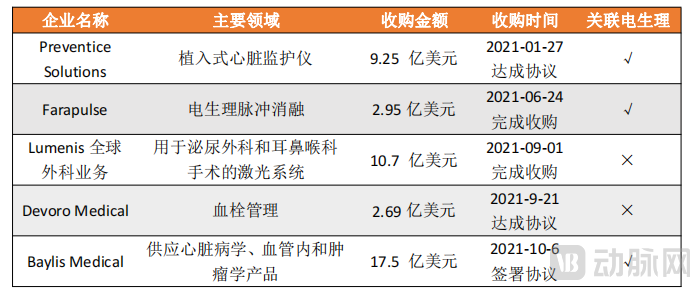
Source: Boston Scientific
No M&A, No Giant. Even Boston Scientific, which had once experienced setbacks in M&A, after a long period of adjustment, still chose to use M&A to consolidate its market position and expand its business territory.
Boston Scientific's Rhythm and Neuro business includes cardiac rhythm management, electrophysiology, and neuromodulation. Its electrophysiology business focuses on developing and manufacturing minimally invasive medical technologies for diagnosing and treating heart rate and rhythm disorders. Its acquisitions of Baylis Medical, Farapulse, and Preventice Solutions all aim to complement and strengthen its advantages in the electrophysiology field.
Baylis Medical: The Most Advanced Atrial Septal Puncture Technology
Baylis Medical is an innovative medical device development company focused on the field of cardiology. It has several star products in the fields of electrophysiology and structural heart, including the radiofrequency (RF) NRG and VersaCross transseptal puncture platforms, as well as a series of auxiliary products required for surgery, such as medical guidewires, sheaths, and dilators. Among these, the most well-known are the NRG and VersaCross platforms.
Specifically, in the past, doctors mainly relied on mechanical needles to perform atrial septal punctures and carry out treatments in the left atrium. However, such procedures not only pose safety concerns but also face challenges in determining the exact needle placement due to variations in patients' anatomical structures.
Baylis Medical's products do not rely solely on mechanical thrust but instead use radiofrequency energy to perform atrial septal punctures in a predictable and safer manner. Clinically proven, the VersaCross and NRG platforms enhance the safety and efficiency of atrial septal punctures in left atrial treatments such as atrial fibrillation ablation, left atrial appendage closure (LAAC), and mitral valve interventions.
Taking the VersaCross platform as an example, VersaCross includes an RF guidewire and a steerable sheath. Its puncture needle and guidewire are integrated into one, eliminating the need for replacement after puncture, which significantly improves surgical efficiency. Meanwhile, the precision RF puncture technology it adopts can adapt to any anatomical structure, easily and accurately passing through the septal position.
It is reported that the NRG platform received FDA 510(k) clearance in 2008, and to date, the technology has been used in more than 1 million surgical procedures. The VersaCross platform also received FDA 510(k) clearance in 2020, and the VersaCross catheter was nominated for the 2021 Prix Galien USA Award, being recognized as one of the 18 most innovative medical devices.
Boston Scientific has set its sights on Baylis Medical's NRG and VersaCross platforms and their complementary solutions. With the completion of this acquisition, Boston ScientificIs the only company that combines a comprehensive access portfolio with existing left atrial treatment solutions, such as left atrial appendage closure and atrial fibrillation ablation., providing medical staff with a full set of tools and equipment to safely and efficiently treat patients.
After the acquisition is completed, Boston Scientific will possess the most advanced atrial septal puncture technology, further expanding the coverage of its electrophysiology and structural heart disease product portfolio to create a strong complement. Additionally, given that Baylis Medical has achieved double-digit sales growth over the past five years, this will also bring significant revenue and operational profits to Boston Scientific.
Farapulse Medical: The First to Achieve PFA Technology Commercialization
Farapulse Medical's products are mainly used for the treatment of atrial fibrillation (AF) and other arrhythmias. Its core productFARAPULSE PFA is the world's first commercially available pulsed field ablation (PFA) product, receiving CE approval in early 2021.。
It is reported that the main ablation methods for treating atrial fibrillation are radiofrequency ablation, which works by generating high temperatures through regulated electric currents to destroy myocardial tissue; additionally, there is cryoablation, which damages myocardial tissue through freezing. However, both types of ablation can damage surrounding healthy tissue.
PFA differs from the ablation technologies of electrophysiological products that have been marketed globally. It utilizes the irreversible electroporation effect of pulsed electric fields. Its greatest advantage is the ability to selectively ablate target myocardial cells without significantly affecting the surrounding tissues, blood vessels, or nerves. Therefore, this technology can help doctors avoid impacting the surrounding tissues, achieve precise ablation, improve treatment outcomes, and reduce postoperative complications.
PFA meets the market demand for simplifying atrial fibrillation treatment and is considered the most promising next-generation atrial fibrillation ablation technology in the electrophysiology field. Currently, giants like Johnson & Johnson and Medtronic have entered the arena. For instance, at the beginning of this year, Medtronic announced it would acquire cardiac ablation company Affera for $925 million. Affera’s primary focus has been on pulsed field ablation technology.
This acquisition of FARAPULSE PFA by Boston Scientific further enhances its existing electrophysiology product portfolio, making itThe only company that provides doctors with a full range of treatment options, supporting them in choosing treatment plans based on their clinical preferences and patients' individual needs.Boston Scientific stated that with the strength and breadth of its own team, it will ensure the promotion of this breakthrough technology while expediting the approval process by U.S. regulators.
In addition, Boston Scientific has acquired Preventice Solutions, which provides comprehensive mobile cardiac health solutions and services. Boston Scientific stated that this acquisition will strengthen its position in the rapidly growing dynamic electrocardiography field and is an essential part of its leading strategy in the cardiac diagnostics and services sector. At the same time, it establishes a significant connection with its core rhythm management and electrophysiology businesses.
Cardiovascular diseases have high incidence and mortality rates, making early detection and management of individuals with potential cardiac risks crucial. The main product of Preventice Solutions is the Body Guardian series of remote wearable cardiac monitors.
It is reported that its latest remote monitoring system, Body Guardian MINI PLUS, enhances heart rhythm examination, waterproofing, and repositioning functions. Combined with the BeatLogic deep learning algorithm (artificial intelligence), it can detect, classify, and interpret changes in heart rate data, offering high sensitivity and predictive value for heart rate detection.
Having gone through hundreds of years, the global medical device market is characterized by rapid technological iteration. Mastering cutting-edge technology largely determines future market position. However, technological innovation requires long-term accumulation, making mergers and acquisitions the optimal choice for giants to maintain long-term competitiveness.
The purpose of Boston Scientific's consecutive acquisitions in the cardiac electrophysiology field is now very clear.
First, the cardiac electrophysiology market is a huge market.From the perspective of market growth, the number of global cardiac electrophysiology procedures has been growing rapidly since the mid-1990s. According to data from BioSig Technologies, the number of global cardiac electrophysiology procedures is expected to reach 1.455 million by 2022. The global cardiac electrophysiology market has grown from $3.4 billion in 2015 to $6.4 billion in 2021, with an annual compound growth rate of 11%.
It is reported that Boston Scientific's revenue in 2021 reached 11.888 billion US dollars, increasing by 19.9% year-on-year. Among this, the revenue of the cardiac electrophysiology business reached 365 million US dollars, increasing by 27.4% year-on-year.
Secondly, the product technology is constantly being updated and advanced.In terms of product development, taking Johnson & Johnson as an example, its Biosense Webster has been continuously iterating the 3D cardiac electrophysiology mapping system, adding consumables and module algorithms to make electrophysiology surgeries more accurate and convenient. In terms of catheters, it has continuously launched leading products such as steerable catheters, cold saline infusion catheters, adjustable diameter circular mapping catheters, pressure-sensing catheters, and high-density mapping catheters.
Nowadays, the next风口 in cardiac electrophysiology has emerged, with innovative technologies such as pulsed field ablation and robotics becoming the "must-contend-for territory" for industry giants. However, Boston Scientific appears relatively weaker in previous competitions. To compete with Johnson & Johnson, Abbott, Medtronic, and others in the cardiac electrophysiology space, it must further enhance its product portfolio and introduce distinctive, representative products.
The acquisition of Baylis Medical and Farapulse Medical significantly complements Boston Scientific's product line in the electrophysiology field. In particular, FARAPULSE PFA, as the world's first pulsed field ablation product, gives Boston Scientific a competitive edge over other industry giants.
Boston Scientific's acquisition is highly patient and strategic.On the one hand, with a focus on future development, preparations were made in advance. Prior to the consecutive acquisitions in 2021, Boston Scientific had already been actively laying out its presence in the electrophysiology field.
In 2013, it acquired Bard's electrophysiology business for $275 million to further enhance and complete its product line, supporting the company’s development strategy in the electrophysiology medical market.
Since 2014, Boston Scientific has been one of the investors in Farapulse Medical, holding approximately 27% of the company's shares before the acquisition. Since 2015, Boston Scientific has also been an investor in Preventice Solutions.
On the other hand, Boston Scientific's acquisitions have focused on its core business areas. A review of Boston Scientific's recent acquisitions shows that it has consistently concentrated on its core fields, with all acquisitions being strengthening mergers and acquisitions.
At the end of 2020, Boston Scientific announced the sale of its BTG Specialty Pharmaceuticals business because it was far from its core areas. As electrophysiology is one of its core business areas, to gain a larger market share, it is necessary to strengthen its competitiveness.
The field of cardiac electrophysiology is primarily associated with arrhythmia diseases. Arrhythmia refers to irregular heartbeats caused by abnormalities in the heart's electrical conduction system, resulting in either a too-fast or too-slow heartbeat. Public data shows that there are 30 million arrhythmia patients in China. Currently, the number of cardiac electrophysiology surgeries in China has increased from 118,000 cases in 2015 to 212,000 cases in 2020, and it is expected to reach 489,000 cases by 2024, with a compound annual growth rate of 23.3%. The market size of cardiac electrophysiology devices has also grown from 1.48 billion yuan in 2015 to 5.15 billion yuan in 2020, and is expected to reach 21.11 billion yuan by 2024, with a compound annual growth rate of 42.3%.
The field of cardiac electrophysiology mainly includes subfields such as catheter ablation, cardiac defibrillation, and cardiac pacing. The market for cardiac electrophysiology in China is monopolized by imported products, but domestically produced products have started to fill the gap and gained strong competitiveness in some areas.
In the catheter ablation market, representative companies in China include MicroPort EP, HT Medical, Jinjiang Electronics, and Sinuopu Medical. In the cardiac defibrillation market, companies such as Mindray, Yuwell Medical, MicroPort, Wusong Medical, and VIVEST are active. The cardiac pacemaker market includes companies like Lifetech Scientific, Lepu Medical, CH-Innomed, Huitai Medical, and MicroPort. The electrophysiology field is characterized by high technical barriers and a market surrounded by imported products. Chinese manufacturers still need to keep up with the innovation trend to seize the initiative amid the opportunities of the times.
Overall, the exciting commercial prospects of cardiac electrophysiology have also drawn the attention of capital to this field. According to incomplete statistics, there were five large-scale financings concentrated in China's electrophysiology sector in 2021. It is expected that the热度 of China's electrophysiology industry will continue to rise in 2022.