

Roche Reports Phase III SKYSCRAPER-02 Trial of Tiragolumab Plus Atezolizumab in First-Line Extensive-Stage Small Cell Lung Cancer Fails to Meet Primary Endpoint
Roche
Oncology Drug Research, Development, and Manufacturing
On March 30, Roche announced that the phase III clinical trial (SKYSCRAPER-02) of tiragolumab + atezolizumab (TIGIT + PD-L1) for the first-line treatment of extensive-stage small cell lung cancer (ES-SCLC) did not meet the primary endpoint of progression-free survival (PFS).
Roche stated that the Phase III clinical trials of PD-L1+TIGIT combination therapy for non-small cell lung cancer, esophageal squamous cell carcinoma, and other cancers will continue as planned.
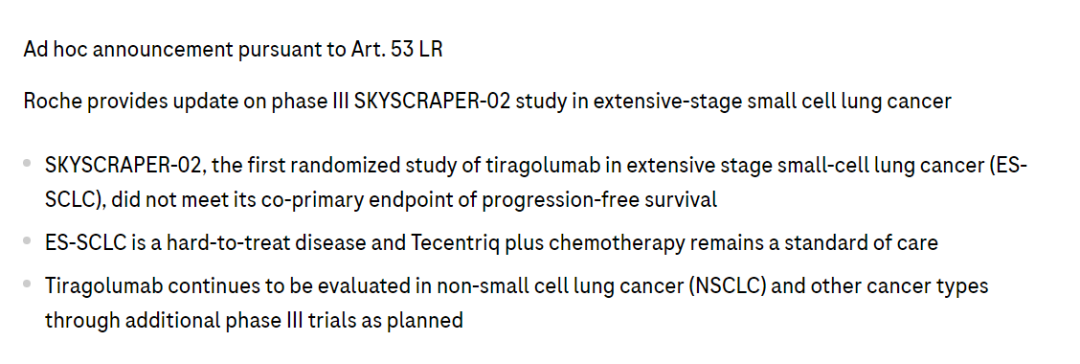
SKYSCRAPER-02 is a randomized, double-blind, placebo-controlled global Phase III clinical study aimed at comparing the efficacy and safety of tiragolumab plus atezolizumab and chemotherapy as a first-line treatment with atezolizumab and chemotherapy in 490 patients with ES-SCLC. The primary endpoints are overall survival (OS) and progression-free survival (PFS).
Tiragolumab is a TIGIT monoclonal antibody that has received FDA Breakthrough Therapy designation. By binding to TIGIT, it can block the interaction between TIGIT and poliovirus receptor (PVR, or CD155), a protein that suppresses the body's immune response, potentially enhancing the body’s immune reaction.
Atezolizumab (Trade Name: Tecentriq) is a PD-L1 immune checkpoint inhibitor independently designed and developed by Roche. It can directly bind to the PD-L1 ligand protein expressed on tumor cells and tumor-infiltrating immune cells, blocking the interaction between PD-L1 and the PD-1 and B7.1 receptors on immune cells, effectively activating T cells to recognize and kill tumor cells. Currently, this product has been approved for multiple indications, including non-small cell lung cancer, small cell lung cancer, hepatocellular carcinoma, melanoma, triple-negative breast cancer, and urothelial carcinoma.
Tiragolumab and Tecentriq in combination synergistically block TIGIT and PD-L1, activate T cells, and enhance NK cell anti-tumor activity.