

Lixin Science Files IPO Prospectus: Pioneering Closed-Loop Regenerative Biomaterial Solutions to Fill Global Market Gaps

Corliber
Developer of Novel Biomaterials and Orthopedic Implant Medical Devices
As an effective tool in the human fight against disease, biomedical materials have a history that can be traced back to before the Common Era. Today, third-generation biomedical materials, which promote self-repair and regeneration in the human body, have begun to see widespread application.
Polylactic acid (PLA), a representative of high molecular degradable materials, is one such novel material.It has good biodegradability and can be completely degraded by microorganisms in nature after use, eventually forming carbon dioxide and water. In the biomedical field, it has high safety for the human body and can be absorbed by tissues. For instance, in the European and American markets, polylactic acid with high molecular weight is widely used as a new type of orthopedic internal fixation material.
Due to the complex variety of raw materials and their corresponding different physical properties, polylactic acid materials produced in China are mostly used for industrial applications. Medical-grade polylactic acid has stringent requirements for raw materials, and its preparation and mass production present significant technological barriers. High-quality raw materials are mainly imported from overseas. Therefore, biomedical polylactic acid is expensive.
Upstream raw materials are still struggling, midstream biomaterial products are also difficult to gain momentum, and high-end products have long been dominated by imports. However, on the other hand, benefiting from policy guidance and the continuous growth of market demand, China's biomaterials industry is in a period of rapid development, with more enterprises and talents gradually entering the industry.
Corliber, a high-tech enterprise that closely meets clinical needs and provides regenerative biomaterial solutions with a fully closed industrial chain loop, has come into our view.In order to learn more about the situation, VCBeat interviewed Dr. Sun Yang, the founder.
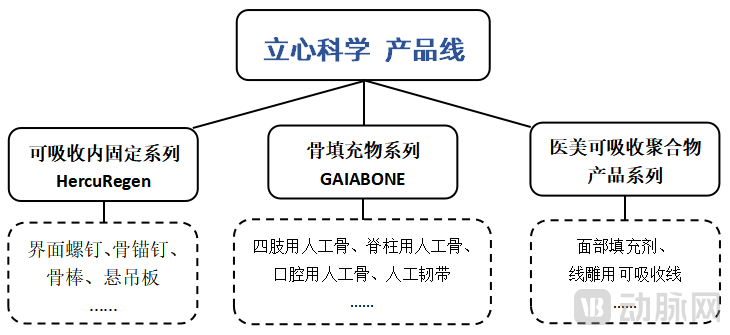
According to reports, Corliber, based on the research and development of biodegradable medical polymers represented by polylactic acid, has formed three product lines: absorbable internal fixation products, bone filler products, and absorbable polymer products for medical aesthetics.Among them, the artificial bone products, with their excellent malleability, resistance to liquid-phase collapse, and efficient osteoinductive regeneration properties, have filled a global product gap.
The rapid development of the biomaterials industry is mainly due to the outbreak of downstream demand.
In recent years, aging has not only been a high-frequency buzzword in the whole society but has also triggered a wave of industrial development. The demand for biomaterials is the highest in orthopedics, accounting for approximately 38% of the entire market share. Aging has brought about a large number of orthopedic patients, expanding the treatment needs for orthopedic diseases.
Meanwhile, with the changes in people's lifestyles and the improvement in quality of life, there has been an increase in demand for sports medicine, dentistry, and orthopedic surgery. According to reports, from 2015 to 2020, the compound annual growth rate of orthopedic implants, sports medicine, dental implants, and injection-based medical aesthetics in China exceeded 15%, with the total size of the细分 markets reaching nearly 100 billion yuan.
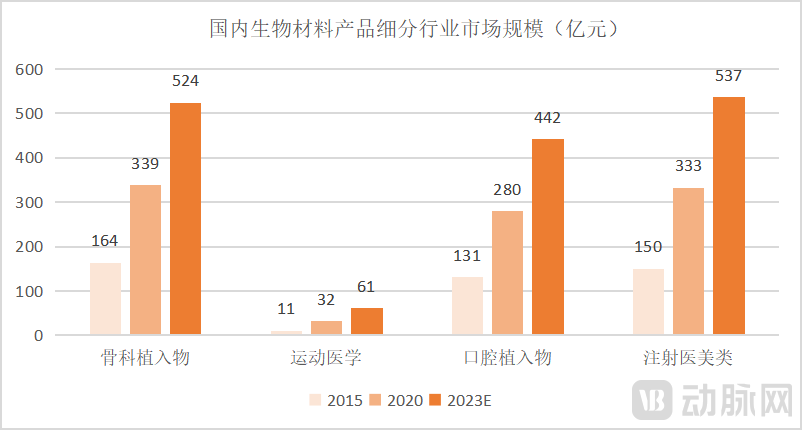
Dr. Sun Yang, Chairman of Corliber, stated that the market demand for biomaterials is very strong. However, looking at the entire industry, firstly, raw materials are mainly imported, and secondly, products reaching end users are also predominantly imported, especially high-end products. Facing significant market potential and opportunities for import substitution, Corliber decisively chose to enter the biomaterials industry.
Corliber focuses on the development of polylactic acid polymer materials due to Sun Yang's academic background. It is reported that Sun Yang studied at the School of Materials Science and Engineering at Shanghai Jiao Tong University for his undergraduate degree. During his Ph.D. and postdoctoral studies at the Department of Materials Science and Engineering at the National University of Singapore, his research topic was the study of polylactic acid composites.
Corliber has formed three major product lines based on polylactic acid medical polymer raw materials.
Source: Corliber
Absorbable Internal Fixation Series, targeting application scenarios in sports medicine, orthopedics, dentistry, and other fields that require fixation of soft tissues or bones. During the development of this product series, Corliber established a material platform. The high-strength, highly tough degradable composite materials produced by the platform can be used to design a series of products with different structures. Sun Yang revealed that the first product in the internal fixation series is expected to obtain registration and come to market in the second half of 2022. Other products will continue to be launched at a rate of 1-2 per year.
Bone Filler Series, including artificial bones for orthopedics, artificial bones for dental use, and other products. It is reported that currently, the FDA has approved more than 400 bone fillers, while in China, there are only about 50 certified products. However, none of them can meet the global unmet needs for moldability, resistance to liquid dispersion, and highly efficient osteoinductive regeneration. Corliber's artificial bone product is the world’s first absorbable artificial bone that effectively meets the above unmet needs. The first-generation product is currently in clinical trials and has been the first to submit an application for FDA certification. It is expected to submit registration to the National Medical Products Administration (NMPA) by the end of 2022.
Medical Aesthetics Absorbable Polymer Product SeriesThe main products include facial fillers, absorbable thread lift lines, etc. The demand in the regenerative aesthetics market is enormous. Taking injectable products as an example, relevant data shows that the market size will reach 4.927 billion yuan by 2025 and will continue to grow. Among these, the usage of PLLA products with poly-L-lactic acid (PLLA) as the main material is also gradually increasing, with the estimated production scale reaching 1.987 billion yuan by 2025.
Sun Yang introduced that Corliber's layout in the medical aesthetics field is based on two aspects: one is to build its own medical aesthetics biomaterials product brand leveraging the mass production capability of absorbable raw materials; the other is to provide OEM services, using material mass production technology to serve more medical aesthetics customers and build a medical aesthetics materials kingdom.
Raw materials are the cornerstone of products. Corliber, backed by an outstanding R&D team, excels in the research and mass production of raw materials.
Sun Yang described his team as follows: "Complementary strengths, meticulous division of labor, and integration of theory and practice." The core team members of Corliber have deep expertise in polymer material R&D, material processing technology, and animal clinical trials for medical devices, accumulating years of industry experience. Overall, the team is research and development-focused, with highly educated talent from universities both within and outside China, as well as industry professionals with rich practical experience. Together, they collaborate in both the theoretical and practical aspects of product development, forming a three-dimensional talent echelon.
Taking the preparation of poly-L-lactic acid (PLLA) as an example, it is highly sensitive to moisture, with unstable performance and prone to decomposition, making it difficult to mass-produce with high purity and high yield. The Corliber scientific research team developed patented technologies such as "continuous thermal pyrolysis," "efficient solvent purification," and "ultra-high vacuum anhydrous anaerobic synthesis" while overcoming process difficulties. These innovations enabled the controllable synthesis and industrial application of two-level raw materials for medical-grade polylactic acid family materials.
Among them, "two levels" refer to monomers and polymers. According to Sun Yang, Corliber has 4-5 types of monomers. By combining these monomers in different proportions and sequences, as well as designing different molecular weights and molecular structures, an infinite variety of polymer raw materials can ultimately be synthesized.This is equivalent to Corliber forming a polylactic acid family material library, with enormous customization potential, capable of meeting the research and development needs of various absorbable implants.
Currently, Corliber owns more than 80 patents, including over 20 invention patents, forming core intellectual property related to composite materials; it also has a 2-ton capacity factory with customized production equipment and production line modifications.
Sun Yang stated, based on the design capability of raw materials,On the one hand, Corliber can closely align with clinical needs to form its own closed-loop industrial chain.That is, according to clinical needs, customize and transform from raw materials, form innovative products through innovative processes for clinical application, and then continuously upgrade the products based on clinical feedback.On the other hand, customized raw materials can be supplied to other medical device manufacturers.
From raw materials to advanced products, Corliber's high-performance end products meet the clinical needs for absorbable induced regeneration.
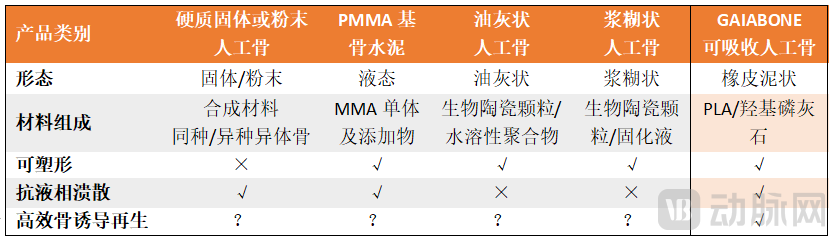
Taking bone fillers as an example, bone defects in clinical settings vary widely, requiring bone fillers to possess malleable properties; they also need to have anti-liquid dispersion performance, meaning they can resist the washout from blood and water without breaking apart. Additionally, the new generation of bone fillers is required to be biodegradable, absorbable, and capable of inducing bone regeneration.
The mainstream products of bone fillers globally can be divided into 4 categories,In terms of performance, there is still a gap in the market for bone filler products that combine malleability, resistance to liquid phase collapse, and high-efficiency osteoinductive regeneration.
Source: Corliber
Corliber integrates these three requirements through super-dispersion technology to form a uniformly dispersed composite absorbable artificial bone, which is malleable like putty and can be shaped with surgical tools for a full filling effect. For comminuted fractures, the patient’s fragmented bones can be incorporated into it to optimize bone formation.
Secondly, it has strong resistance to liquid dispersion. It can be soaked in a 37°C water environment for one month without dispersing and can be stably applied in various surgical environments. Based on the above, this product can save operation time in practical applications.
Thirdly, the product has gradient degradation characteristics, which can provide a favorable microenvironment for bone regeneration and achieve rapid bone conduction regeneration. In addition, regarding the issue of slow bone healing caused by diabetes, the latest research from Corliber shows that its product has significant osteogenic effects in diabetic rat skull defects. This undoubtedly brings more possibilities to Corliber's products.
And in order to realize numerous possibilities, Corliber has recently initiated its A+ round of financing.Combined with the short-term development plan to advance product approval and market launch as soon as possible, the financing will be used for product research and development, team building, and market promotion.
When talking about the company's longer-term strategic goals, Sun Yang told us about the origin of the company's name, which comes from the great scholar Zhang Zai of the Northern Song Dynasty: "To establish a conscience for heaven and earth, and to secure a destiny for the people."
"As a medical enterprise, this is Corliber's guiding light," he explained. "The corporate culture of Corliber aligns with the profound meaning conveyed by this ancient teaching. We aim to truly benefit patients by leveraging modern science and technology. Allowing the company to develop independently, grow stronger, and become a national brand is an ideal we have always adhered to."