

Founder with Prestigious Medical School Background and Decade of MNC Experience Taps into the Billion-Dollar Ophthalmic Surgical Equipment Market

Rhino Health
Developer of High-End Ophthalmic Surgical Equipment
In recent years, with the basic realization of domestic substitution in fields such as biochemical diagnostics, patient monitors, and coronary stents, the research and development efforts of domestic medical device companies have been proceeding vigorously amidst the wave of "domestic substitution."
VCBeat once compared the number of approved medical device products from 2016 to the first half of 2021 and found that the number of approved Class II devices in China far exceeded that of imported Class II devices. As the number of approved Class III devices in China gradually increased, it surpassed the total number of imported Class III medical devices, leading to the conclusion that "in the mid-to-low-end device sector, domestically produced devices have largely achieved substitution, while in the high-end medical device sector, domestic substitution is beginning to accelerate."
However, by comparing the approval of Class III devices in 2018 and 2020, VCBeat found that the number of approved devices for dental instruments, orthopedic surgical instruments, obstetrics and gynecology, assisted reproductive and contraceptive devices, physical therapy devices, and respiratory, anesthesia, and emergency devices increased significantly, ranking in the top five. The increase in ophthalmic devices was only 9.1%, with 11 and 12 devices approved respectively, forming a stark contrast to the "high-speed" progress of domestic substitution in the aforementioned fields.
The domestic substitution of ophthalmic medical devices is a long and challenging journey. However, on this less crowded path, a group of domestically produced enterprises has emerged, gaining initial market recognition.
According to data from the VCBeat database, in 2021, there were 45 financing events in China's ophthalmology primary market, of which 13 occurred in the ophthalmic medical device sector. Further analysis revealed that one of these was Rhino Health, a company specializing in the research and development of advanced ophthalmic surgical equipment.
Founded in October 2020, Rhino Health is an ophthalmic product company that integrates the research and development, production, sales of ophthalmic surgical equipment and consumables, as well as surgical training; its core products include phacoemulsification systems, vitrectomy surgery systems, ultrasonic vitrectomy, and laser vitrectomy systems.
In the field of ophthalmic medical devices, why does Rhino Health focus on high-end surgical equipment? Why choose the path of independent research and development? What is the progress of its self-developed technology? Besides R&D, why has training become another key focus? Regarding the business layout of "R&D, production, sales, and training," what preparations has Rhino Health made? On a morning in March, founder Zhang Chi shared with VCBeat the original intentions, strategies, and plans of Rhino Health.
"I graduated from the clinical medicine program in 2000." Zhang Chi's voice came through on the other end of the phone, his speech slightly rapid, seemingly diverging a bit from the typically composed demeanor associated with medical students.
Subsequently, Zhang Chi briefly introduced his work experience since graduation: In 2005, he entered a provincial tertiary hospital as an ophthalmologist, where he not only ran an independent outpatient clinic but also worked as a surgical doctor; in 2007, he returned to school to pursue a graduate degree; after graduating in 2010, he joined a well-known foreign ophthalmology company until the end of 2020.
In other words,From 2000 onward, Zhang Chi's life trajectory can be depicted as follows: School — Hospital (Clinical) — School — Pharmaceutical Company/Foreign Enterprise.
The first turning point in this trajectory was Zhang Chi's decision to return to school from clinical practice, which can also be seen as the budding period for the future development of equipment research and training as Rhino Health's core business layout.
According to Zhang Chi, during his time working at the hospital, due to a shortage of doctors, Zhang Chi gradually grew from a resident doctor into a surgeon capable of independently running an outpatient clinic. Despite this, Zhang Chi still chose to return to school for further studies.
Speaking of this, Zhang Chi jokingly said, "I was remade at that time."
AndWhat made Zhang Chi decide to "start over" was the lag in grassroots hospitals regarding access to and learning about new ophthalmic technologies and equipment.
"At that time, compared with large hospitals in Beijing, Shanghai, and Guangzhou, the medical level at the grassroots was relatively backward. Many new devices and technologies had not yet reached grassroots hospitals, and we had no access to them at all," said Zhang Chi.
AndThe second turning point occurred in 2010; by this time, Zhang Chi, after graduating, chose not to return to clinical work but instead opted to work for pharmaceutical and foreign enterprises. In 2020, he decided to start his own business.
As for the reason why he didn't return to being a doctor, Zhang Chi explained with an industry insight: China lacks not only ophthalmologists but also bridges of communication between doctors and enterprises.
"Actually, in many cases, we find that on one hand, companies have many excellent products, but doctors don’t know how to use them; on the other hand, doctors have many great ideas and needs that need to be met, but companies are unaware of them. This leads to a situation where corporate R&D is disconnected from the actual needs of doctors, and grassroots doctors are unable to promptly learn about and understand the latest products and technologies launched by companies," said Zhang Chi. He also stated that this is why Rhino Health was founded. "On a personal level, my decision not to return to clinical practice is similar to Lu Xun’s philosophy—there’s no need to be a doctor to help society. I can contribute to society and push the medical field forward from a different perspective."
AndWhy Rhino Health Chooses Self-Developed Products Over Import Distribution: Zhang Chi Explains
Moreover, according to Zhang Chi, foreign companies impose strict blockades on the core technologies of high-end ophthalmic equipment, "from a small component to the patent principle of a new technology, all are under strict lock and key. As a result, despite some R&D attempts by upstream ophthalmic companies in China, few achievements have been made."
So, how did Rhino Health break through?
"The toughest time was when all members of our R&D team stayed in the lab, working over 12 hours a day, and finally we broke through a particularly challenging core technology." Speaking about the product development process, Zhang Chi expressed deep emotion.
Such a spirit of dedication to research allowsRhino Health has obtained three core R&D patents and five new practical patents, covering multiple core products in various fields such as cataract surgery, vitreous surgery, and ocular trauma surgery. These include phacoemulsification systems, vitrectomy systems, ultrasonic vitrectomy, and laser vitrectomy systems. Notably, the laser vitrectomy system was independently developed by Rhino Health.
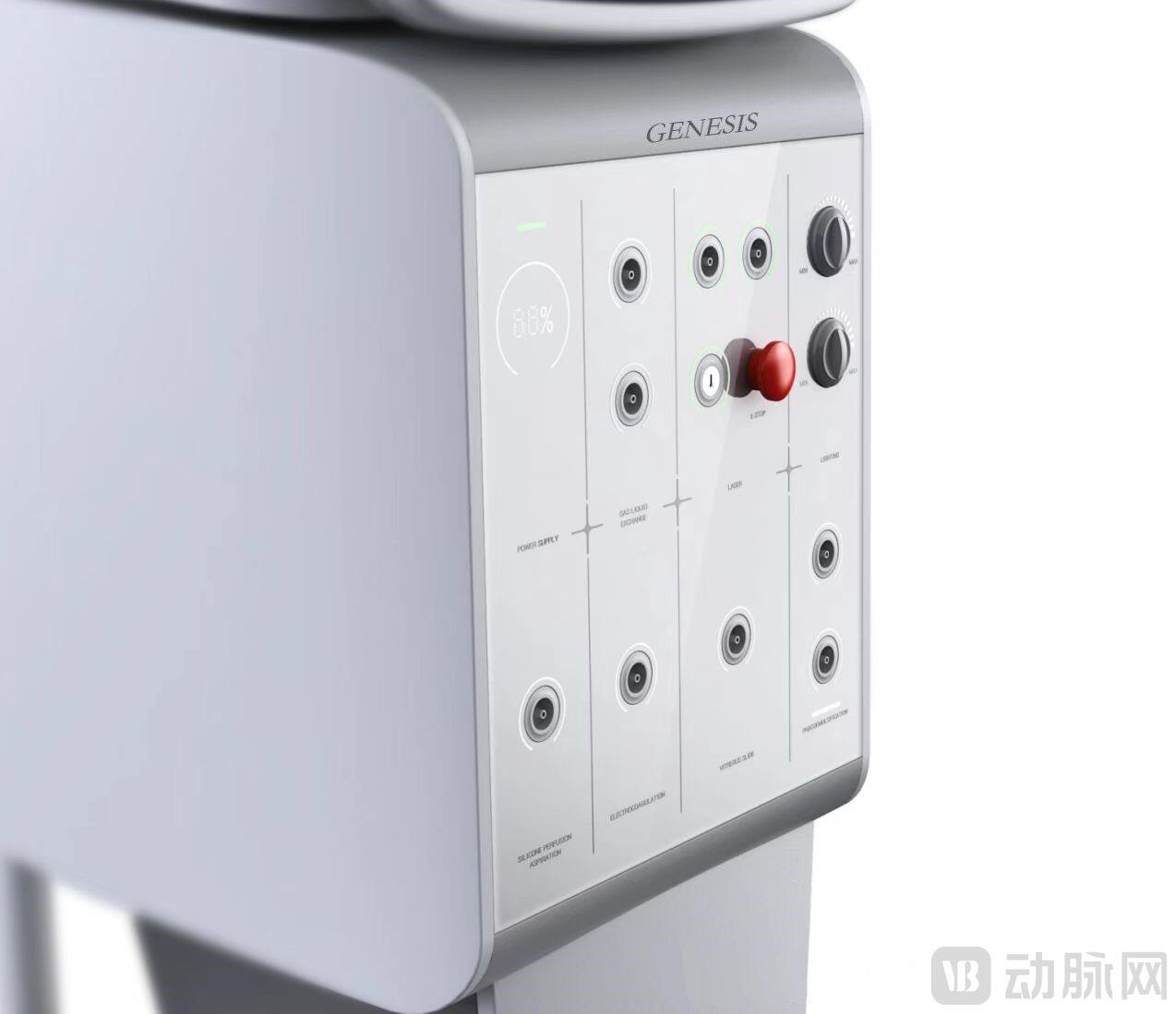
Rhino HealthGenesis Product Renderings
"Previous mechanical vitrectomy surgeries were less efficient and safe. Rhino Health's laser vitrectomy system transforms this mechanical vitrectomy technology into a photoelectric ablation technique, which not only improves the precision and efficiency of the surgery but also enhances its safety," Zhang Chi revealed to VCBeat. Currently, this technology is still quite advanced, with few companies able to achieve it.
Rhino Health's ability to develop laser vitrectomy technology within a year is first and foremost due to its R&D pathway.
According to Zhang Chi, the R&D of Rhino Health has received support from many large ophthalmic hospitals in the industry, senior ophthalmology professors, and some key university laboratories. This not only ensures the efficiency of R&D but also guarantees the correctness of the R&D direction.
Secondly, the professional background of Zhang Chi and the core team is also a significant boost that cannot be ignored.
The research and development of ophthalmic surgical equipment falls into the highly interdisciplinary category of medical-engineering integration, which requires that the R&D team include members with both engineering and medical backgrounds.
As it turns out, Zhang Chi has both.Having systematically studied ophthalmic medical knowledge and accumulated clinical diagnosis and treatment experience in ophthalmology, Zhang Chi's medical background in the ophthalmic field is naturally beyond question. During his work experience at a foreign enterprise, while being responsible for marketing and equipment training, Zhang Chi also engaged in in-depth systematic learning of the structure and functional integration of ophthalmic surgical equipment through exchanges with R&D engineers from the foreign company.
These work contents undoubtedly also gave Zhang Chi a deep understanding of how an ophthalmic device is researched, produced, sold, and applied. With rich clinical experience and high-quality customer resources, Rhino Health clearly knows the technologies and difficulties urgently needed in clinical settings, thereby targeting precisely to custom-make surgical equipment for clinicians.
And,In actual research and development, Zhang Chi did not work alone but found a "left-hand man" with a strong medical background and a "right-hand man," an engineer with experience in developing ophthalmic vitrectomy systems.
Finally,Thanks to years of medical education background and ophthalmology clinical experience, Zhang Chi has accumulated abundant doctor resources, which also ensures that Rhino Health's R&D remains closely connected with clinical needs.
However, the abundant doctor resources bring not only R&D support but also assistance in equipment training to Rhino Health.
Unlike some well-known domestic ophthalmic upstream enterprises that focus on equipment maintenance as one of their key business layouts, training doctors will be one of the key future focuses for Rhino Health.
What are the reasons behind this? In an interview, Zhang Chi frankly stated, "Currently, due to cost considerations, many companies do not offer large-scale training services. However, for a company, while focusing on economic benefits, social benefits should also be emphasized. Moreover, for Chinese ophthalmologists, especially those in grassroots hospitals, the desire and need for training are enormous. Therefore, in order to better serve doctors, shorten their learning curve, and respond to the national call of 'minor illnesses treated without leaving the county, major illnesses treated without leaving the village,' training services will definitely be an important part of Rhino Health's future strategy. Only in this way can we truly promote the rapid development of ophthalmic prevention and treatment in China."
Moreover, VCBeat learned that,Rhino Health's planned training path is: the company collaborates with a group of ophthalmologists to first train this small group of ophthalmologists, who will then go on to train ophthalmologists at grassroots hospitals, thereby extending the reach to ophthalmic hospitals across China.
"Actually,During the training process for the first group of doctors, Rhino Health standardized and quantified every key step that doctors needed to master. Through these quantified operational standards, the first group of doctors could then guide new grassroots doctors in learning new technologies and equipment. This not only shortened the doctors' learning curve but also helped them avoid unnecessary detours," said Zhang Chi.
However, the foundation for the development of training services is the launch of products. With strong R&D capabilities and abundant industry resources, how is Rhino Health's product progress coming along?
At the end of the interview, Zhang Chi stated that in the second half of 2022, Rhino Health's first product, Genesis, will complete animal experiments, and clinical trials will be carried out as planned next year for a period of one year. It is expected to obtain product registration in 2025.
The domestic substitution of ophthalmic medical devices still requires the accumulation of time.