

NeuroXess Emerges as a Dark Horse in Brain-Computer Interface Race with Backing from Chen Tianqiao and Shen Nanpeng

NeuroXess
Invasive Brain-Computer Interface Developer
The complexity of the brain is like a vast ocean. With 86 billion neurons, 500 trillion synapses, and various complex factors such as neurotransmitters composed of amino acids, peptides, and proteins in the human brain, fully deciphering the "secrets" of the human brain requires not only time but also breakthroughs in cognition and the deep integration of industry, academia, research, and funding.
Fortunately, in the face of brain science, known as "the ultimate frontier of humanity," many explorers have already set sail on their own arks, and capital has also shown anticipation for this track. Looking back at the development over the past few years, more than 100 companies and over 90 brain science research institutions have been established in China, with over 200 financing events occurring and more than tens of billions of yuan flowing in.
Among them, there are a total of 66 projects related to electroencephalography (including brain-computer interfaces, electroencephalographs, and disposable EEG sensors), accounting for over 50%, making it the absolute mainstream in the field of brain science. Brain-computer interfaces are divided into two technical schools: invasive and non-invasive. Non-invasive methods outside the skull allow for convenient signal collection, but due to physical and environmental factors, signals can be affected by various types of noise. Invasive methods inside the skull provide clear signals but are limited by safety concerns and carry a high risk of infection. For this reason, most innovative products in this field in China are non-invasive electrophysiological devices and EEG signal acquisition systems, while invasive products and implantable chip solutions remain almost nonexistent.
But its value is undeniable. As brain-computer interfaces evolve towards ultra-miniaturization, wireless capability, and integrated acquisition-stimulation, invasive brain-computer interface chips may become a significant area in the future development of brain science.
In October last year, NeuroXess, a life technology company focusing on flexible brain-computer interface technology, was established, effectively filling the gap in China's invasive brain-computer interface field.NeuroXess Announces Completion of 97 Million Financing Led by Shanda and Sequoia China Seed Fund Just Three Months After Its Establishment (January 2022).
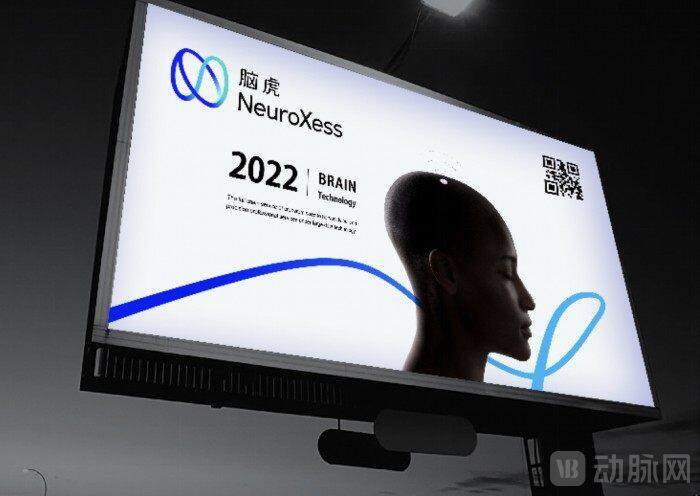
Enterprise Exhibition Board
Chen Tianqiao, founder of the TCCI (Tianqiao and Chrissy Chen Institute), chairman and CEO of Shanda Group, and lead investor of this funding round, has publicly stated that he hopes to make NeuroXess a model for supporting brain science research in China, truly allowing brain science achievements to benefit the public and scientists.
Three Five-Year Plans: Achieving Development from Interaction to Symbiosis and Then to Twinning
"Brain science is at a turning point from academia to industry." At the start of the conversation, Peng Lei, founder and CEO of NeuroXess, made this assertion.
"However, brain science is a very long-term endeavor, requiring decades or even longer for technological research. At this turning point, it is particularly important to clearly understand the company's mission, vision, values, and core capabilities. Only in this way can we truly ensure the continuous enhancement of the company's commercial value." Peng Lei has his own set of cognitive logic regarding the future development direction of enterprises and even the market. It seems that through this cognitive logic, he can see the future risks and opportunities with absolute clarity.
Notably, the two founders of NeuroXess were undergraduate classmates at the University of Science and Technology of China 25 years ago.Founder and Chief Scientist of NeuroXessTao Hu is an authoritative expert in the fields of brain-computer interface, artificial intelligence, and micro-nano sensing in China., currently serving as the Deputy Director of the Shanghai Institute of Microsystem and Information Technology, Chinese Academy of Sciences, and the Founding Director of the 2020 Frontier Laboratory. He has led his team to publish numerous top papers in the fields of micro-nano sensors, biomedical materials, brain-computer interfaces, and applied for dozens of core patents in these areas, making him one of the representative scientists in the field.
Peng Lei is an S-level serial entrepreneur with multiple successful startup experiences over the past 20 years.Founded in 2012, Keruyun was one of the largest SaaS service providers in China at the time. After being wholly acquired by Alibaba for 1 billion yuan in 2019, its founder was invited to join Alibaba and serve as the Senior Vice President of Local Life. Selected by Alibaba CEO Daniel Zhang (Flower Name: Xiaoyaozi), he was chosen to join the Xiaoyaozi Class (Alibaba Group's core internal training program) personally led by Zhang and became the youngest executive grooming candidate under his mentorship.
Two people whose development paths seemed completely parallel have now jointly founded NeuroXess. In Peng Lei's words, this is because he saw that Tao Hu's scientific and technological reserves had reached a critical point, and it was the best time to enter the commercialization stage.
Peng Lei is very confident that this foray into the brain track is the right move. He believes that brain-computer interfaces are one of the main battlegrounds where life science and information technology intersect. Although the United States currently leads in this field, China also maintains a strong development momentum. With the support of national policies, interdisciplinary collaboration, and industrial integration, there is hope to achieve "rapid catch-up" in the short term.
Combined with Tao Hu's understanding of brain-computer interface technology and the current market situation in China's brain science field,Peng Lei and Tao Hu, founder and chief scientist of NeuroXess, have customized "Three Five-Year Plans" for NeuroXess:
In the first five years, achieve human-computer interaction.Apply NeuroXess's brain-computer interface technology in the medical market, using the products for the restoration of sensory and motor functions in diseases such as ALS, high-level paralysis, Alzheimer's disease, brain tumors, and epilepsy. Enable patients to regain essential living and social abilities through brain-computer interface technology, returning to their families and society.
In the second five-year period, achieve human-machine symbiosis.After sufficient validation in the medical market, both the product itself and public awareness have matured significantly. NeuroXess is set to launch a product aimed at the general public, which involves implanting a brain chip to enhance human sensory experiences while improving reaction speed, information acquisition, and transmission efficiency. This allows humans to surpass their natural physical capabilities through brain-computer interface technology.
In the third five-year period, achieve human-machine twinning.By rapidly connecting brain-computer interfaces to the cloud-based brain network, human memories, emotions, and consciousness can exist within a digital space independent of the body, paving the way for an era of "human-machine-environment" trinity integration in the intelligent interconnection of all things.
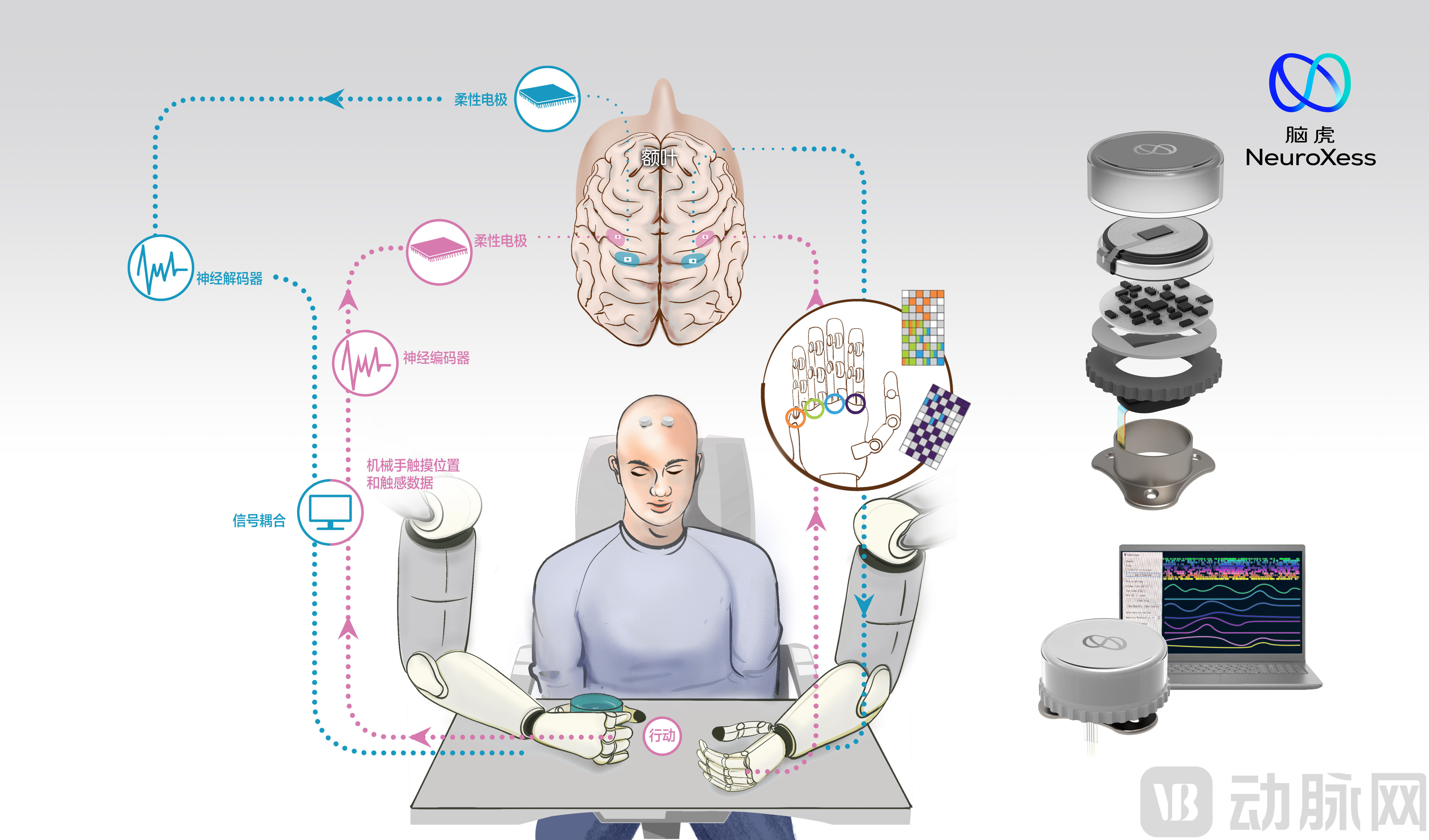
NeuroXess (NeuroXess) Electrode Scenario Principle and Product Diagram
"In October 2021, I officially left Alibaba and decided to explore the integration of cutting-edge technology in academia, research, production, and commerce with Tao Hu. This time, we are committed to the values of giving back to scientific research and society, aiming to achieve the coexistence of artificial intelligence and human intelligence, which is the ultimate dream of our entrepreneurship. Based on current research and the speed of technological advancement, we believe this singularity will definitely arrive. We also hope that through our efforts in technological research and commercialization, we can help bring this singularity to fruition sooner," Peng Lei said.
It is reported that in the past six months since its establishment, NeuroXess has built a professional team of more than 40 people (including commercialization, scientific, and advisory teams) covering R&D in implantable devices, chips, algorithms, and surgical robots, as well as understanding of medical scenarios, product registration, market sales, brand operations, and human resource management.
Flexible electrodes, 2640 single-device channels, craniotomy-free…… Achieving core technology breakthroughs and manufacturing of key components.
A year and a half ago, Chen Tianqiao had a nearly one-hour video call with Tao Hu.
According to Tao Hu's statement, when presented with NeuroXess's "Three Five-Year Plans," Chen Tianqiao did not find the timeline too long or unattainable. Instead, he immediately decided to fully support the project from research to commercialization. Chen also expressed that as long as Tao Hu is willing to proceed step by step, he can be more patient than their set schedule.
Currently, NeuroXess is progressing faster than their scheduled timeline.
Relying on the team of scientists from the Chinese Academy of Sciences and original independent core technologies, NeuroXess directly competes with Neuralink, founded by the world's richest man, Elon Musk.
Tao Hu told VCBeat"Elon Musk is very skilled at product integration, capable of presenting a complex product in a simple and aesthetically pleasing form. However, if you break down each part of it, there might still be room for improvement and enhancement. We focus more on the key challenges of the technological future, including neural bandwidth (such as the number of electrode channels), the safety of implantation methods (such as surgical incisions and in-body working time), and the sophistication of algorithmic decoding (such as real-time performance, reliability, and robustness), among others. At the same time, we are carrying out a series of efforts around clinical applications to make this technology truly feasible, rather than just proposing a concept. In the short period of less than half a year since our company was founded, the progress of our technology development has actually been faster than when I worked alone from a purely academic perspective."
It is reported that NeuroXess has achieved core technology breakthroughs and key component manufacturing in the field of invasive brain-computer interfaces.The product has 2,640 single-device channels, an in-vivo duration of 8 months, and an electrode thickness of 1.5.μm), Implantation Method (Non-invasive), Implantation Incision (Less than 0.7mm)In some aspects, it has surpassed Neuralink and gained a leading edge.
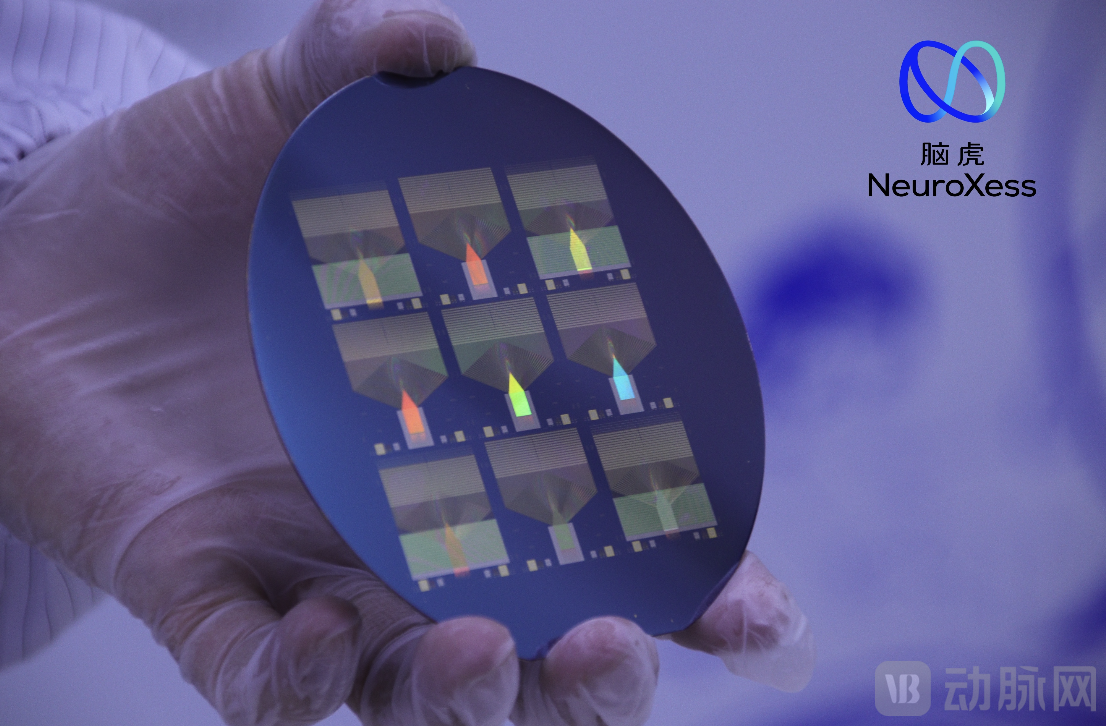
Product Silicon Wafer
NeuroXessThe main material of the brain-computer interface product, silk fibroin, is a traditional Chinese material, offering unique advantages such as flexibility and high in-body safety.Last year, the flexible brain-computer interface technology developed by Tao Hu and his team was unveiled at the World Artificial Intelligence Conference, where it won the conference's highest award, the SAIL Award (Super AI Leader). This technology, along with Huawei's Pangu large model and Alibaba Cloud's self-developed Zhen旦 heterogeneous computing acceleration platform, was selected as one of the "treasures of the exhibition hall."
Tao Hu explained the critical nature of this technology to VCBeat.: "We have always emphasized that NeuroXess is aProtecting and Exploring the Brain through Flexible Brain-Computer Interface Technology's life technology company, which precisely indicates the importance of flexible technology. Invasive brain-computer interfaces move with our daily activities within the brain, and only flexible electrodes can largely solve this problem.
If rigid electrodes are fixed to the skull, local micro-injuries in the brain caused by relative motion between the electrode and the brain may lead to persistent brain inflammation. Neural scarring formed in the brain can encapsulate the electrode, affecting its function due to insulation. In severe cases, it may also cause other brain diseases and impact the safety of the brain-computer interface in vivo. Therefore, we use a high-throughput, minimally invasive, implantable flexible brain-computer interface system to raise the ceiling of its application while reducing its harm to the brain.
Among these, the most critical aspect is the use of special technology to temporarily harden the flexible electrode, which is rigid when inserted into the brain and becomes soft after entry.The implantation process only requires drilling a small hole with a diameter of less than 0.7 millimeters in the skull., can be directly inserted into the brain and can work in the body for a long time, truly maximizing the utilization of the brain while minimizing damage to it."
NeuroXess's entry will undoubtedly fill the gap in invasive brain-computer interface technology in China and provide possibilities for the domestic invasive brain-computer interface technology to enter a new stage of development in the future.
Why Do We Still Have Confidence in Brain Research Despite Its Difficulty?
Invasive brain-computer interface products are one of Musk's key early ventures in the medical field. In 2017, he took over Neuralink, a company dedicated to developing "neural lace" technology. Since then, Neuralink has almost annually generated new topics of discussion, drawing attention from all sectors. The importance of invasive brain-computer interface technology goes without saying.
But the medical field may not have Musk's romance. On the one hand, implantable brain-computer interfaces and gene editing both face ethical challenges, clinical applications, and many other issues. While developing the technology, researchers need to not only establish corresponding ethical frameworks but also design products around clinical applications. Step by step is the rhythm and speed that healthcare should maintain.
On the other hand, the development of brain science is not as simple as a single breakthrough in disease mechanisms, material science, chips, anti-interference capability of brain-computer interface systems, transmission speed, neural network encoding and decoding, or practical application of research results... Faced with the vast system of brain science, a successful enterprise needs to achieve breakthroughs in all aspects of its research and address industry pain points through the deep integration of industry, academia, research, and funding.
In fact, from 2015 to today, within a few years, China has surpassed the United States in the clinical research of many neurological diseases. Meanwhile, numerous companies in the industry have been established and are conducting related explorations around brain science. NeuroXess is one of them.
"The field of brain science is challenging, but why do we still have the confidence to pursue it? Because only in this way can we truly fulfill the mission of brain-computer interfaces as connectors that enable direct communication between the human brain and the outside world, or even the entire world," said Tao Hu in conclusion.