

Generate Biomedicines Files IPO Prospectus: Pioneering Generative Biology to Invent, Not Discover, Therapeutic Proteins

Generate Biomedicines
New Drug Developer
Future drugs will be invented, not discovered.
Generate Biomedicines, the originator of this slogan, is the first drug generation company incubated by Flagship Pioneering, a top venture capital firm in the life sciences.Pioneering the field of "Generative Biology" at the intersection of machine learning, bioengineering, and medicine by utilizing computer algorithms to artificially create proteins that do not naturally exist.

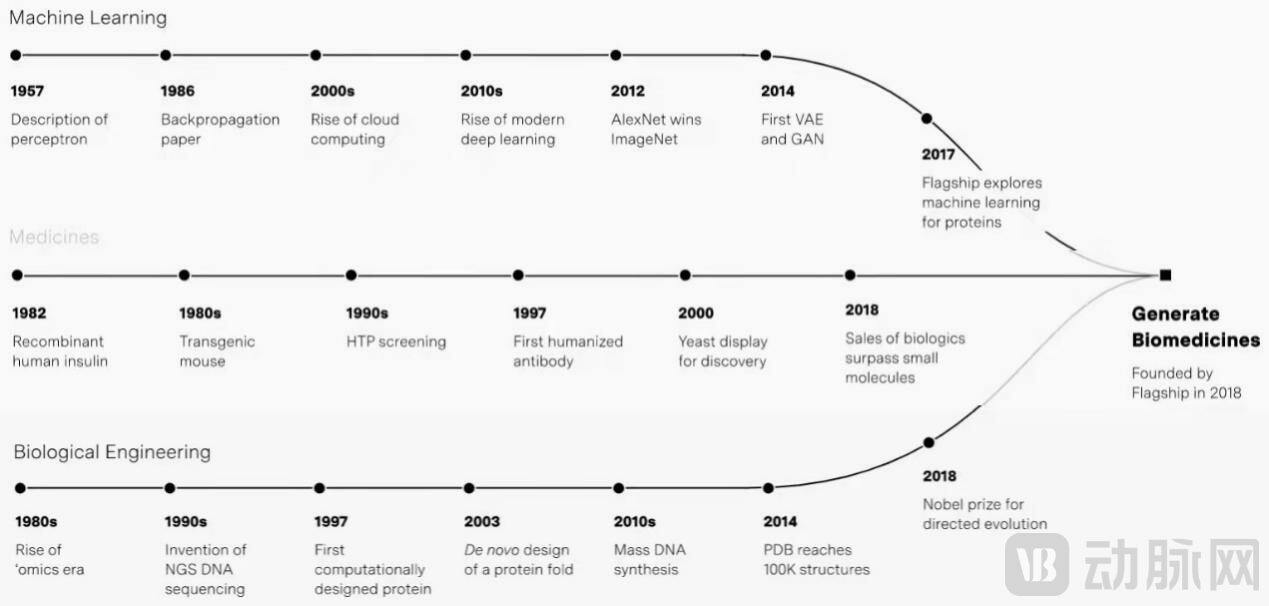
Generate Biomedicines itself is a chimera: the product of two projects from Flagship Pioneering that merged in 2019.
A project initially codenamed FL56, led by Flagship Pioneering partner Avak Kahvejian, aims to apply the discovery of protein structures as a foundation for algorithmic technology platforms in drug discovery. At the same time, Molly Gibson, a principal at Flagship Pioneering, is collaborating with von Maltzahn on another project, codenamed FL57, to explore whether advancements in machine learning for processing language and images can also be applied to amino acid sequences of proteins.
To continue advancing in these two areas of research, innovation in machine learning is ultimately required to move beyond predicting existing proteins and toward generating new ones. Therefore, it would be more effective to form a specialized team working at the intersection of biology, machine learning, and engineering, enabling scientists from different fields to collaborate in new ways and jointly invent and innovate.
Both projects involve the exploration of protein structures and share the same goal: to establish a generative platform for creating protein-based drugs.Therefore, in 2019, the partners merged FL56 and FL57 into a single company, Generate Biomedicines, which focuses on analyzing protein structures and manufacturing protein drugs.Kahvejian and von Maltzahn serve as co-founders and co-CEOs, Gibson as Chief Innovation Officer, and Grigoryan as Chief Technology Officer.
After its establishment, Generate divided its employees into three teams: a machine learning team focused on developing computational models, a bioengineering team dedicated to generating more original protein structure data, and a drug team concentrating on preclinical biology experiments.
Generate Biomedicines was launched in 2020 after conducting fundamental research for a period within the lab division of Flagship Pioneering following its establishment. Only then did Generate finally emerge from three years of stealth mode, presenting itself to the world with a new image.
Turning the vision of Generate Biomedicines into reality requires not only the integration of scientific technology and expertise but also substantial financial backing.
Fortunately, Generate, which had just been launched a year earlier, announced its first external equity financing of up to $370 million in November 2021. This financing enabled Generate to further develop its platform and rapidly expand the organization, while also attracting top scientific and computational talent.Truly usher in the "Generative Biology" era.

For a hundred years, the number of diseases requiring treatment has been increasing, but the process of drug discovery has hardly changed.
Drug discovery is an extremely expensive trial-and-error process, and over time, it has only become increasingly costly and inefficient. The exponential rise in the inefficiency of drug discovery has led to an explosive increase in drug development costs, with the true cost of commercializing a new drug rising from about $800 million in 2001 to over $2.5 billion by 2020.
Driven by machine intelligence, the fundamentals of therapeutic development are shifting to create proteins that don't exist today.
Generate Biomedicines, Inc. posed a question: What if, instead of discovering protein drugs through trial and error, we could use new computational tools to generate novel protein therapies? Is this possible?
Conventional protein drugs merely make minor changes to existing molecules through a "trial and error" approach. To break this deadlock, Generate Biomedicines has opened up a new field, no longer limited to producing what already exists in nature, but generating entirely new proteins with specific functions from scratch.
Over the past decade, machine learning has revolutionized fields such as computer vision, natural language processing, speech recognition, medical imaging, and computational biology. The emergence of large datasets, combined with advancements in processing techniques, has made it feasible to train massive neural networks.
The continuous improvement in computing power, coupled with the exponential growth in high-throughput biological data production, has ushered in a new era of drug discovery and development for scientists.
From Observation to Analysis, and Then to the Generation of New Proteins:Generate has run machine learning algorithms on powerful processors to analyze millions of known proteins, searching for statistical patterns that connect sequences, structures, and functions in order to learn generalizable rules for how nature encodes protein functions. By leveraging these learned rules, supplemented with proprietary experimental data, Generate is able to create novel protein sequences that do not exist in nature according to specific needs, generating customized protein therapies (short peptides, antibodies, enzymes, gene therapies, protein compositions, etc.), and ultimately forming new drugs with specific therapeutic functions.
This process significantly increases the success rate of drug discovery and reduces the time required for drug discovery, which Generate refers to as"Generate Biology", expanding Generate's capabilities in treating diseases and addressing complex biological challenges, representing a fundamental shift in the possibilities of therapeutic development with broad potential.
The shift from traditional drug discovery to "Generative Biology" has caused a tremendous change in the life sciences field.Generate Biomedicines no longer focuses on discovering naturally occurring drugs for treatment purposes but centers on producing drugs that do not exist in nature; it also creates therapeutic opportunities not only by seeking chances from laboratory observations but by identifying specific biological processes involved in diseases.
Generate Biomedicines has proven that generative biology can be applied to all protein modalities, creating novel proteins with desired functions.
To better and faster achieve the goal of on-demand protein production, Generate Biomedicines has learned from all known proteins, applying the fundamental principles of gene sequence encoding for protein structure and function to build a specialized Generative Biology platform. This platform primarily creates novel protein sequences with therapeutic potential. Notably, the versatility of the platform enables the creation of enzymes, peptides, and antibodies with broad applications and makes it possible to pioneer entirely new categories of protein-based drugs.
Generate Biomedicines' proprietary Generative Biology platform can produce custom protein drugs on demand at unprecedented speed and success rates, which are different from any current drugs. By using machine algorithms to generate various types of protein complexes, including antibodies and peptides, enzymes, stealth proteins (a new family of proteins identified through computational identification that make bacterial pathogens invisible to the host immune defense), and even novel therapeutic proteins against SARS-CoV-2 within less than three weeks.
The Generative Biology platform overcomes multiple barriers that limit the discovery of protein drugs, making the following vision a reality:
1. Generation of antibodies or binders to pre-specified epitopes on a target
2. Generate antibodies against membrane targets or multi-protein complexes, which are traditionally difficult to express in vitro.
3. Therapies that generate pain in the target or control specific receptor signaling
4. Generate highly selective molecules capable of distinguishing between desired and undesired targets.
5. Generate Synthetic Gene Editing Proteins with New Functions
A major feature of the Generative Biology platform is its ability to predict novel binders for desired targets.That is, it can generate antibodies that bind specific epitopes to desired targets, achieving the on-demand use of computer algorithms to create effective antibodies.
The human immune system's ability to recognize and eliminate non-human proteins limits the efficacy of many biologic drugs. Therefore, producing effective biologic drugs requires controlling the relationship between protein sequence, structure, function, and immune activation.
Using Generate Biomedicines' Generative Biology platform to generate antibodies, it fully re-encodes therapeutic proteins to maintain their structural functions while reducing or eliminating recognition by the immune system.
Generate Biomedicines currently has six candidate drugs in the research and development stage. Although more details have not been disclosed to the public, its main candidate drug for heart failure with reduced ejection fraction (HFrEF), GEN-387, is expected to enter clinical trials in 2022.
Although Generate Biomedicines' current focus remains on internal R&D for its own products, the company is not working in isolation. While actively developing its products, Generate also seeks to establish partnerships with external pharmaceutical companies to achieve mutual benefits.
On January 6, 2022, Amgen (NASDAQ: AMGN) and Generate Biomedicines announced a collaboration research agreement aimed at discovering and creating protein therapies for five clinical targets across multiple therapeutic areas. Under the agreement, Amgen will pay $50 million upfront for the initial five programs, with up to $370 million in future milestone and royalty payments for each program. Amgen will also participate in a future financing round for Generate Biomedicines.
Combining Amgen's biologics drug discovery expertise with the powerful capabilities of Generate Biomedicines' artificial intelligence (AI) platform offers further opportunities to advance multispecific drug design by shortening discovery times and generating potential lead molecules with predictable manufacturability and clinical behavior.