

Phase 2 Trial Shows Axi-cel CAR-T Therapy Achieves High Response Rates as First-Line Treatment in High-Risk Large B-Cell Lymphoma

Kite Pharma
CAR-T Cell Immunotherapy R&D Provider

Gilead Sciences
Antiviral Drug Developer

MD Anderson Cancer Center
MD Anderson Cancer Center is a comprehensive cancer center located in Houston, Texas. It is the largest cancer center in the United States and one of the original three comprehensive cancer centers designated in the country. Functioning both as a degree-granting academic institution and as a cancer treatment and research facility within the Texas Medical Center in Houston, it is affiliated with The University of Texas Health Science Center at Houston. MD Anderson is among the most respected institutions worldwide dedicated to the care, research, education, and prevention of cancer.
News on April 6, 2022/BioValleyBIOON/---In a phase 2, multicenter, single-arm clinical trial named ZUMA-12, researchers from the MD Anderson Cancer Center at the University of Texas and other institutions found that first-line treatment with axicabtagene ciloleucel (axi-cel), a chimeric antigen receptor (CAR) T-cell therapy, showed efficacy in high-risk large B-cell lymphoma.Lymphoma(LBCL) patients achieved a high complete remission rate. The relevant research results were published online in the journal Nature Medicine on March 21, 2022, with the paper titled "Axicabtagene ciloleucel as first-line therapy in high-risk large B-cell lymphoma: the phase 2 ZUMA-12 trial". This study was funded by Kite Pharma, a subsidiary of Gilead Sciences.
Among the 40 patients treated with axi-cel, 89% achieved an objective response and 78% achieved a complete response. The estimated overall survival rate at 12 months was 91%. At the data cutoff point, after a median follow-up of 15.9 months, 73% of patients had ongoing responses. Although the median duration of response, event-free survival, and progression-free survival were not reached, the estimated rates at 12 months were 81%, 73%, and 75%, respectively.
"The existing treatments for LBCL include six months of chemotherapy. These new research findings provide evidence that axi-cel may offer an effective response in a single treatment and eliminate the need for patients to undergo other therapies," said Dr. Sattva Neelapu, professor of Lymphoma and Myeloma at the University of Texas MD Anderson Cancer Center and corresponding author of the paper.
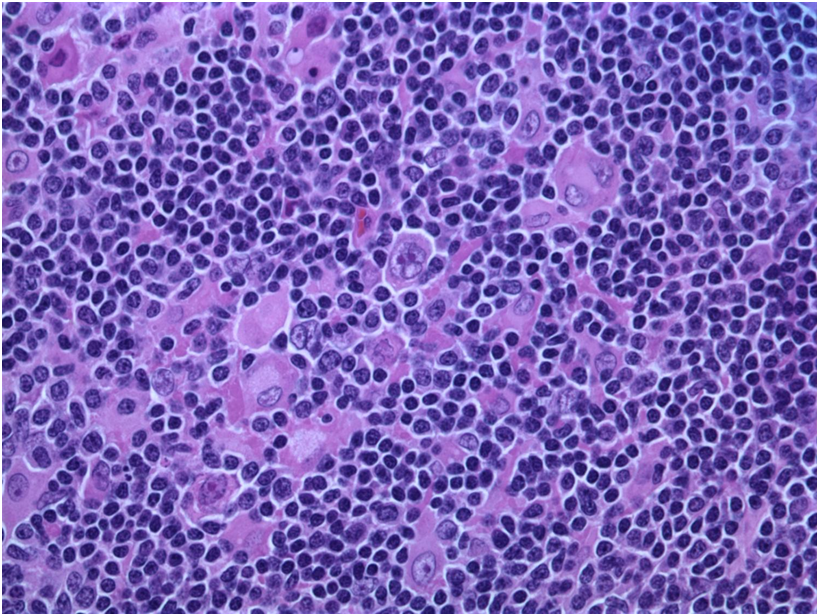
Hodgkin's lymphoma, nodular lymphocyte predominant (high power view), image courtesy of Gabriel Caponetti, MD./Wikipedia/CC BY-SA 3.0.
As a CD19-targeted autologousCAR-TCell therapy, axi-cel is manufactured by extracting a patient's own T cells and then genetically modifying these T cells to express CAR molecules that help them recognize cancer cells. The resulting axi-cel is infused back into the same patient to attack the cancer.
Based on the pivotal ZUMA-1 study, axi-cel was approved by the U.S. Food and Drug Administration (FDA) in 2017.ManagementBureau (FDA) approved for the treatment of adult patients with relapsed or refractory (R/R) LBCL who have received two or more lines of systemic therapy. The ZUMA-12 clinical trial expanded on the findings of ZUMA-1 by evaluating axi-cel as a first-line therapy for high-risk LBCL patients.
High-risk LBCL patients have double-hit or triple-hit lymphomas, or other clinical risk factors determined by the International Prognostic Index (IPI) or interim positron emission tomography (PET). Historically, fewer than half of these patients achieve remission through chemotherapy.ImmunityTherapies and other typical treatment methods achieve long-term disease remission.
Forty high-risk LBCL patients were enrolled and received axi-cel treatment. 95% of the patients had stage III/IV disease, 25% were double-hit or triple-hit lymphoma status in central evaluation, and 78% had an IPI score ≥3. The treatment was well tolerated with no new safety signals.
Neelapu said, "A randomized trial is necessary to confirm these results. I am very encouraged that with further research, we may be able to use CAR-T cell therapy as the first treatment option for high-risk lymphoma patients."
Neelapu and his team plan to continue follow-up analyses to confirm the durability of patients' responses to axi-cel. Additionally, more clinical trials are needed to definitively demonstrate whether CAR-T cell therapy is more effective than chemoimmunotherapy (the current standard of care) for high-risk LBCL patients. (Bioon.com)
References:
Sattva Neelapu et al. Axicabtagene ciloleucel as first-line therapy in high-risk large B-cell lymphoma: the phase 2 ZUMA-12 trial. Nature Medicine, 2022, doi:10.1038/s41591-022-01731-4.