

Pfizer's JAK1 Inhibitor Abrocitinib Approved in China for Moderate-to-Severe Atopic Dermatitis

Pfizer
Pharmaceutical R&D Developer
On April 11, Pfizer's Abrocitinib was approved for marketing by the National Medical Products Administration (NMPA) in China, indicated for adult patients with refractory, moderate to severe atopic dermatitis who have had an inadequate response to or are unsuitable for other systemic treatments (such as hormones or biologics). This is the fifth JAK inhibitor innovative drug to be marketed in China.
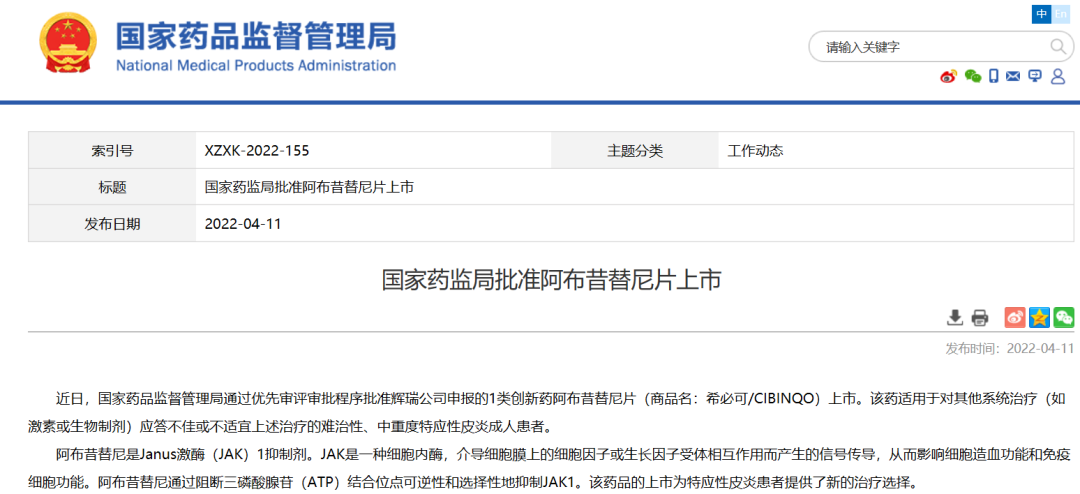
Abrocitinib, a once-daily oral JAK1 inhibitor developed by Pfizer, works by modulating various cytokines associated with atopic dermatitis, including interleukin (IL)-4, IL-13, IL-31, IL-22, and thymic stromal lymphopoietin (TSLP).
In September and December 2021, the drug was approved for marketing in Japan and the EU, respectively, for the treatment of moderate to severe atopic dermatitis. On January 14, 2022, Abrocitinib was approved for marketing in the United States, with recommended doses of 100mg and 200mg. It had previously received FDA Breakthrough Therapy designation and Priority Review status.
The FDA approval was primarily based on five clinical trials, including four Phase III clinical studies and one long-term open-label extension study, demonstrating improvements in skin lesion clearance, disease extent and severity, and itching. Among these, three randomized, double-blind, placebo-controlled Phase III clinical trials evaluated the efficacy and safety of abrocitinib in treating patients with moderate to severe atopic dermatitis. The trials assessed the co-primary endpoints of IGA and EASI-75 responses at week 12.
JADE Mono-1 and JADE Mono-2 Aim to Evaluate the Efficacy and Safety of Abrocitinib Monotherapy in 778 Patients Aged 12 Years and Older with Moderate to Severe AD. The results showed that the IGA response rates (Week 12) in JADE MONO-1 were 24%, 44%, and 8%, and the EASI-75 response rates were 40%, 62%, and 12%. In JADE MONO-2, the IGA response rates (Week 12) were 28%, 38%, and 9%, and the EASI-75 response rates were 44%, 61%, and 10%.
JADE COMPARE aims to evaluate the efficacy and safety of two doses of abrocitinib (100mg and 200mg daily) in 837 adult patients with moderate to severe AD receiving background topical therapy. Compared with placebo, the trial also included an active control arm where patients received dupilumab treatment. The trial results showed that the IGA response rates at week 12 were 36%, 47%, and 14%, respectively, and the EASI-75 response rates were 58%, 68%, and 27%, respectively. Additionally, the 200mg dose of abrocitinib demonstrated superiority over dupilumab in itch response at week 2. At week 16, there was no significant difference between the two doses of abrocitinib and dupilumab.
Currently, five JAK inhibitors have been approved for marketing in China. Apart from abrocitinib, there are baricitinib (JAK1/2, Eli Lilly), tofacitinib (JAK1/2/3, Pfizer), ruxolitinib (JAK1/2, Novartis), and upadacitinib (JAK1, AbbVie).