

The $450 Million Surge: Domestic "Da Vinci" Surgical Robots Gain Approvals—How Will They Break Through?

MicroPort
High-end Medical Device R&D and Manufacturer

Intuitive Fosun
Medical Device Developer

TINAVI
Orthopedic Surgical Robot Developer
If we were to select the hottest medical device track of 2021, surgical robots would definitely be a top choice.
Surgical robots not only created the highest IPO in the medical device industry in the secondary market in 2021 — MicroPort Robotics, but Intuitive Surgical, the industry leader in the United States, also continued its growth myth, with an increase of more than 175 times since its listing. At the same time, surgical robot financing in the primary market in China has exceeded 3 billion yuan.
Chinese surgical robots have long been telling the story of Da Vinci. From 2021 to early 2022, products from several domestic companies have been approved. Chinese-produced surgical robots have already stepped into the market.
How Should Chinese-Made Surgical Robots Break the Monopoly of Foreign Leading Enterprises?
If surgical robots are the hottest trend in recent years, then Intuitive Surgical, the company behind the Da Vinci Surgical System, is the brightest star in this field. As the absolute leader in this niche market, what insights can be gleaned from its annual report?
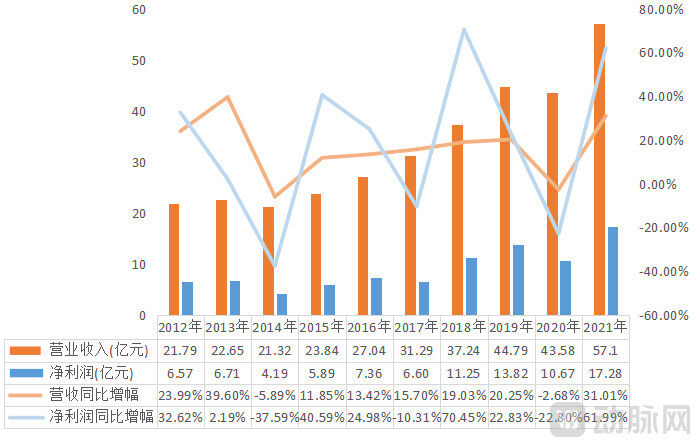
Intuitive Surgical's Revenue in the Past Decade, Data from the Company's Annual Reports
Let's start with revenue. The annual report shows that in the fiscal year 2021Net profit attributable to母公司股东为17.05亿美元,同比增长61%; Operating revenue was 5.71 billion USD, increasing by 31.01% year-on-year. As can be seen from the table, in 2021, the revenue has completely reversed the decline caused by the epidemic in 2020.
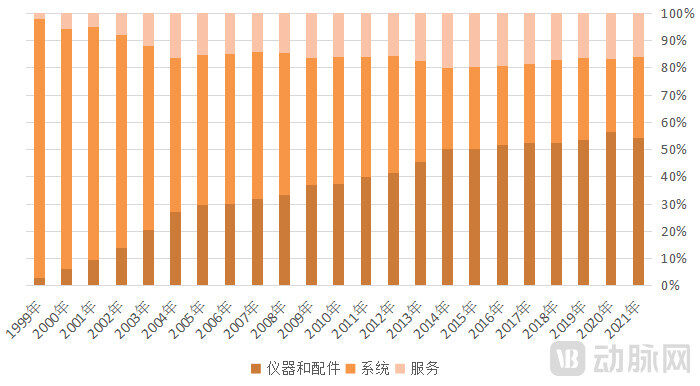
Intuitive Surgical Revenue Composition, Data from the Company's Annual Report
In terms of business model, Intuitive Surgical isDrive Revenue from Consumables and Services through the Installation Volume of Surgical Robots, simply put, is "system + consumables + service".
Due to the high cost of surgical robot systems themselves, hospitals are not likely to replace them frequently, creating significant first-mover barriers for robotics companies. On the other hand, once the equipment is purchased and put into use, follow-up costs will be incurred, and as the installed base of equipment grows, it can generate steady revenue (consumables + services).
As can be seen from the table, Intuitive Surgical's early revenue was mainly from systems. As the number of surgeries increased, the percentage of revenue from consumables rose significantly. In 2021, consumables accounted for nearly 60% of total revenue, and this proportion is expected to continue to increase. Service income is related to the number of existing instruments and has remained relatively stable in recent years, at about 15% to 20%.
According to the annual report data, the cost of the da Vinci system ranges from $500,000 to $2.5 million. Based on the average value over the three years from 2019 to 2021, it is approximately $1.67 million per unit. The cost of surgical consumables increases with the number of surgeries, averaging between $600 and $3,500 per surgery. Service fees mainly cover maintenance, training, etc., amounting to $80,000 to $190,000 annually. This revenue structure allows Intuitive Surgical to maintain long-term profitability even after completing the deployment of the entire system.
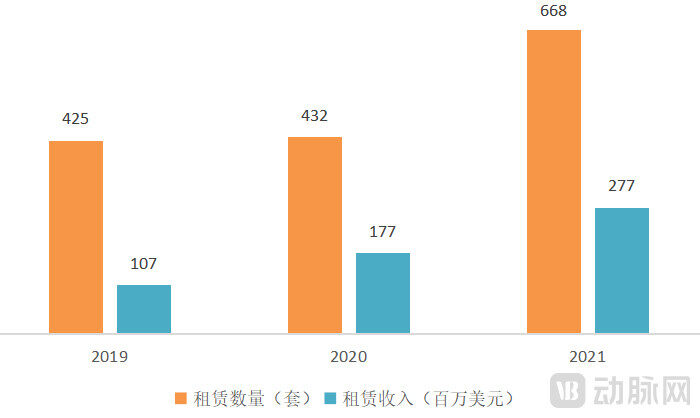
Revenue from Intuitive Surgical's leasing model, data sourced from annual reports
Besides direct sales,Leasing is also a business model of Intuitive Surgical.。
Due to the high one-time procurement and usage costs of the da Vinci surgical robot, it poses a significant financial burden on medical institutions. Therefore, Intuitive Surgical is attempting to promote the surgical robot through leasing. Medical institutions only need to pay an annual training service fee of $80,000 to $190,000 first, after which they can obtain the da Vinci surgical robot via lease.
According to the annual report data, in 2021, 2020, and 2019, a total of 668, 432, and 425 da Vinci surgical robots were leased, generating revenues of $277 million, $177 million, and $107 million, respectively. Calculations show that the annual leasing fee per robot in 2021 was approximately $410,000. Additionally, due to lease agreements allowing customers to exercise buyout options at specific points in time, revenue from this aspect over the past three years was $96 million, $52.22 million, and $92.8 million, respectively. Although the absolute revenue figures are not particularly high, leasing has proven to be an effective way to penetrate the market.
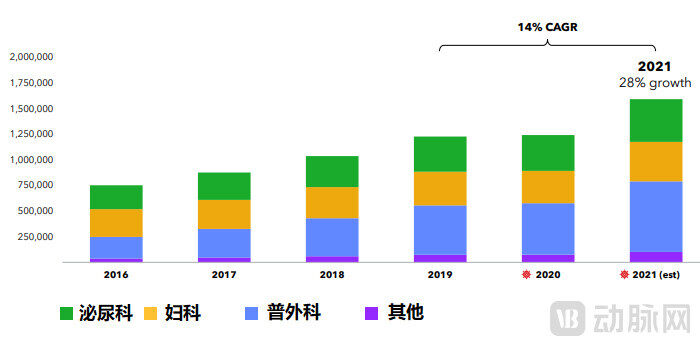
Application Scope of the Da Vinci Surgical Robot, Data from Annual Reports
Expanding the application scenarios of surgical robots is expanding the market.。
From the evolution of surgical procedures using the da Vinci surgical robot, it initially started in urology, then extended to gynecology and general surgery. Taking the United States as an example, before 2008, urology was the primary focus, with robot-assisted radical prostatectomy accounting for the majority. This is mainly because the special anatomical location of the prostate and its surrounding structures make the surgery highly complex. The use of the da Vinci robot can effectively reduce the difficulty of the operation and offers significant advantages in terms of operation time, intraoperative blood loss, incidence of surgical complications, catheter removal time, and hospital stay. It also shows remarkable benefits in the recovery of urinary control and sexual function, thus becoming the industry standard. Currently, over 90% of radical prostatectomies in the U.S. market are performed using surgical robots.
By 2009, gynecology had become the field with the largest number of surgeries, primarily dominated by robot-assisted hysterectomies. This was mainly due to the advantages of surgical robots in complex cases such as morbid obesity, oversized uterus, and severe pelvic adhesions. These advantages include better visualization, simulation, tremor filtration, stable operation in narrow spaces, and visual magnification, along with shorter hospital stays post-surgery. Currently, there is still an annual demand for 200,000 to 250,000 such surgeries in the United States.
Since 2018, general surgery has become the largest surgical field. During the reporting period, the number of Da Vinci surgeries in the United States increased by 27% year-on-year. The main reason for this growth was the increase in general surgical procedures. Inguinal and ventral hernia repairs, cholecystectomies, and bariatric surgeries contributed the most incremental growth in 2021. In markets outside the United States, urology remains the primary focus, but general surgery is expected to bypass gynecology and become the next mainstream field.
After years of market education, the installation volume of Da Vinci surgical robots in China has begun to grow explosively., but the demand is far from being met.
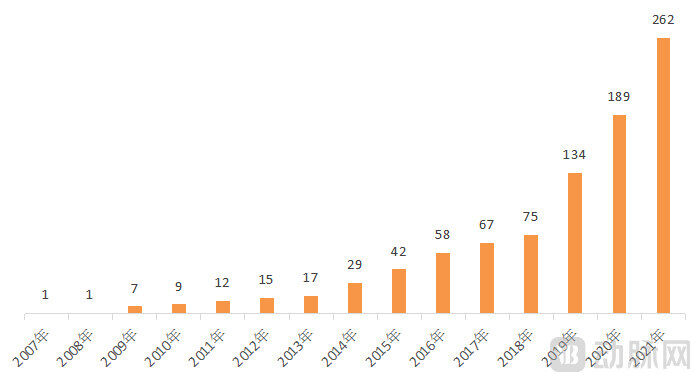
The Number of Da Vinci Surgical Robots Installed in China, Data from Annual Reports
According to data from Shanghai Fosun Pharmaceutical, in 2021, 73 Da Vinci surgical robots were sold domestically in China, an increase of 18 units year-on-year. Considering the unit price of Da Vinci in China is over 20 million yuan, the cost of purchasing the machines alone is close to 2 billion yuan. Based on the revenue structure ratio of Intuitive Surgical, it can be further estimated that the annual cost of consumables far exceeds the purchase cost of the machines.
Since the introduction of the first da Vinci surgical robot in China in December 2006, a total of 262 units had been installed nationwide by the end of 2021. Before 2013, the annual installation volume was basically less than 5 units, and from 2014 to 2018, about 10 new units were added each year. In the recent three years, there has been an explosive growth with 59, 54, and 73 units respectively.
According to previous statistics, these surgical robots are mainly distributed in coastal economically developed areas and a few second-tier cities. The core cities are still not saturated, and the下沉市场has not yet begun. With reference to the United States, which had 3,720 units in service in 2020, there is still significant room for growth in the installation volume of surgical robots in China.
The excellent achievements of Intuitive Surgical are inseparable from continuous innovation, which has constantly improved the smoothness of clinical use. From the first-generation model in 2003 to the fourth-generation Da Vinci Xi in 2014, and the single-port version Da Vinci Xi SP in 2018, the continuous iteration and innovation of products have also allowed the Da Vinci surgical robot to maintain an excellent reputation among doctors for a long time, becoming synonymous with surgical robots, and continuously leading the development of the entire industry.
Although Intuitive Surgical initially targeted the pain points of urological surgeries and made precise efforts to break through, it has not stood still over the years. Instead, it kept expanding its indications. After a decade of continuous penetration, general surgeries have become the category with the highest proportion of da Vinci surgical procedures, offering significant room for market imagination.
Moreover, to continuously gain favor in the secondary market, relying solely on core technology and product storytelling is insufficient. Intuitive Surgical pioneered a business model in the surgical robotics field: equipment + consumables + services, supplemented by a leasing model. The revenue from consumables steadily increases as the installed base of equipment grows. This mature business model’s ability to generate continuous cash flow has given the secondary market tremendous confidence. Since its listing, Intuitive Surgical's stock price has risen up to 170 times at its peak. It is precisely its outstanding performance that has made the surgical robotics sector thrive in China.
As a listed company对标ing Intuitive Surgical's da Vinci robot, MicroPort Robot also recently released its first earnings report after going public. Listed on the Hong Kong Stock Exchange on November 2, 2021, MicroPort Robot reported revenue of RMB 2.15 million for the fiscal year ending December 31, 2021, which, compared to having no operating income in 2020, represents significant growth. However, the company's net loss reached RMB 584 million, making the revenue seem negligible in comparison. Compared to a loss of RMB 209 million in 2020, this marks an expansion of nearly 180%.
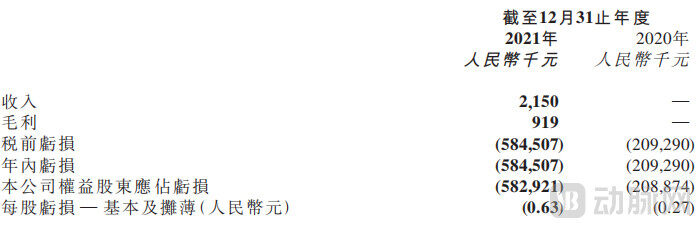
Financial Summary of MicroPort Robotics 2021 Annual Report, Data from the Annual Report
According to the annual report data, the revenue comes from the Dragonfly Eye DFLens three-dimensional electronic laparoscope, which began to be promoted and sold in hospitals after obtaining approval from the National Medical Products Administration in June 2021. However, the loss mainly stems from the research and development costs, which increased by 190.0% from RMB 135.4 million as of December 31, 2020, to RMB 392.6 million.
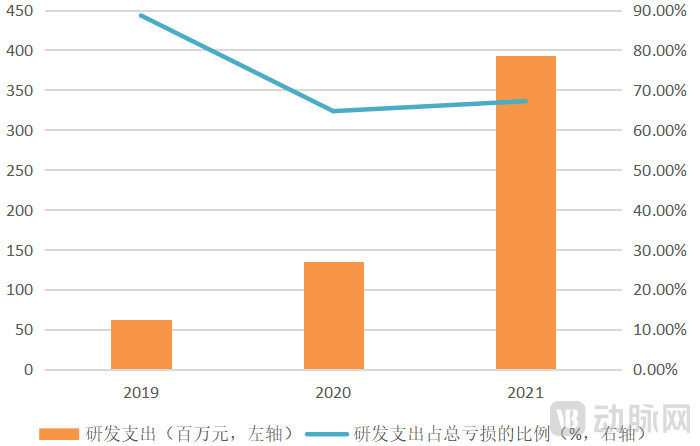
MicroPort Robotics R&D Expenditure, Data from the Company's Annual Report
In terms of R&D, MicroPort Robotics currently has eight R&D teams responsible for electrical development, software development, visual imaging development, algorithm development, mechanical engineering, testing, intellectual property management, and fund management. As of December 31, 2021, the R&D team consisted of 317 members, approximately 60% of whom hold a master's degree or higher.
In terms of patents, as of the end of 2021, MicroPort Robotics has applied for 503 patents worldwide, of which 159 have been granted, including 129 patents in China and 30 overseas patents. The remaining 344 patents are still in the application process, covering areas such as clinical applications, automated surgery, and AI technology.
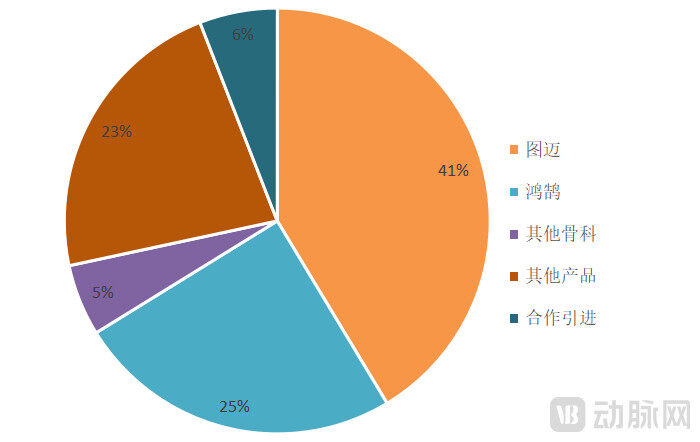
Proportion of R&D expenses, data sourced from annual reports
The annual report disclosed the proportion of R&D expenses, and from the distribution of MicroPort Robot's R&D expenses, it can be seen that Tumor, the core product as a laparoscopic surgical robot, occupies the majority of MicroPort Robot’s resources. The registration application for urological surgery indications has been approved. Tumor is the first approved domestically produced four-arm laparoscopic surgical robot and will primarily compete with Da Vinci in the Chinese market.
In addition to TuMi, the HongHuo orthopedic robot also incurred significant R&D expenses, as orthopedic surgical robots are expected to become the next widely adopted field after laparoscopic surgical robots. In terms of application scenarios, orthopedic surgical robots are mainly used in joint replacement surgeries (knee or hip), spinal surgeries, and trauma surgeries (fracture reduction).
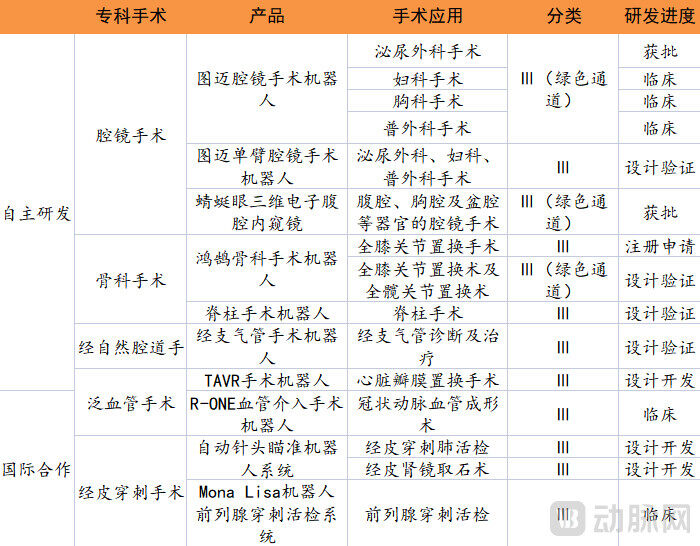
Research and Development Layout and Progress of MicroPort Robotic Products, Data from Annual Report
It can be seen that the huge R&D investment has not only brought about two flagship products, TuMi and HongHu, but also a rich product layout, all of which are the foundation for the diversified and sustainable development of the enterprise.
Recently, TINAVI's annual report forecast was released, expecting to achieve revenue of 170 million yuan in 2021, a year-on-year increase of 24.89%; net loss of 74.7535 million yuan, with the loss widening by 37.24% year-on-year.R&D expenses increased significantlyIt was also one of the reasons for TINAVI's expanded losses in 2021.
TINAVI stated that during the reporting period, it increased its R&D investment in new technologies and products for orthopedic surgical robots. The R&D expenses during the reporting period were approximately 110 million yuan, a year-on-year increase of 48.48%. It is expected that R&D expenditure will account for about 64.83% of operating income, an increase of approximately 10.3 percentage points compared to the previous year.
As of 2021H1, TINAVI has cumulatively applied for 270 patents (including 99 invention patent applications), obtained 171 patent grants (including 36 invention patent grants), and currently holds 157 valid patents (including 32 invention patents).
Currently, TINAVI's research and development mainly focuses on several core technologies: one is the configuration of orthopedic surgical robots, which simply means optimizing the design to meet the environmental needs and developments of operating rooms; the second is high-precision online calibration technology, which is error control; and the third is multi-modal medical image fusion and processing technology.
From the perspective of the project, TINAVI's research and development mainly focuses on improving the TiRobot series: First,Indication Expansion; Second, the productImprovement in Intelligence Level; Third isLocalization of Core Components; Fourth,Consumables R&D。
TINAVI's orthopedic surgery navigation and positioning robot has been developed to the third generation, with two main commercial products: "Tianji" and "Tianji 2.0." "Tianji" completed registration and was launched in November 2016 (which can be regarded as Tianji 1.0), while "Tianji 2.0" obtained a Class III medical device registration certificate in February 2021 and was officially introduced to the market at the end of April the same year. By the end of 2021, the total number of surgeries performed during the reporting period exceeded 10,000 cases.
In terms of indications, TiRobot 2.0 is consistent with TiRobot 1.0, both applicable to orthopedic trauma and full-segment spinal surgeries. However, TiRobot 2.0 is more intelligent, with more convenient and user-friendly machine operation, allowing doctors to independently perform surgeries and operate the robot, significantly reducing operation time while improving surgical quality and efficiency. Additionally, the all-new Viper Prime (TM) TiRobot Spine Robotic Surgery Integration Solution, jointly developed by TINAVI and Johnson & Johnson Medical, has officially been launched and put into use.
As the R&D phase comes to an end, a number of surgical robots made in China have been successively approved for marketing.
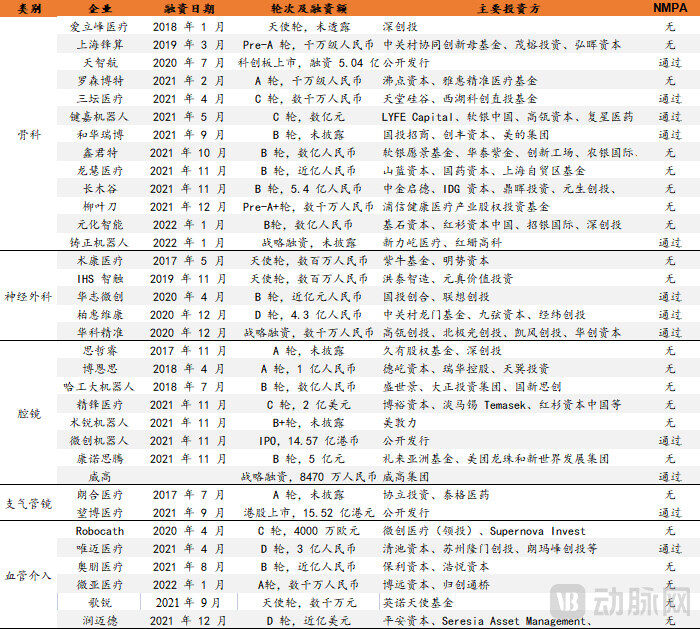
Surgical Robot Layout of Major Enterprises in China, Data from VCBeat
Weigao Robot
The innovative product "Laparoscopic Surgical Equipment" produced by Shandong Weigao Surgical Robotics Co., Ltd. officially received NMPA approval in October 2021 and was authorized for market launch. Notably, Weigao Surgical Robotics' "Laparoscopic Surgical Equipment" became the first domestically produced laparoscopic surgical robotic system approved for marketing in China, filling a domestic gap and breaking foreign monopolies.
Hangzhou Jiana
ARTHROBOT HIP, the total hip replacement surgical robot independently developed and manufactured by Hangzhou Jiana Robotics Co., Ltd., officially received market approval from the National Medical Products Administration (NMPA) in April 2022, becoming the first China-produced hip joint surgical robot to obtain NMPA certification.
ARTHROBOT HIP is the first "total hip arthroplasty surgical robot" product in China to enter the NMPA Innovative Medical Device Special Review Process, and also the first domestically approved joint arthroplasty robotic platform system with open implant data. Based on the same platform, Jianjia Robotics has also developed ARTHROBOT KNEE for knee replacement, which completed clinical trial enrollment in October 2021 and is expected to be approved for marketing in 2022.
Baihui Weikang
RM-50 Neurosurgical Robot, Independently Developed by Beijing Baihui Weikang Technology Co., Ltd., Obtained NMPA Certification in January 2022. The launch of the RM-50 surgical robot marks the first time that China has truly achieved "domestic production" of key core components in neurosurgical robots, breaking the passive situation in the field of core components for domestic surgical robots.
Core Components of Neurosurgical Robots Include Optical Tracking Positioning Devices and Robotic Arms. Baihui Weikang independently develops optical tracking positioning devices, which can track the precise location of target objects in real-time under ambient light conditions, quickly completing spatial registration for surgical robots; additionally, artificial intelligence technology is utilized to enhance the accuracy and stability of domestically produced robotic arms.
Zhu Zheng Robotics
Zuhang 300 "Spine Surgical Navigation and Positioning Equipment" developed by Zhuzheng Robotics received NMPA approval for marketing in March 2022. This is the fifth spine surgical robot to be approved for marketing in China, following TINAVI's "Tianji Robot," Zimmer Biomet's Rosa One, Medtronic's MAZOR X, and Xinjun Special's ORTHBOT robot.
Suzhou Zhuzheng Robotics Co., Ltd. was established in 2016, with its research and development focused on the field of minimally invasive spinal surgery. Zuo Hang-300 is currently the only robot capable of performing orthopedic surgeries under local anesthesia, effectively addressing issues such as long operation times and high surgical costs.
Hua Rui Bo
HURWA Robot for Total Knee Arthroplasty, Produced by Beijing Hua Rui Bo Medical Technology Co., Ltd., Officially Received NMPA Approval for Market Launch in January 2022. The HURWA robot automatically performs osteotomy operations with the robotic arm directly holding the power tool. During this process, the surgeon does not need to make position judgments and only needs to trigger the movement of the robotic arm to complete the osteotomy. The system accuracy is within 1.5mm.
In addition, the surgical robot products of five companies—Jingfeng Medical, HuaKe Precision, Changmu Valley, Zhen Health, and Lancet—have recently successfully passed the special review for innovative medical devices and entered the green approval channel. As can be seen from the table above, domestically produced surgical robots in China have gradually moved from the research and development stage to the approval stage. The next challenge will be the commercialization process.
The promotion of domestically produced endoscopic robots in China inevitably revolves around the da Vinci system.。
From the hospital's perspective, the purchase price of a da Vinci system ranges from 20 to 30 million yuan. Calculated on an 8-year depreciation schedule, the annual depreciation cost is approximately 3.3 million yuan. Next are the maintenance costs, with annual maintenance fees for the da Vinci surgical robot exceeding 1.5 million yuan. Additionally, consumables are a significant expense; as seen from Intuitive Surgical’s annual report, revenue from accessories and consumables is double that of the robot itself.
The logic of domestic substitution is inevitably related to price. In terms of manufacturing itself, domestic companies have a natural cost advantage. As long as they can provide products with similar performance, substitution will inevitably occur. In the face of foreign technical blockades, domestic companies need to have sustainable self-research and development capabilities. Whoever has strong continuous R&D capabilities will have the priority to complete the substitution.
From the patient's perspective, the total cost of a single surgery using the Da Vinci surgical robot exceeds 40,000 yuan. Although in recent years, with the success of market education, patients have begun to recognize the value of robotic surgery and are willing to pay for it, who would mind if the price were lower?
The real barrier that China-produced endoscopic robots need to face is doctors, who are trained with the da Vinci system as the standard. After undergoing various training programs provided by da Vinci in the early stages, they have not only become accustomed to the overall operation method of da Vinci but also developed a deep-rooted belief that the da Vinci system is stable and rarely encounters issues.
To reverse this situation, enterprises must not only rely on conventional methods such as training, collaboration with clinical institutions, hospital promotions to encourage doctors to use their products, or even comparing with da Vinci to gain doctors' approval, but also provide better services.
Taking MicroPort's surgical robot as an example, they have developed the Toumai Robotic Mobile Training and Exhibition Platform. This platform has comprehensive support capabilities, providing the energy, consumables, and maintenance required for endoscopic surgical robot training, as well as exhibition and teaching functions. It enables more medical staff to access, experience, and understand domestically produced surgical robots without traveling, thereby lowering the training threshold.
Concerns About Orthopedic Surgical Robots in Policy。
As early as 2021, surgical robots were successively included in the medical insurance programs of Shanghai and Beijing. Under the national trend of promoting medical service price reform and supporting innovative products with clinical value, the coverage of medical insurance payments for surgical robots may accelerate.
Beijing Launched Medical Insurance Payment Plan in August 2021: Surgical Robots and Consumables Included in Coverage
By early March 2022, a "letter soliciting opinions on the 'Guidelines for Improving the Pricing and Related Policies of Orthopedic Surgical Robots and 3D Printing-Assisted Operations (Draft for Comments)'" began circulating within the industry.
In the above-mentioned draft for soliciting opinions, there is a clear classification of the actual functions of orthopedic surgical robots. For instance, if a surgical robot only possesses and performs navigation and positioning functions, it will be reflected as an "additional charge item" of the orthopedic surgery price project to reflect the value of auxiliary operations. The name of the "additional charge item" should indicate the navigation and positioning functions. If a surgical robot only possesses and performs navigation and positioning functions, the additional charge for each surgery should not exceed 40% of the total cost. For core procedures costing more than 5,000 yuan per case, the additional charge is capped at 2,000 yuan per session.
"Surgical robots, under the control of medical staff, complete or participate in completing part of the surgical operation, with an additional charge ratio not exceeding 80%." The draft also explicitly pointed out that some regions have received applications for new orthopedic "surgical robot" and "3D printing" medical service price projects, which generally present a situation of "dual high" costs: equipment procurement cost and disposable accessory prices.
An industry insider stated: "The logic behind the draft opinion is that, after the volume-based procurement of artificial joints, the product prices have been reasonably controlled. However, if the price of surgical robots is too high, it may offset the effects brought by volume-based procurement. But for companies, the pricing of surgical robots needs to balance multiple factors. It must meet the demand for clinical innovation, avoid imposing excessive medical burdens, and ensure their own development at the same time."
Enterprises need to find the balance point among academic value, clinical value, and commercial value.
“Surgical robots are the new infrastructure of hospitals"An investor said in an interview with VCBeat.
From the hospital's perspective, as more and more clinical evidence accumulates, the advantages of robotic surgery will become more apparent. From the patient's standpoint, not everyone can have the privilege of being operated on by a top director, but if the same level of precision can be achieved with the help of a robot, and the price difference is controllable, patients are willing to make that choice.
At that time, surgical robots should not be simply regarded as a surgical instrument, but as a basic piece of equipment, like CT or MRI machines. A CT or MRI machine can cost tens of millions, while the fee for a single examination is only a few hundred. Why do hospitals still purchase them? The reasons are: firstly, the large volume of usage; secondly, they are part of the hospital's infrastructure.
Surgical robots are equivalent to the infrastructure of the operating room. Based on this infrastructure, new and optimized surgical tools will be derived. These are no longer traditional manual staplers or various clamping tools like forceps. In the future, it will evolve into a new system. From the perspective of the entire surgical procedure, it will develop in a new direction. If leading hospitals start to shift in this direction, the hospitals below will follow.
"In the long run, once this trend starts, it cannot be stopped."
In the future, hospitals purchasing robots will be like an arms race. Because if a hospital does not have robots, patients may choose other hospitals with robots for surgery. This is not an exaggeration. In the UK, under the competition of hospitals equipped with the da Vinci surgical robot, 25% of hospitals without robots have shut down their prostate cancer treatment services.
Professor Freddie Hamdy, a urology expert from the University of Oxford, stated: "Once these devices become mainstream, it will be very difficult to phase them out."
Surgical robots are entering a golden age of development, but as the industry heats up, signs of overcrowded competition are beginning to show. An investor told VCBeat: "In the overheated market environment, there needs to be some cold reflection."
In 2022, although surgical robots are indeed a hot topic, careful comparisons between different projects are necessary, and one cannot blindly follow the logic of investing in a specific track. Especially now, with so many companies in the race, the number of players the future market can accommodate will definitely be limited.
“The medical device track is all about competing to become the leader in a细分 market.。”
In the end, which company can survive and grow strong depends on the founding team, the technical accumulation in related fields, their understanding of the market, resources in relevant fields, future planning, the ability to expand the technology roadmap in clinical application scenarios, and commercialization capabilities.
Reviewing the commercialization journey of da Vinci, surgical robots can only achieve true scale with solid foundational design, excellent clinical outcomes, and a long period of market cultivation. China-produced surgical robots still need to continuously enhance their internal capabilities to meet future development.