

Life Biosciences Files for IPO: Pioneering Comprehensive Therapies Against Aging-Related Diseases with Over $300M Raised

Life Biosciences
Drug Developer
Global Population Is Entering an Aging Phase: The number and proportion of elderly populations are increasing in almost every country worldwide. Data from the United Nations' "World Population Prospects: 2019 Revision" shows that in 2019, the global population aged 65 and over accounted for 9%, and this figure is expected to rise to 16% by 2050. Additionally, the population aged 80 and above is projected to increase from 143 million in 2019 to 426 million in 2050, with a growth rate of approximately 200%.
With the acceleration of the global aging process, the prevalence of aging-related diseases (ARD), such as ischemic heart disease, Alzheimer's disease, stroke, and chronic obstructive pulmonary disease, continues to rise. Longevity and health are almost everyone's desire, and how to address the challenges brought by aging is increasingly becoming a focal point for all sectors of society.
Life Biosciences, founded in 2017 and headquartered in Boston, Massachusetts, U.S., is developing innovative therapies targeting the biology of aging to prevent age-related diseases. Life Biosciences focuses on eight biological signals that trigger age-related diseases in the human body to comprehensively combat aging. In 2022, the company will initiate human studies for a mitochondrial uncoupler candidate drug.
Life Biosciences was co-founded by Dr. David Sinclair and Mr. Tristan Edwards.
Dr. Tristan Edwards is currently the President and Chief Investment Officer of Life Biosciences. Dr. Tristan has 16 years of investment experience and extensive global financial capital markets, regulatory, and fiduciary oversight expertise, having worked in leading financial institutions in Australia, London, Hong Kong, and Singapore. Dr. Tristan's career began at the Australian Treasury, and he has held senior investment roles at leading financial groups such as Goldman Sachs, Brevan Howard, Trafalgar Capital, and Mosaic Asset Management. He holds a business degree from the University of Tasmania and has earned the CFA, CMT, and CPA designations.
 Co-founder, President, and Chief Investment Officer Tristan Edwards
(Source: Life Biosciences official website)
David Sinclair is currently a director of Life Biosciences. Dr. Sinclair is a tenured professor in the Department of Genetics at Harvard Medical School and is considered one of the world's leading researchers in the study of aging and age-related diseases. He has made significant contributions to understanding the causes of aging and how to slow down or even reverse this process. Dr. Sinclair has extensive experience in running companies, having co-founded several biotechnology and genomics companies dedicated to researching aging, neurological, metabolic, infectious, and rare diseases. Additionally, Dr. Sinclair has received over 35 awards for medical research, innovation, and teaching and was named by Time magazine as one of the "100 Most Influential People in the World" and one of the "50 People Transforming Healthcare."
 Co-founder and Director David Sinclair
(Image source: Life Biosciences official website)
The two founders of Life Biosciences possess deep knowledge and extensive experience in the finance and biopharmaceutical industries, while the current CEO has rich experience in corporate management.
Jerry McLaughlin is currently the Chief Executive Officer and a member of the board of directors at Life Biosciences. With over 30 years of experience in the biopharmaceutical industry, he has been involved in the discovery, clinical development, and global commercialization of more than a dozen FDA-approved drugs. Most recently, Jerry served as the President and Chief Executive Officer of Neos Therapeutics, a commercial-stage pharmaceutical company. Prior to that, he was the President and Chief Executive Officer of AgeneBio, a neuroscience-focused pharmaceutical company, and the Senior Vice President and Chief Commercial Officer of NuPathe (acquired by Teva Pharmaceuticals in 2014), another neuroscience-focused pharmaceutical company.
 Jerry McLaughlin, CEO and Director
(Source: Life Biosciences official website)
The three individuals each perform their respective roles, leveraging their professional expertise in financial investment, drug research and development, and company operations. The team collaborates seamlessly.
In the view of Life Biosciences, human aging is not an independent physical symptom but is closely related to changes in eight biological signals. These eight biological signals that cause aging-related diseases are: mitochondrial dysfunction, altered communication and inflammation, chromosomal instability, cellular senescence, loss of proteostasis, epigenetic alterations, stem cell exhaustion, and metabolic decline.
Unlike other companies that focus on one or a few biological signals,Life Biosciences enables its six subsidiaries to work collaboratively, aiming to achieve full coverage across eight major fields.Each subsidiary of Life Biosciences focuses on at least one of these areas. For example, Unity Biotechnology specializes in eliminating senescent cells, while Continuum Biosciences is dedicated to ensuring the proper functioning of mitochondria. Then, the six subsidiaries integrate and analyze scientific research information through Lua, a centralized data sharing and communication platform.
Currently, Life Biosciences has developed corresponding therapeutic technologies targeting three biological mechanisms: loss of protein homeostasis, mitochondrial dysfunction, and epigenetic alterations, and has established three major platforms.
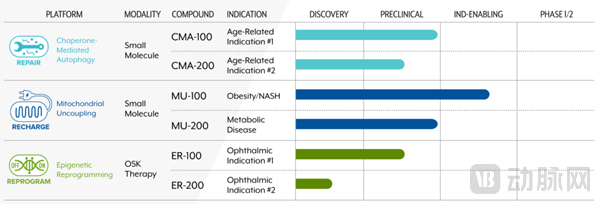
Product Pipeline (Source: Life Biosciences Official Website)
Partner-Mediated Autophagy Platform
Chaperone-Mediated Autophagy (CMA) can degrade unnecessary soluble proteins in cells. With age, the expression of LAMP2A, a key protein regulating CMA activity, decreases, leading to a reduction in CMA activity. This results in the accumulation of insoluble proteins, disrupting cellular function and causing related diseases.
Life Biosciences is developing CMA activators to reduce the accumulation of aggregated proteins, which have already demonstrated safety and efficacy in preclinical models of neurodegeneration and age-related decline in stem cell function.
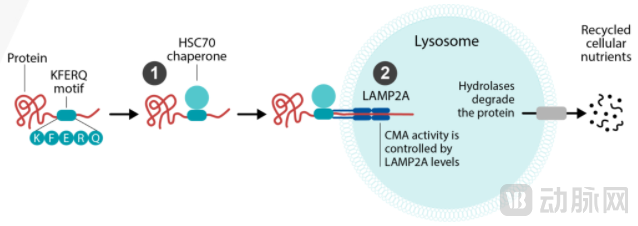
Mechanism of Partner-Mediated Autophagy Platform
On September 28, 2021, Life Biosciences received translational research funding from the Alzheimer's Drug Discovery Foundation (ADDF) to support the development of CMA activators.
Currently, Life Biosciences has two CMA activators targeting aging-related diseases, both in the preclinical research stage.
Mitochondrial Uncoupler Platform
As people age, their metabolism declines. Mitochondrial uncouplers have been shown to increase metabolic rate, reduce oxidative stress, and extend lifespan in preclinical species.
Life Biosciences is developing small-molecule mitochondrial uncoupler compounds to increase metabolic rate. The mitochondrial uncoupler has demonstrated safety and efficacy in preclinical models of obesity and non-alcoholic steatohepatitis (NASH).
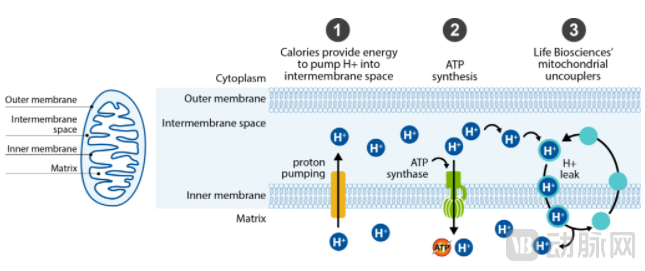
Mechanism of Action of Mitochondrial Uncouplers Platform
Currently, Life Biosciences' mitochondrial uncoupler for obesity and NASH has received IND approval, and Phase I studies will be initiated in 2022. Another mitochondrial uncoupler targeting metabolic diseases is in the preclinical research stage.
Epigenetic Reprogramming Platform
The epigenome consists of chemical modifications to DNA and DNA-binding proteins that turn genes on and off. The epigenome changes with age, leading to dysregulated gene expression.
Life Biosciences reprograms the epigenome of older animals to a younger animal-like state by expressing three Yamanaka factors (OCT4, SOX2, and KLF4 [OSK]). This technology has demonstrated safety and efficacy in preclinical models of nerve compression and glaucoma.
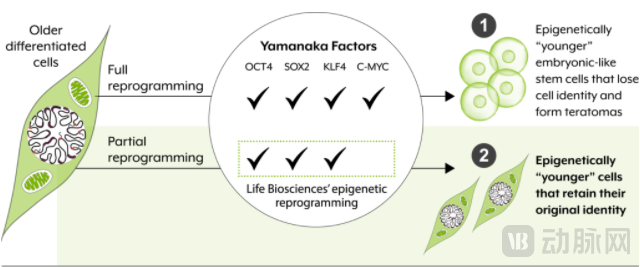
Mechanism of Action of Epigenetic Reprogramming Platform
Currently, Life Biosciences has two candidate products for ophthalmic diseases, one in the discovery stage and the other in the preclinical research stage.
Life Biosciences continues to make efforts in both investment and financing, steadily advancing the research and development of innovative therapies to achieve treatments for age-related diseases.
In December 2018, Life Biosciences led a strategic financing round for the biotechnology company Prana Biotechnology, investing a total of $7.5 million. The latter primarily focuses on researching neurodegenerative diseases.
In January 2022, Life Biosciences completed an $82 million Series C financing round led by Alpha Wave Ventures. The proceeds will be used to accelerate research and development activities across the company’s three platforms aimed at treating various aging-related diseases. To date, Life Biosciences has raised over $200 million through three rounds of financing.

In recent years, an increasing number of startups have emerged in the anti-aging field. Life Biosciences stands out with its comprehensive anti-aging strategy and proprietary therapeutic platform, showing promising prospects.