

China's recombinant protein leader Acrobiosystems launches push for HK listing

ACROBiosystems
Provider of Biopharmaceuticals and Biological Reagents
On December 18, Acrobiosystems (stock code: 301080.SZ) announced that its board of directors had reviewed and approved the relevant proposal regarding the issuance of overseas listed foreign shares (H-shares) and the intended listing on the main board of the Hong Kong Stock Exchange. The announcement stated that the move aims to accelerate its globalization strategy, build an international capital platform, and boost overall competitiveness. However, specific details such as the issuance scale, pricing range, and issuance timeline are still under formulation. Subsequent steps will require submission to the general meeting of shareholders for review and approval, as well as obtaining the necessary authorizations and approvals from relevant governmental and regulatory authorities.
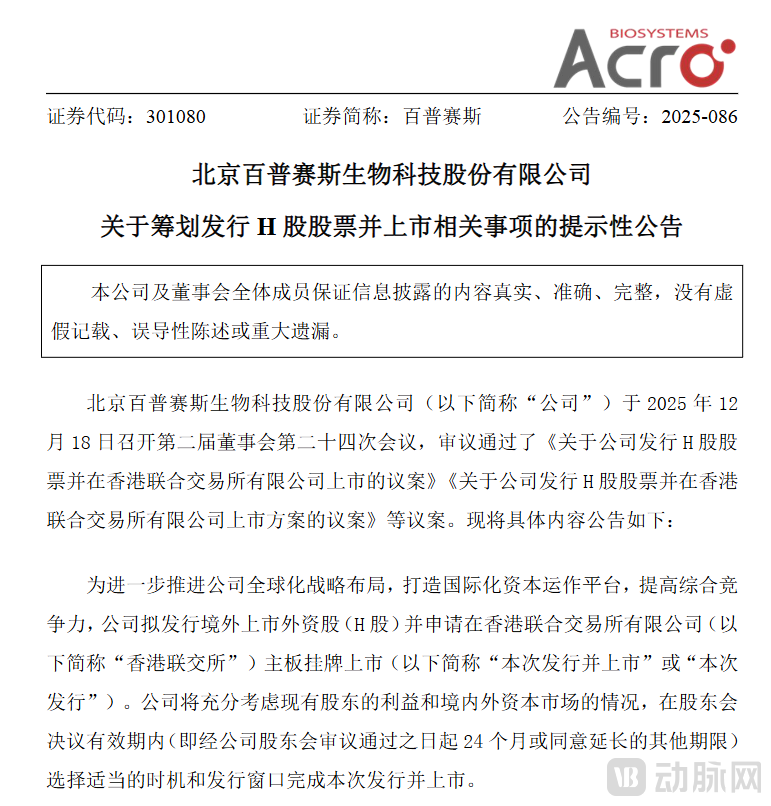
This capital market move comes approximately four years after its 2021 IPO on Shenzhen's ChiNext board. Compared to its initial listing, the proposed H-share issuance signals a more pronounced strategic shift towards internationalization and deeper engagement with global capital markets.
Building the Toolbox for Global Drug R&D
In 2010, Acrobiosystems entered the market focusing on recombinant proteins and related biological reagents, precisely targeting the upstream segments of the biopharmaceutical R&D chain from the outset. The company aimed to become a core tool supplier for fundamental research and early-stage drug development.
This positioning was not accidental but stemmed from a profound understanding of the pain points in biopharmaceutical R&D. Under traditional models, in-house laboratory protein production or reagents from scattered sources often led to batch inconsistencies, resulting in poor comparability of experimental outcomes. This not only increased R&D costs but also amplified uncertainty in R&D decision-making.
To address this critical pain point, Acrobiosystems established a product system centered on recombinant proteins, antibodies, and reagent kits, leveraging standardized, scalable supply as its entry strategy. Its sub-brands include Membrane Masterpiece, Star Staining, Aneuro, ComboX, ActiveMax, and GENPower. Acrobiosystems' main products and services include proteins, antibodies, reagent kits, and analytical testing services, which are applied across various stages such as drug screening and optimization, preclinical and clinical trials, drug manufacturing process and control (CMC), and diagnostic reagent development in areas including oncology, autoimmune diseases, cardiovascular diseases, infectious diseases, and neurological disorders.
To better serve global clients, Acrobiosystems has extended its business reach to major markets in Asia, North America, and Europe. It has established offices, R&D centers, and production bases in over ten cities across China, the United States, Switzerland, and other countries, forming a network that combines localized responsiveness in China with global service capabilities. To date, the company has served more than 11,000 clients and has established deep collaborations with leading innovative drug manufacturers and CRO/CDMO companies both in China and abroad, including Johnson & Johnson, Pfizer, WuXi AppTec, Innovent Biologics, Junshi Biosciences, and BeOne Medicines. In recent years, as the proportion of overseas clients and international collaborations has grown, its products have been utilized in early-stage R&D projects of several global pharmaceutical companies and are gradually being integrated into global R&D workflows.
Supporting these strategic initiatives are Acrobiosystems' capacity-building capabilities and robust financial performance.
The China headquarters project in Beijing's Yizhuang New Town, launched in November 2023, is centered on an integrated R&D and production platform covering multiple categories such as proteins and antibodies, reagent kits, magnetic beads, cell lines, and culture media. According to project filings and environmental impact assessment reports, upon reaching full production capacity in 2028, the facility is expected to achieve an annual output of 816,000 vials of protein and antibody products, 10,000 analytical testing services per year, with an estimated annual output value exceeding RMB 1.2 billion.
Financially, the Q3 2025 report shows that Acrobiosystems achieved operating revenue of RMB 226 million, a year-on-year increase of 37.50%, and net profit attributable to shareholders of RMB 48.62 million, surging by 81.46% compared to the same period last year, highlighting a significant improvement in profitability. Notably, while expanding its business scale, Acrobiosystems has demonstrated effective cost control. In the first three quarters of 2025, its sales expense ratio, administrative expense ratio, and R&D expense ratio decreased by 2.62, 2.44, and 4.18 percentage points year-on-year, respectively. The simultaneous enhancement in operational efficiency has laid a solid financial foundation for its global expansion.
Hong Kong Listing: A Strategic "Passport" for Global Integration
In recent years, global pharmaceutical R&D investment has continued to rise. According to Evaluate Pharma data, the global pharmaceutical industry's R&D expenditure in 2024 grew by 1.5% year-on-year, reaching approximately USD 288 billion. This rising R&D expenditure fuels demand for upstream tools and reagents: the IMARC report indicates that the global biotechnology reagent market was valued at around USD 91.748 billion in 2024 and is expected to maintain steady growth in the coming years. Meanwhile, research by Global Growth Insights highlights that key biotech reagent segments, particularly antibodies and recombinant proteins, are projected to sustain double-digit growth in the future.
Despite the growing demand, the industry's competitive landscape has not loosened significantly. The global high-end research-grade and GMP-grade biotech reagent market has long been dominated by comprehensive multinational giants such as Thermo Fisher and Danaher. Their edge stems not only from the stability and consistency of product performance but also from established brand equity, mature global compliance frameworks, and deep integration into—and acceptance by—the global procurement systems of multinational pharmaceutical companies.
In recent years, Chinese companies have made continuous advancements in engineering capabilities and quality control, achieving competitiveness in some research-grade and domestic GMP scenarios in China. However, they still require time to build credibility in international financing channels, establish trust with global clients, and secure compliance endorsements on a worldwide scale. For enterprises positioned as core tool suppliers, having a presence in international capital markets is increasingly evolving into an implicit requirement for entry into the global procurement systems of multinational pharmaceutical companies.
Given these market realities, pursuing a Hong Kong listing emerges as a critical strategic step for Acrobiosystems to advance its globalization. An H-share listing serves a dual purpose: it enables the direct raising of foreign capital for overseas R&D and market system development, while also leveraging Hong Kong's capital market, which has cultivated a mature investor base in the life sciences sector. This enhances Acrobiosystems' visibility within the global industrial chain and shortens the timeline for building trust with international pharmaceutical enterprises.
From a broader industry perspective, this choice also reflects the stratified competitive landscape taking shape in the life science tools sector. At the upstream end of the industrial chain, integrated giants like Thermo Fisher and Danaher have built comprehensive ecosystems encompassing "reagents + instruments + integrated services" through continuous acquisitions, securing core positions across both R&D and production. Meanwhile, specialized suppliers relying on engineering stability and delivery efficiency retain irreplaceable niches in specific targets or application scenarios. With the rising momentum of innovative drug R&D in China, Chinese pharmaceutical companies' demand for high-quality, responsive tool-based products is growing in parallel, creating differentiated entry opportunities for Chinese specialized manufacturers.
Acrobiosystems exemplifies this path of deep specialization over scale—integrating into global R&D workflows through standardized offerings and reliable delivery, rather than competing via broad-based M&A.
It is important to recognize that this path also entails structural risks. Tool-centric companies are highly dependent on R&D cycles; when financing for innovative drugs tightens and project numbers decline, upstream demand may face corresponding pressures. Additionally, competition in pricing and efficiency could intensify if international giants enter niche segments through acquisitions.
In summary, Acrobiosystems' pursuit of a Hong Kong listing marks a strategic leap from a domestic leader to an aspiring global contender in the life science tools ecosystem. This reflects a broader trend where Chinese upstream leaders, having achieved technical parity, now seek international capital credentials and global systemic integration. Its success will be measured by the listing's progression, the sustained growth of overseas revenue, and continued R&D prowess.