

Neoadjuvant Opdivo (Nivolumab) Plus Chemotherapy Significantly Improves Event-Free Survival in Resectable NSCLC: First FDA-Approved Immunotherapy-Based Neoadjuvant Regimen
Bristol-Myers Squibb
Biopharmaceutical and Nutritional Product R&D and Sales
News on April 12, 2022 / BIOON / -- Bristol-Myers Squibb (BMS) recently announced the latest results of the Phase 3 CheckMate-816 trial (NCT02998528) for the anti-PD-1 therapy Opdivo (nivolumab) at the 2022 American Association for Cancer Research (AACR) Annual Meeting.
This is a randomized, open-label, multicenter trial conducted in patients with resectable IB-IIIA stage non-small cell lung cancer (NSCLC), regardless of PD-L1 expression status. In the trial, patients were randomly assigned to receive either Opdivo plus chemotherapy regimen (once every 3 weeks for a total of 3 cycles) or chemotherapy alone (once every 3 weeks for a total of 3 cycles) as neoadjuvant (pre-surgery) treatment, followed by surgery. The primary endpoints of the trial are pathological complete response (pCR) and event-free survival (EFS). pCR is defined as no evidence of cancer cells present in the resected tissue according to blinded independent pathological review. EFS is defined as the length of time without disease progression or recurrence.
Data presented at the meeting showed that when used for preoperative treatment, with a minimum follow-up of 21.0 months, Opdivo + chemotherapy demonstrated a significant improvement in EFS compared to chemotherapy alone, reducing the risk of disease progression, recurrence, or death by 37% (HR=0.63; 97.38% CI: 0.43-0.91; p=0.0052). The median EFS was 31.6 months for patients in the Opdivo + chemotherapy group and 20.8 months for those in the chemotherapy group.
Moreover, although the overall survival (OS) data are not yet mature and the analysis did not reach statistical significance, favorable early OS results were observed in the Opdivo plus chemotherapy group compared to the chemotherapy alone group (HR=0.57; 99.67% CI: 0.30-1.07). After two years, 83% of patients in the Opdivo plus chemotherapy group were alive, compared to 71% in the chemotherapy group. The trial will continue to follow up on OS.
Previously published primary endpoint data for pCR showed that: compared with the chemotherapy group, the pCR in the Opdivo + chemotherapy group significantly improved (24% vs 2.2%). Regardless of PD-L1 expression levels, histology, or disease stage, pCR consistently demonstrated improvement. In this trial, the safety of neoadjuvant Opdivo combined with chemotherapy was consistent with previous reports, and no new safety signals were observed at the time of EFS analysis.
CheckMate-816 represents the first phase 3 trial in which immunotherapy has demonstrated positive results in the neoadjuvant treatment of NSCLC. The data show that, in patients with resectable stage IB-IIIA NSCLC, Opdivo + chemotherapy significantly improved event-free survival (EFS) and the pathological complete response rate (pCR) compared to chemotherapy alone.
In March 2022, based on the results of the CheckMate-816 trial, the U.S. FDA approved Opdivo in combination with platinum-doublet chemotherapy, administered once every 3 weeks for a total of 3 cycles, as neoadjuvant (preoperative) treatment for adults with resectable (tumor ≥4 cm or lymph node-positive) non-small cell lung cancer (NSCLC), regardless of PD-L1 status.
Opdivo + Chemotherapy Also Marks the First Immunotherapy-Based Treatment Regimen for Neoadjuvant (Preoperative) Treatment of NSCLC. Previously, Opdivo-based immunotherapy combination regimens have been approved for the treatment of metastatic and early-stage NSCLC.
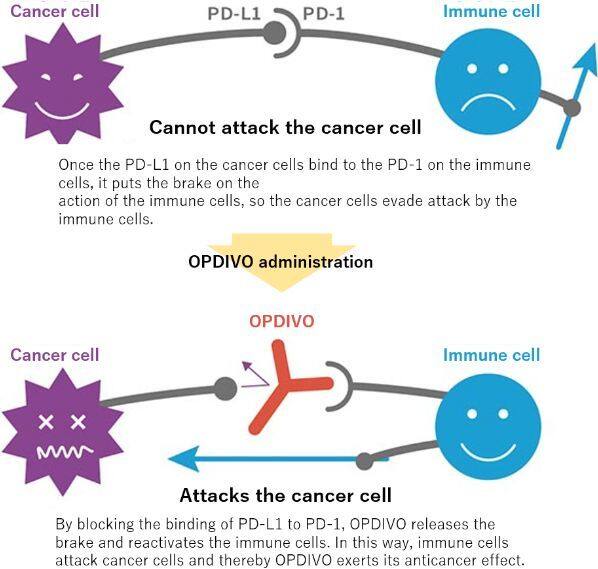
Mechanism of Action of Opdivo (Source: ono-pharma.com)
Lung cancer is the leading cause of cancer death worldwide. The two main types of lung cancer are non-small cell lung cancer (NSCLC) and small cell lung cancer (SCLC). NSCLC is the most common type of lung cancer, accounting for 84% of lung cancer diagnoses. Non-metastatic cases make up the majority of NSCLC diagnoses (approximately 60%). Although many patients with non-metastatic NSCLC are cured by surgery, 30%-55% of patients experience recurrence and die from the disease after surgical resection, necessitating the use of treatment regimens before surgery (neoadjuvant) and/or after surgery (adjuvant) to improve long-term outcomes.
Currently, in early-stage NSCLC, Bristol-Myers Squibb and its collaborators are exploring the application of immunotherapy in neoadjuvant treatment, adjuvant treatment, perioperative treatment, as well as in combination with chemoradiotherapy. The scientific rationale for using immunotherapy in the neoadjuvant setting has two aspects: (1) It provides the earliest opportunity to treat cancer cells that have spread undetected in the body (occult metastases); (2) The presence of a tumor during immunotherapy may generate a stronger immune response, potentially making the treatment more effective against the primary tumor.
Opdivo belongs to the PD-(L)1 tumor immunotherapy, designed to harness the body's own immune system to fight cancer by blocking the PD-1/PD-L1 signaling pathway to induce cancer cell death. It has the potential to treat various types of tumors. To date, Opdivo has been approved globally for multiple cancer indications.
In China, Opdivo was approved for marketing in June 2018, becoming the first approved Immuno-Oncology (I-O) treatment drug in the Chinese market, with multiple indications already approved. (Bioon.com)
Source of the original text:Neoadjuvant Opdivo (nivolumab) with Chemotherapy Significantly Improves Event-Free Survival in Patients with Resectable Non-Small Cell Lung Cancer in Phase 3 CheckMate -816 Trial