

China's First Domestic Iliac Vein Stent Approved for Market, Tianhong Shengjie Strengthens Its One-Stop Platform for Venous Disease Treatment

Venmedtech
Peripheral Vascular Field Product R&D and Manufacturer
On April 21, Venmedtech's Venastent® Iliac Vein Stent was approved for marketing by the National Medical Products Administration. This is the first domestically produced iliac vein stent in China to receive approval, marking a breakthrough for original Chinese production.
The approval of Venastent® is traceable, as it is the first iliac vein stent in China to pass through the special review process for innovative medical devices, and has completed clinical enrollment ahead of others. The product boasts excellent support, flexibility, and imaging performance, conforms easily to blood vessels, and effectively prevents thrombosis on the opposite side.Clinical trial results show that the iliac vein patency rate was 100% at 12 months after Venastent® stent implantation in patients with iliac vein stenosis or occlusion.
The approval and market launch of this iliac vein stent product not only pushes Venmedtech further towards its goal of becoming a one-stop product platform for venous disease treatment but also sends a positive signal to the industry——Only by entering the blue ocean of venous intervention with innovative products can we more effectively build a high-quality industrial chain based on clinical needs.Venmedtech is the first comprehensive product platform in China's venous treatment field, focusing on diseases with urgent clinical needs and insufficient solutions.
Starting from clinical needs, Venmedtech has developed the Venastent® iliac vein stent, used to treat diseases caused by iliac vein stenosis or occlusion leading to lower extremity and/or pelvic venous reflux disorders. The number of such patients is large, with a low treatment rate, and the clinical demand is urgent.
According to clinical epidemiological research data, in Western countries, the incidence of iliac vein compression in symptomatic patients with left lower limb chronic venous insufficiency (CVI) is as high as 90%. Although there is no detailed clinical epidemiological research data in China, a literature review reveals that retrograde venography of CVI patients shows that iliac vein compression syndrome predominantly occurs in the left lower limb, with an incidence of approximately 17-32% in left lower limb chronic venous insufficiency.
Currently, the criterion of 50% stenosis in the compressed segment of the iliac vein has become a conventional indicator both in China and internationally to determine whether treatment is needed for iliac vein compression. According to the "Guidelines for the Diagnosis and Treatment of Deep Vein Thrombosis (Third Edition)," patients found to have an iliac vein stenosis greater than 50% are recommended to undergo balloon dilation and stent placement.
In 2019, there were 700,000 patients with iliac vein compression syndrome in China alone, and the number of patients is increasing year by year.But in the past, due to the lack of dedicated iliac vein treatment products in China, coupled with insufficient market promotion and clinical education, doctors could only use peripheral arterial stents for related treatments during venous interventional surgeries.
The anatomical structures of peripheral arteries and veins, as well as the pathological mechanisms causing vascular stenosis, are different. Even if necessary balloon angioplasty or standard arterial stents are used to relieve symptoms and achieve short-term clinical efficacy, the insufficient radial force of arterial stents often makes it difficult to resolve stenosis caused by abnormal intraluminal structures through lumen expansion. This may lead to the stent being compressed again, resulting in in-stent restenosis.
In addition, due to the special anatomical structure of the iliac vein, the blood vessels often follow a C/S-shaped path, so the iliac vein stent requires high flexibility. Meanwhile, after implantation, the iliac vein stent must also avoid contralateral thrombosis caused by the stent extending into the inferior vena cava.
Therefore, the off-label use of arterial stents to treat venous diseases may fail to effectively dilate highly narrowed areas and could potentially lead to complications such as contralateral thrombosis.The unique anatomical characteristics of the iliac vein determine the necessity of dedicated venous stents.。
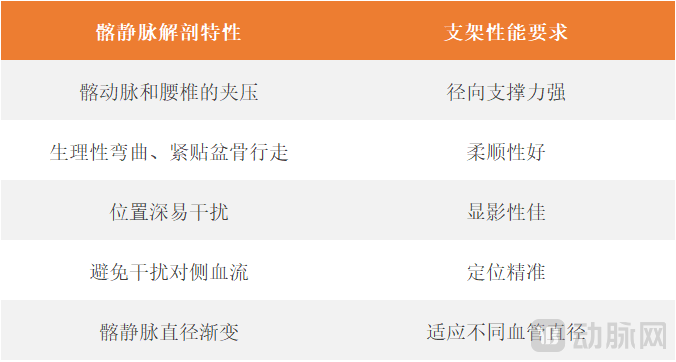
Anatomical Characteristics of Iliac Veins and Stent Performance Requirements Source: Venmedtech
However, the research and development barriers for dedicated iliac vein stents are relatively high, as they need to simultaneously meet the requirements of vascular compliance, radial support, and anti-kinking. Previously, only two imported products had been approved.
Venmedtech Takes the Lead in Layout of Peripheral Venous Intervention Products. In October 2018, the company's Venastent® iliac vein stent initiated a multi-center, randomized, parallel-controlled, non-inferiority clinical trial across 19 clinical centers in China, enrolling a total of 256 patients. The company completed all clinical enrollments in December 2019 and finished 12-month imaging follow-ups for relevant patients in December 2020, with a clinical follow-up rate of nearly 96%.
Venastent® Iliac Vein Stent is an original product with independent intellectual property rights. It features a large mesh coronal design at the proximal end, effectively avoiding the impact on contralateral blood flow when the stent enters the inferior vena cava and reducing the incidence of thrombosis. The front half of the stent mainly adopts a closed-loop mesh design to enhance support, while the rear half primarily uses an open-loop design to improve flexibility. Additionally, this iliac vein stent exhibits excellent imaging performance, enhancing the accuracy of stent positioning and deployment.

Venastent® Iliac Vein Stent Source: Venmedtech
According to experts involved in the clinical trial of Venmedtech's Venastent® iliac vein stent: "In previous clinical procedures, due to the large diameter of venous stents, there is generally a forward jump during deployment, which requires very high precision in positioning by the doctor. However, in front of the patient's iliac vein is a large cavity, with a narrow section in the middle and a wider common iliac vein below, making it difficult for every doctor to achieve precise positioning when deploying the stent."
Venmedtech considered this factor when designing the stent. The proximal end of the stent features a large crown design with three rows of clear marker points (Mark) for precise positioning, which will help doctors accurately deploy the stent during surgery. Additionally, the large mesh crown design at the front end of the stent greatly avoids disturbing the blood flow on the opposite side caused by the stent entering the lower cavity, thereby preventing thrombosis.”

Venastent® Iliac Vein Stent Source: Venmedtech
In vascular interventional surgery, the learning curve for doctors to master the iliac vein stent implantation technique is short, allowing for rapid adoption at the grassroots level. In recent years, with the rapid development of vascular surgery, the treatment rate and standardization of venous diseases have been increasing year by year. The emergence of a high-performance domestically produced iliac vein stent product will further promote the widespread treatment of iliac vein compression syndrome.
Since last year, Venmedtech has been expanding its sales team and building sales channels. Next, it will accelerate the promotion of the Venastent® iliac vein stent product across China. At the same time, the company is in contact with overseas enterprises and plans to launch its products outside of China through a "License-out" model.
Venmedtech, as the first company in China to focus on the treatment of venous diseases, has been able to take the lead in the field of venous intervention and launch the first domestically produced iliac vein stent, which is inseparable from its product development logic based on clinical needs and the strong support of its research and clinical expert team behind it.
Venastent® Iliac Vein Stent adopts a research and development model that combines medical and engineering expertise, with vascular surgery experts from well-known tertiary hospitals in China deeply involved in product development and providing positive and effective clinical guidance.
Since its establishment, Venmedtech has maintained effective interactions with clinical experts and developed interventional treatment products for venous diseases based on actual clinical needs.The company focuses on peripheral venous obstruction, stenosis, thrombosis, reflux and other diseases, continuously improving its industrial layout, and moving towards the direction of becoming a one-stop product platform for venous disease treatment in China.
Venous disease is one of the major diseases affecting people's quality of life and safety. Clinically, venous diseases account for approximately 60% of vascular surgical diseases, often occurring in the lower limbs, with an incidence rate about six times that of arterial diseases. There are over 100 million patients with venous diseases in China, but the treatment rate is low, and there is a lack of dedicated interventional treatment products for veins, indicating a clear clinical need.
With the improvement of social living standards and the intensification of population aging, the market for venous disease treatment is growing rapidly. In 2013, the market size of venous interventional devices in China was only 370 million yuan, reaching 890 million yuan in 2017. This rapid growth trend will accelerate with the increasing clinical application of venous interventional surgeries. By 2022, the market size of venous interventional devices in China is expected to reach 3.1 billion yuan, with a compound annual growth rate (CAGR) of 28.4% from 2017 to 2022.
AndAccording to CIB Securities, the market value of China's venous intervention devices, mainly used for treating common venous diseases such as varicose veins, deep vein thrombosis, and iliac vein compression syndrome, is approximately 19.46 billion yuan.
Venmedtech Founder Wang Yonggang Mentioned: "In the Rapidly Growing Field of Venous Interventional Treatment, Venmedtech Aims to Establish a Full Industry Chain Layout, but This Goal Cannot Be Achieved Overnight."
In the first phase, the company has obtained five NMPA product registration certificates, including the iliac vein stent system, peripheral balloon dilation catheter, endovascular foreign body retrieval device, great saphenous vein stripping catheter, and balloon inflation device. Meanwhile, the company’s product pipeline also includes thrombolytic catheters, mechanical thrombectomy catheters, and more.
Next, the company will also gradually expand into the fields of lower limb arterial and peripheral vascular treatment. The product range will also extend from access products to drug-device combination and functional products.
To gain a first-mover advantage and leading position in the venous interventional device market, Venmedtech's excellent clinical understanding and efficient execution are indispensable. Behind the company is a multidisciplinary team and a comprehensive patent layout. Founder Yonggang Wang has many years of experience in the cardiovascular interventional device field, and more than half of the company’s employees are R&D personnel, covering multiple fields such as medicine, engineering, and materials science.
Currently, Venmedtech has applied for 55 patents in China, with 38 granted, including 7 invention patents, 29 utility model patents, and 2 design patents. It has also applied for 7 international patents in the United States, Europe, Japan, etc., among which the patent application for venous stents in the United States has been granted.
In the future, Venmedtech will continue to improve the venous intervention product chain and gradually expand to cover peripheral artery disease treatment. The company, positioned on the peripheral disease treatment chain, will further consolidate its leading advantage in venous disease treatment through steady and solid R&D efforts.