

Global Top 10 Pharma Companies: R&D Budgets Up 16%, $106.2 Billion Pours Into Key Therapeutic Areas
Pfizer
Pharmaceutical R&D Developer
Since the outbreak of COVID-19 in 2019, humanity has unprecedentedly focused its attention on the medical field, which has become a powerful weapon in our fight against this "black swan." COVID-19 testing, COVID-19 vaccines, and anti-COVID-19 drugs... Humanity has been combating this black swan from various dimensions. However, over two years have passed, and the normalization of epidemic prevention and control has become a reality. Having undergone several mutations, the pandemic still shows no sign of ending, marking a protracted tug-of-war between humans and the virus.
As a leading global pharmaceutical company, it has undoubtedly become the "ammunition supplier" in this battle, from Pfizer's anti-COVID-19 vaccine Comirnaty to Merck's anti-COVID-19 oral medication Molnupiravir. According to statistics, almost all of the top 10 pharmaceutical companies in terms of global R&D investment in 2021 quickly added pipelines and operations related to COVID-19 after the outbreak of the pandemic. Among them, Pfizer has stood out in its business layout for COVID-19, not only developing a COVID-19 vaccine but also researching an antiviral drug for the disease. Moreover, Pfizer is actively working on the development of next-generation vaccines and drugs targeting the variants of the SARS-CoV-2 virus.
In addition to the pipeline business related to COVID-19,What Are the Top 10 Global Pharmaceutical Companies Focusing On? What Innovative Research Are They Conducting? How Much Human and Financial Resources Have Been Invested? And What Is the Current Progress?VCBeat (WeChat ID: idaifu) has compiled and analyzed the R&D investment fund flows of the global TOP 10 pharmaceutical companies through public data, attempting to identify patterns that serve as industry bellwethers for the benefit of readers.
R&D Investment Exceeds 20% of Revenue: Roche Spends 16.1 Billion, AstraZeneca Increases R&D Budget by 62%
According to the 2021 annual report data analysis of the top 10 global pharmaceutical companies in terms of R&D investment, Roche, Merck, Johnson & Johnson, BMS, Pfizer, Novartis, GSK, AstraZeneca, AbbVie, and Eli Lilly all invested more than 20% of their total revenue in R&D in 2021.
Among them,Johnson & Johnson topped the list with an annual revenue of $93.8 billion in 2021.Roche topped the list with a research and development budget of $16.1 billion, becoming the No. 1 in R&D investment among the top ten pharmaceutical companies globally in 2021. AstraZeneca increased its R&D spending by 62% compared to 2020, achieving the highest R&D expenditure ratio of 26% among the top ten pharmaceutical enterprises in 2021. The total R&D funds amounted to approximately $9.7 billion, accounting for 80% of the company's total expenditure in the previous two years.。
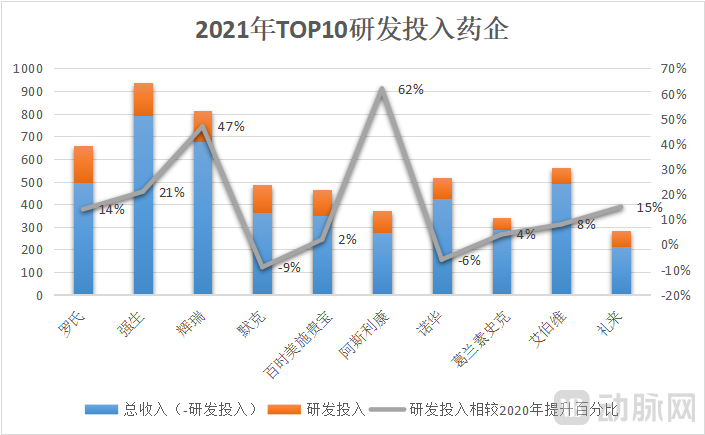
In 2021, the top ten pharmaceutical companies in terms of R&D investment spent approximately $106.2 billion on R&D and production. Which fields did such a huge amount of funding flow into, and what results were ultimately achieved? After a brief review, the author found that the primary destination for funding was the anti-COVID field, followed by increased investment in oncology and neuro-related disease areas.Among the global TOP 10 pharmaceutical companies, Merck and GSK remain highly active in the infectious disease field, while Novartis and AbbVie continue their strong enthusiasm for ophthalmic research.。
In addition, it was also found that there is some parallel competition among the global TOP 10 pharmaceutical companies in new technologies and new layouts. For example, Roche, Pfizer, and AstraZeneca are increasing their investment in new technologies.Small Molecule Degradersin terms of R&D efforts, and all three companies are targeting the same estrogen receptor (ER) for degrader development; in terms of COVID-19 treatment, several major pharmaceutical companies have coincidentally attempted "Cocktail Therapy", which seems to point out the mainstream path for future COVID-19 treatment.
Eight Pharmaceutical Companies Join "Anti-Epidemic" R&D, From Variant-Specific COVID-19 Vaccines to Treatments for Mild and Severe Cases
Through the collation of public information, we found that among the top 10 pharmaceutical companies in terms of global R&D investment in 2021, eight pharmaceutical companies invested part of their funds into "anti-epidemic" R&D. Bristol Myers Squibb (BMS) and AbbVie, which performed slightly worse, did not neglect the layout of businesses related to COVID-19; rather, the core flow of their R&D funds was not focused on combating the pandemic.
For example, Bristol-Myers Squibb (BMS) continues to focus its research on cancer treatment. In terms of COVID-19 business layout, the company collaborated with Rockefeller University in the U.S. for the first time in 2021 to develop a combination therapy for COVID-19 treatment, which is currently in Phase II clinical trials; AbbVie did not announce a collaboration with Scripps Research in the U.S. to develop antiviral treatments for COVID-19 until 2022.
1Pfizer Becomes the Biggest Winner in the "Epidemic Fight," with 2021 COVID-19 Vaccine Revenue Exceeding $36 Billion
Under the impact of the COVID-19 pandemic, Pfizer, as one of the top ten pharmaceutical companies globally, responded the fastest, with itsThe COVID-19 vaccine Comirnaty was the first to receive emergency use authorization from the EU and the U.S. FDA in December 2020, making it the first COVID-19 vaccine authorized for use in the United States., generating $36.781 billion in revenue for Pfizer in 2021。
According to Pfizer's 2021 annual report, sales of COVID-related products generated a total revenue of $36.857 billion for the company, accounting for 45.34% of its total revenue. Pfizer also stated in its annual report that the company’s focus will continue to be on the development of related products targeting COVID-19. "COVID-19 has not been 'eradicated,' and we will test different versions of the Comirnaty vaccine against multiple variants of COVID-19, including conducting candidate vaccine tests for Omicron."
2Johnson & Johnson's COVID-19 Vaccine Ad26.COV2.S Faces Scrutiny
Unlike Pfizer's fortune, Johnson & Johnson's Ad26.COV2.S, the third COVID-19 vaccine approved by the U.S. FDA (the second being Moderna's COVID-19 vaccine), has faced heavy skepticism.
In February 2021, Johnson & Johnson's COVID-19 vaccine Ad26.COV2.S was approved for marketing by the U.S. FDA. However, just two months later on April 13, the FDA urgently suspended the vaccination of Johnson & Johnson's COVID-19 vaccine across the United States. This was because six patients developed rare cerebral venous sinus thrombosis with thrombocytopenia (CVST) after receiving the Johnson & Johnson vaccine, one of whom died. By that time, 7.23 million doses of the Johnson & Johnson vaccine had been administered in the United States, with CVST occurring at a rate of approximately 87 per 100,000,000.
Although on April 23, 10 days later, the U.S. FDA resumed the use of Johnson & Johnson's COVID-19 vaccine after a thorough safety review confirmed that the risk of this side effect was extremely low, it also significantly undermined American public confidence in the vaccine, which will have a certain impact on the future sales of Johnson & Johnson's COVID-19 vaccine.
Even so, the Ad26.COV2.S vaccine brought substantial revenue to Johnson & Johnson. Despite the company's annual R&D investment increasing by 21% compared to 2020, the proportion of R&D investment to revenue only rose by 1%, thanks to increased income primarily related to the COVID-19 vaccine.
3AstraZeneca Publicly States It Will Not Profit from COVID-19 Vaccine

In the previous data on the increase in R&D investment, we can see that AstraZeneca increased its R&D expenditure by 62% in 2021, mainly for investment in "anti-epidemic" efforts and clinical trials.
AstraZeneca hasA COVID-19 Vaccine VaxzevriaAndA COVID-19 treatment drug Evusheld, bringing the company $4.1 billion in sales in 2021. Among them, Vaxzevria is the well-known Oxford/AstraZeneca COVID-19 vaccine, jointly developed by the University of Oxford in the UK and AstraZeneca. It was first granted Emergency Use Authorization by the UK's MHRA in December 2020. The EU approved the vaccine for use within the EU in January 2021, and it was officially named Vaxzevria in March of the same year.
Although the Phase III clinical data of AstraZeneca's Vaxzevria showed that its average efficacy rate (79% protection effectiveness) was lower than that of Pfizer and Moderna vaccines, AstraZeneca isThe Only Vaccine Developer Currently Committed to Not Profiting from the Global Pandemic, and it is also the only manufacturer that increases production by opening technical authorization to other vaccine manufacturers for participation.
It is reported that 90% of the vaccines distributed by the WHO-led global vaccine distribution program (COVAX) are AstraZeneca vaccines produced by the Serum Institute of India and SK Bioscience of South Korea.
4GSK Collaborates with Sanofi to Develop COVID-19 Vaccine
As a major vaccine manufacturer, GlaxoSmithKline (GSK) did not perform satisfactorily during the global outbreak of the COVID-19 pandemic. While peers such as Johnson & Johnson and Pfizer had already entered the commercialization phase of their products, GlaxoSmithKline (GSK) only began seeking partners for the joint development of a COVID-19 vaccine product in 2021. Moreover, these products will not reach key milestones until 2022 or later.
In 2020 and 2021, GlaxoSmithKline (GSK) respectively partnered with two biopharmaceutical companies, Sanofi and Medicago, to develop products related to COVID-19 vaccines.
Through the collaboration with Sanofi, GSK will provide adjuvant technology for pandemic disease prevention vaccines, complementing Sanofi’s S protein 2019-nCoV antigen based on recombinant DNA technology. By leveraging each other's strengths, they aim to accelerate the development of a recombinant protein COVID-19 vaccine. Clinical studies are currently being conducted simultaneously in the United States, Australia, France, and the United Kingdom, with Phase III clinical data expected to be released in 2022 in preparation for vaccine approval.
The collaboration with Medicago focuses primarily on the development of plant-derived vaccines, which are alsoThe World's First Plant-Based Vaccine, effective against multiple variants, with official reports indicating 71% efficacy. It induces high levels of neutralizing antibodies post-injection and allows for rapid, large-scale production. Recently released Phase III clinical data shows "a very robust immune response," making further developments worth watching.
1Pfizer Wins COVID-19 Vaccine, Oral MedicationFDA's First Batch"Double Crown"
Not only in the COVID-19 vaccine, but Pfizer has also made remarkable achievements in the performance of COVID-19 therapeutic drugs.Pfizer's COVID-19 oral drug Paxlovid is the first approved oral medication for COVID-19 in the United States., which was approved by the FDA for marketing at the end of 2021, and has authorized five Chinese pharmaceutical companies to produce generic versions of the drug.
Paxlovid is an oral antiviral medication for COVID-19 composed of two antiviral drugs, nirmatrelvir and ritonavir. Pfizer is developing a next-generation version of Paxlovid without ritonavir, with the first human trials expected to commence in 2022.
Benefiting from the COVID-19 vaccine Comirnaty and the oral medication Paxlovid, it is foreseeable that Pfizer will remain the biggest "winner" in 2022.
2AstraZeneca's COVID-19 "cocktail therapy" has been launched in Europe, the US, and the UK.

Like Pfizer, AstraZeneca is also pursuing both vaccines and therapeutic drugs.
Evusheld, a COVID-19 therapy independently developed by AstraZeneca, is a "cocktail therapy" consisting of two monoclonal antibodies: tixagevimab (AZD8895) and cilgavimab (AZD1061). Both monoclonal antibodies were derived from B cells donated by patients in the convalescent stage after SARS-CoV-2 infection. They were discovered by Vanderbilt University Medical Center and licensed to AstraZeneca in June 2020.
In December 2021, the U.S. FDA granted Emergency Use Authorization (EUA) for Evusheld, making it the only antibody therapy authorized in the U.S. for pre-exposure prophylaxis of COVID-19 and the only COVID-19 antibody administered via intramuscular injection (150mg tixagevimab and 150mg cilgavimab). In March 2022, Evusheld received approval for marketing in the European Union and conditional marketing authorization from the UK MHRA.
3Roche's Anti-COVID Drug: A "Shock" and a "Surprise"
Unlike Pfizer and AstraZeneca, Roche's R&D funding is mainly allocated to the development of COVID-19 therapeutic drugs. The company has respectively partnered with Regeneron Pharmaceuticals and Atea Pharmaceuticals for the development of COVID-19 related drugs.
Good news continues for Ronapreve, the anti-COVID therapy co-developed with Regeneron.Approved by the U.S. FDA in 2021 for the treatment of patients with mild to moderate COVID-19 infections, and has subsequently received emergency or temporary epidemic use authorization in more than 20 countries, including the European Union, India, Switzerland, and Canada. This is also an "antibody cocktail therapy" that combines casirivimab and imdevimab monoclonal antibodies, marketed as REGEN-COV in the United States and Ronapreve in other countries.
The post-exposure prophylactic oral antiviral drug AT-527 for COVID-19, co-developed with Atea Pharmaceuticals, was not as fortunate. Roche invested $486 million in the project, but it failed in Phase II clinical trials. Roche has now completely withdrawn from the development of this drug.
4Merck Abandons Patent Fees for COVID-19 Oral Capsule "Molnupiravir" Sold to 105 Developing Countries

During the COVID-19 pandemic, Merck & Co. collaborated with Ridgeback Biotherapeutics to develop an antiviral drug, Molnupiravir, which was first approved for marketing by the UK's MHRA and also received Emergency Use Authorization (EUA) in the United States. However, Molnupiravir is only applicable for treating mild to moderate COVID-19 infections in adults and is not suitable for severe cases.
Notably, Merck & Co. reached an agreement with the United Nations' "Medicines Patent Pool (MPP)",The company will not charge patent fees for the sales of Molnupiravir during the pandemic.MPP stated that it will distribute the drug to 105 developing countries according to regulations and allow 27 countries from Africa, Asia, and the Middle East to produce generic versions.
5Novartis Explores New Anti-COVID Therapy "Ensovibep"
In 2021, Novartis partnered with Swiss biopharmaceutical company Molecular Partners to launch a global multi-center Phase 2/3 clinical trial for the anti-COVID-19 therapy Ensovibep (MP0420), exploring the novel DARPin protein therapy for treating COVID-19. Ensovibep is a unique tri-specific DARPin protein therapy with synergistic target binding capabilities and potent viral inhibition efficacy.
DARPin molecules are constructed from DARPin protein modules. Compared with monoclonal antibodies, DARPin molecules are very suitable for pandemic environments due to their advantages of multi-specific target binding, long half-life supporting sustained activity, and highly scalable production.
6Eli Lilly Proposes New Approach for Anti-COVID Therapy
At the early stage of the COVID-19 outbreak, Eli Lilly proposed to treat the virus respiratory disease infection with traditional methods and developed the antibody treatment drug Bamlanivimab. This drug can prevent the virus from attaching to and entering human cells, thereby neutralizing the virus and potentially preventing and treating COVID-19. Based on Bamlanivimab, Eli Lilly combined it with Junshi Biosciences' Etesevimab to form a dual-antibody therapy, which received FDA Emergency Use Authorization in 2021.
However, as new COVID-19 treatment drugs have been successively launched, Eli Lilly and Company has gradually recognized the limitations of traditional therapeutic agents. The company has begun to roll out a new generation of anti-COVID-19 drug Bebtelovimab, which was recently disclosed in the published clinical results.Bebtelovimab remains active against the Omicron variant of COVID-19 and received FDA Emergency Use Authorization in February 2022.
Beyond COVID-19, Cancer Treatment Remains a Research Hotspot; Interest in Neurology and Infectious Diseases is Rising
Tumor treatment has always been an eternal hotspot in the field of new drug research and development. From traditional surgery, radiotherapy, and chemotherapy to the latest cell therapy and targeted therapy, emerging therapies have continuously propelled humanity step by step toward the goal of "completely curing cancer." The funding flow of the top 10 global R&D investments also shows that leading international pharmaceutical companies are no less enthusiastic about "anti-cancer" than "anti-epidemic," with nine out of the top 10 pharmaceutical enterprises prioritizing the progress of their tumor-related pipelines.
Roche, Pfizer, and AstraZeneca are currently increasing their efforts inBreast CancerProgress of Relevant Pipelines; Johnson & Johnson, BMS, and AbbVie Are AdvancingMyelomaTreatment-related pipelines; Roche and Novartis are advancing the development of lung cancer-related drugs; Eli Lilly is progressing with Phase I/II clinical trials for "Pirtobrutinib," a treatment for hematological tumors (leukemia, lymphoma).
In addition, in 2021, Roche, Novartis, AbbVie, and Eli Lilly all made significant investments in the neuroscience field, with Roche and Eli Lilly focusing onAlzheimer's Disease (AD)Pipeline Progress Update; Novartis, AbbVie TargetParkinson's Disease (PD)Carried out pipeline development and advancement.
Similarly, we also found that, in response to highly harmfulInfectious Disease HIVAbove, Bristol-Myers Squibb (BMS) and GlaxoSmithKline (GSK) also made updates in 2021, which we will cover in "What Are the Top 10 Global Pharmaceutical Companies Doing (Part 2)?》for further interpretation.
Beyond the popular fields, other funding destinations for the top 10 pharmaceutical companies in R&D investment also include ophthalmology, rare diseases, and diabetes. Roche has announced it will increase its R&D investment in China, Pfizer is concurrently developing a Lyme disease vaccine, Bristol-Myers Squibb's (BMS) blood thinner "Milvexian" showed outstanding performance in Phase II clinical trials, and Eli Lilly's anti-inflammatory drug "Mirikizumab" has completed Phase III clinical trials and is expected to be launched soon, which is worth looking forward to.
In summary, we can see that the R&D efforts of most of the top 10 global pharmaceutical companies have increased rather than decreased under the pandemic, compared to the year before last.Pharmaceutical companies invest more efforts in core areas such as "anti-epidemic" and "anti-cancer", and the focus of research and development has also shifted from the saturated COVID-19 vaccine to the development of COVID-19 drugs. Currently, China does not have any independently developed COVID-19 treatment drugs on the market, and the generic versions of COVID-19 treatment drugs for large pharmaceutical companies are being actively advanced.
In the face of the pandemic, there are no borders. We have witnessed the efforts made by leading global pharmaceutical companies for the health of all humanity, as well as their responsibility and commitment as industry leaders. Each of the top 10 has come a long way from their initial passion for the cause of human health, overcoming numerous challenges to reach where they are today. Fighting diseases knows no boundaries, and we can offer them more understanding and trust.