

Three Chinese TIL Therapy Candidates Enter Clinical Trials, Signaling a Breakthrough for Solid Tumor Treatment

Grit Biotherapeutics
Developer of Immunotherapy Drugs for Solid Tumors
Juncell Therapeutics
Solid Tumor Cell Therapy Developer
Chineo
Developer of Tumor and Immune Disease Therapeutics
DISCOVERY TO CURE
TIL Therapy Developer
Recently, multiple clinical approval news of TILs therapy products from companies in China have been successively sweeping the official accounts of various media.
On April 12, 2022, the official website of the Center for Drug Evaluation (CDE) of the National Medical Products Administration (NMPA) of China announced that ZL Biotech's first tumor-infiltrating lymphocyte (TILs) new drug, ZLT-001 Injection, has been accepted for review.
On April 22, 2022, the CDE website announced that GT101 Injection (acceptance number: CXSL2200061), independently developed by Grail Bio, has officially received clinical trial tacit approval from the National Medical Products Administration (NMPA); GT101 Injection is the first tumor-infiltrating lymphocyte drug approved for clinical use in China.
On April 24, 2022, the TIL cell drug "Autologous Natural Tumor Infiltrating Lymphocyte Injection (GC101 TIL)" (Acceptance No.: CXSL2200070), independently developed by Juncell Therapeutics, officially received the clinical trial implied permission from the National Medical Products Administration (NMPA); GC101 TIL isThe world's first natural TIL cell drug that requires no lymphodepletion and no IL-2 injection.
Multiple milestone advancements in China's TILs therapy field have further fueled the booming development of the TIL sector.Firewood”。
Adoptive Cell Transfer Therapy (ACT) refers to the process of isolating immunologically active cells from cancer patients, expanding and functionally characterizing them in vitro, and then infusing them back into the patient to directly kill tumors or stimulate the immune system to respond against tumor cells. Adoptive cell transfer therapy mainly includes LAK, DC, CIK, DC-CIK, CAR-T, TCR-T, NK, CAR-NK, TILs, etc.
After decades of research, the main outstanding performances in various ACT therapies at present areCAR-T、TCR-T、TILsThese three cell therapies.From the development history of these three cell therapies alone, the history of TILs therapy is no shorter than that of CAR-T and TCR-T, but its "fame" seems to have come more slowly than that of CAR-T and TCR-T.
InCAR-TFor example, since the FDA approved two CAR-T products in 2017, more than 10 CAR-T products have been successively approved worldwide so far—six CAR-T products have been approved by the U.S. FDA, three by the EU, and two CAR-T products have been approved in China. It can be said that since the approval of the first product, CAR-T has entered its "highlight moment," and more CAR-T products are still on the way to being approved, ready to launch.
TCR-TAlthough no products are currently approved for marketing, the frequent "money-raising" news from multiple TCR-T startups and the announcements of numerous pharmaceutical giants betting on the TCR-T field have drawn significant public attention. Top pharmaceutical companies such as Roche, Bristol-Myers Squibb (Celgene), GlaxoSmithKline, and Amgen have initiated strong collaborations in the TCR-T space, with successive "buy-buy-buy" actions serving as the best endorsement for the industry. There are quite a few companies in China researching TCR-T therapies. In September 2020, the U.S. FDA approved the IND application for TCRT-ESO-A2, a product of Xiangxue Precision, a TCR-T company in China, marking the first TCR-T project in China to receive FDA clinical trial approval.
By contrast, the "path to fame" for TILs therapy has been much slower.The tipping point came in 2019. At the 2019 ASCO conference, Iovance Biotherapeutics, a leading company in TIL therapy, announced significant clinical trial results for its TIL product pipelines LN-145 and LN-144 in treating patients with recurrent metastatic cervical cancer and malignant melanoma, drawing widespread attention from the medical industry. In the same year, the FDA granted LN-145, developed by Iovance, Breakthrough Therapy Designation for treating patients with recurrent, metastatic, or persistent cervical cancer after chemotherapy — marking the first time a cell-based immunotherapy for solid tumors received such an honor, demonstrating the potential of TIL therapy in treating solid tumors.
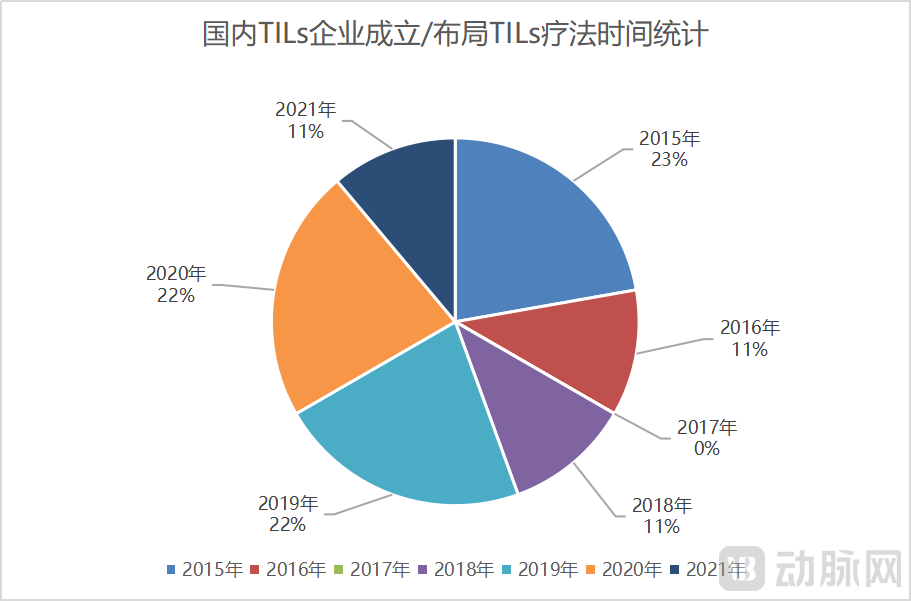
Since then, the industry's enthusiasm for TILs therapy seems to have truly ignited. According to incomplete statistics from VCBeat,Among nearly 10 companies in China developing TILs therapy, more than 50% were established or began laying out TILs-related businesses in 2019 or later.
Since the 1980s, when Steven A. Rosenberg and others first discovered that TILs could inhibit the metastasis of malignant melanoma cells in patients,TILs therapy has undergone more than 30 years of development, with a longer history than CAR-T and TCR-T.And in 1988, the earliest clinical attempt at treatment was initiated, achieving an objective response rate (ORR) of 60% in treating metastatic melanoma.
So, why has TIL therapy, despite being the earliest to "set out," been the slowest to "gain fame"? What issues have plagued the advancement of TIL therapy over the past 30-plus years? What significant progress has been made in this field that has brought TIL therapy into the "spotlight" in recent years? In terms of treating solid tumors, how much market potential does TIL actually offer us? With these curiosities and questions in mind, VCBeat has formed this article.
The above multiple questions correspond to multiple answers, which we mainly divide into two aspects to answer.The first aspect is some limitations faced by CAR-T and TCR-T in the treatment of solid tumors.
CAR-T has indeed achieved remarkable success in the treatment of hematological tumors. Compared with autologous CAR-T, universal CAR-T therapy shows great potential in terms of patient accessibility due to its low drug cost, stable quality, and high preparation success rate, which make it possible for standardized mass production, timely supply, and cost reduction. This has attracted numerous researchers and companies. However, when it comes to solid tumors, which account for over 90% of cancers, CAR-T faces significant challenges.
First,CAR-T can only recognize antigens on the surface of tumor cells, but is "powerless" against tumor-associated antigens expressed inside the cells.——But nearly 90% of tumor cell proteins are located inside the cells. In terms of the specificity of tumor antigens,In addition to mutant-derived target antigens, such as EGFRviii, it is difficult for CAR-T to find safe target antigens that are only expressed on the surface of tumor cells and not on normal tissues;This severely limits the dosage of CAR-T cells, preventing them from reaching an effective therapeutic dose.
In addition,Since CAR-T has too strong an affinity for antigens, it tends to accumulate on the surface of tumor tissues, leading to T cell exhaustion, making it difficult to enter the interior of the tumor for expansion and exert cytotoxic effects.The killing effect on solid tumors is limited. Universal CAR-T cells also face high preparation difficulties and higher potential clinical risks.
TCR-TCompared with CAR-T, it can recognize more target antigens, including antigens on the intracellular and cellular membranes. TCR-T also has unique advantages in targeting neoantigens generated by tumor cell mutations. Therefore, TCR-T also holds certain potential in the field of solid tumor treatment. However,Since TCR-T antigen recognition relies on HLA presentation, and the variety of MHC in the human body is extensive with variations in antigen expression among individuals, the clinically available TCR sequences are limited.Although there are many TCR-T pipelines currently entering the clinical stage, most of them are still in the relatively early clinical research stages of Phase I and II.
In contrast,TILs TherapyThe astonishing clinical efficacy demonstrated in the treatment of solid tumors is particularly striking. This is also the direct reason why TILs therapy has received significant attention from various capital and enterprises in recent years, and its popularity in the industry has soared.
In addition to the significant clinical trial results of LN-145 and LN-144, two products developed by Lovance, in treating patients with metastatic cervical cancer and malignant melanoma, which garnered widespread attention in the medical community at the 2019 ASCO conference, subsequent...The news of TILs therapy showing significant clinical efficacy in treating various solid tumors has continuously and strongly stimulated the nerves of both the scientific research and industrial communities.
On August 12, 2021, a groundbreaking study on TILs therapy was published in the top journal *Nature*. The study showed that for advanced lung cancer patients who did not respond to PD-1 treatment and were extremely difficult to treat clinically, treatment with TIL as a cell therapy enabled some NSCLC patients who had no response to PD-1 inhibitors to achieve long-term remission. More encouragingly, in this proof-of-concept clinical trial, the tumors of two patients completely disappeared and they remained in remission for over a year and a half. Most patients began to show significant tumor regression on CT scans after their first TIL treatment.
In November 2021, at the annual meeting of the Society for Immunotherapy of Cancer (SITC), Iovance announced the clinical research results of its TILs therapy product LN-145 in treating metastatic non-small cell lung cancer (mNSCLC). In the study, 28 patients with recurrent/refractory mNSCLC were treated with LN-145 monotherapy, achieving an overall response rate (ORR) of 21.4% (1 complete response and 5 partial responses, including 2 PD-L1 negative tumors), with 12 cases showing stable disease and a disease control rate (DCR) reaching 64.3%.
Even in patients who develop PD-1 resistance, TILs therapy can still achieve good treatment outcomes.According to Iovance's data, TILs therapy still achieved an overall response rate (ORR) of 36% in melanoma patients resistant to PD-1 antibodies; for non-small cell lung cancer patients resistant to PD-1 antibodies, TIL therapy can still reach an ORR of 21%.
Combined with PD-1 monoclonal antibody therapy for patients with advanced solid tumors, TILs therapy has achieved even more impressive clinical outcomes.(More latest clinical data on TILs therapy for solid tumors, clinical progress of related products from TILs companies in China, VCBeat previously reported atThe First Solid Tumor Cell Therapy Product is About to be Born, Will This Field Be the Hottest Topic This Year?For detailed disclosure, see elsewhere.)
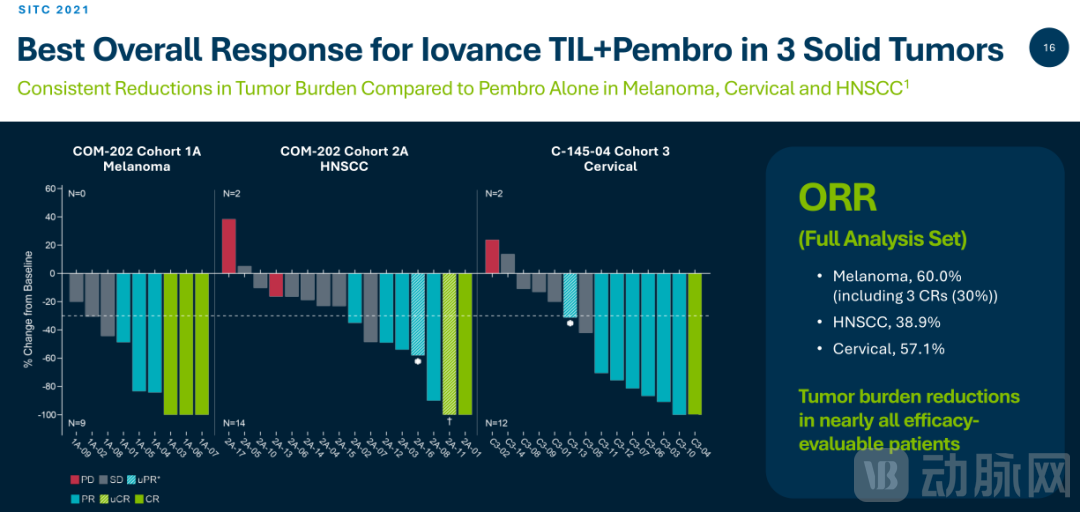
From December 11-14, 2021, at the annual meeting of the Society for Immunotherapy of Cancer (SITC), Iovance Biotherapeutics presented clinical data on the TILs therapy Lifileucel (LN-144) in combination with the PD-1 antibody Pembrolizumab for the treatment of various solid tumors.
In addition, in terms of safety, since TILs are derived from the patient's own body, they are not recognized as foreign antigens by the immune system; thus, TILs therapy is particularly outstanding in terms of safety.In the more than 30 years of TILs therapy development, researchers have not yet observed any significant side effects inherent to TILs themselves.
Currently, clinical trials of TILs therapy have been conducted globally for various solid tumors, including metastatic melanoma, nasopharyngeal carcinoma, squamous cell carcinoma of the head and neck, cholangiocarcinoma, recurrent or refractory ovarian cancer, osteosarcoma, cervical cancer, ovarian cancer, non-small cell lung cancer, glioblastoma, and pleural mesothelioma. TILs therapy has shown efficacy in treating these cancers, includingMetastatic melanoma, squamous cell carcinoma of the head and neck, cervical cancer, non-small cell lung cancerand have demonstrated clinical value in a variety of solid tumors.
One more point to mention is that although PD-1/PD-L1 monoclonal antibodies are called "miracle drugs for cancer," their objective response rate (ORR) is not high, generally between 10% and 30%. The overall clinical treatment efficacy rate is basically no higher than 20%, and it is only effective for some patients. Moreover, once patients develop drug resistance, subsequent treatment will become even more challenging.
In such a situation, the remarkable efficacy of TILs therapy in treating solid tumors has rekindled hope for patients with advanced solid tumors.Insensitive to PD-1/PD-L1 drug treatmentFor patients,For patients who develop resistance to chemotherapy drugs or immune checkpoint inhibitorsFor patients,For those who have undergone various treatment options but have yet to achieve satisfactory therapeutic outcomesFor cancer patients, TILs therapy is the only effective treatment worth trying and also the second chance for these patients to pursue survival.
"TILs therapy is not only a great blessing for patients, but also a kind of 'redemption' for clinicians. Every time when we have tried various treatment options but the patient still shows little improvement, we feel heartbroken yet helpless," said Dr. Feng Li, expressing his feelings about treating many advanced cancer patients in clinical practice. "That sense of powerlessness really makes one feel particularly distressed."
Dr. Feng Li has over 10 years of cumulative experience in the development and clinical application of innovative immunotherapies for cancer, as well as 5 years of experience in the development and production of TIL therapy at the TIL Lab of MD Anderson Cancer Center. Having extensively researched TIL therapy, she has personally witnessed its remarkable efficacy for cancer patients. To bring this cutting-edge technology back to China and enable domestic patients to benefit from more advanced cancer treatment options as soon as possible, she returned to China with two other co-founders and established Suzhou Lanma Medical Technology Co., Ltd. Dr. Feng Li is a co-founder and the CSO of Lanma Medical.
The second aspect is that TILs therapy has been able to develop "vigorously" in recent years, based on the significant progress made in this field by the scientific research community and the industry over the past 30-plus years.
First, the issue of "difficulty in surgical sampling" for TILs in advanced cancer patients has been largely resolved.For many patients with advanced tumors, they usually no longer have surgical indications, making it difficult to obtain suitable samples of surgically removed tumor tissues through surgical means. In the past, under such circumstances, it was very challenging to implement TILs therapy for these patients.
But now, this situation has changed significantly. "With the iteration and breakthroughs in technologies such as TIL expansion and culture, our current success rate of culturing TILs through tumor biopsy samples is also very high. In terms of sample collection, it may not be a particularly big issue for most patients at present," said Dr. Feng Li.
Suzhou Lanma Medical Technology Co., Ltd. currently has a plan to establish a "TIL Bank" – hoping to culture TILs from tumor tissues obtained through early surgery from certain cancer patients, especially those prone to metastasis and recurrence. Once the TILs are cultured to a specific stage, they will be stored long-term so that when patients need them, further expansion and refinement can be performed before being reinfused into the patient for treatment.
Secondly, the "waiting" risk for advanced cancer patients caused by the long preparation cycle of TILs therapy in the past—where patients might not survive until the TILs product was ready for reinfusion—has now been largely eliminated.
Influenced by various film and television works, we often have this impression of end-stage cancer patients: the moment they receive a diagnosis of advanced cancer, it means their days are numbered, and they could pass away at any time within a short period. However, the reality is not that bleak. With the continuous advancement in various cancer treatment options over the past few decades, for most patients with advanced cancer today, a survival period of 1.5 to 2 years or even longer can actually be achieved.
"At present, I am in clinical practice, and most of the patients I treat have advanced stage 3 or 4 tumors with basically no indication for surgery. Many patients arrive with very poor PS scores; some are even bedridden, suffering from pleural effusion and ascites. However, even for these patients, after receiving certain treatments such as less-sensitive chemotherapy or interventional therapy, they can still achieve relatively good outcomes, sometimes extending survival to around two years. Of course, this depends on the specific type of cancer. But for the majority of late-stage cancer patients, their survival period generally lasts about six months to one year," explained Dr. Feng Li.
So, what is the production cycle of TILs therapy? Currently,Companies represented by Iovance have been able to shorten the production cycle of TILs therapy to a minimum of 16 days.(LN-144, produced by the third-generation process). Of course, the production cycle of TILs therapy for different indications and different cancer patients may vary. However, TILs therapy companies represented by Iovance, including Instil’s ITIL-168 (with a production cycle of about 24 days), have basically been able to control the production cycle of TILs therapy within one month.
In other words,Under the current medical standards, the one-month production and preparation time for TILs is generally not a significant issue for the vast majority of advanced cancer patients, and it is rare for patients to pass away before receiving TIL therapy.Over the past 30 years, advancements in various cancer treatment options and the shortened production cycle of TILs have significantly enhanced the application of TILs therapy for patients. Dr. Feng Li stated that TILs therapy has developed rapidly in recent years, with improvements and iterations to the process occurring approximately every one to two years.
Over the past thirty years, the commercialization progress of TILs therapy has been relatively slow. Another significant issue lies in the challenges that TILs therapy faces in terms of its technical process.For example, the activation and effective expansion of TIL cells, etc.
TILs Therapy Requires 100 Times More Cells Than CAR-T Therapy to Be Effective, Approximately 30-50 Billion Cells, but There Are Technical Challenges in Large-Scale Expansion of TILs. Additionally, Since Most TILs Are Exhausted T Cells, Their Killing Ability Is Relatively Weak. Therefore, High Doses of IL-2 Are Needed to Activate TILs During In Vitro Expansion. However, Excessive IL-2 Can Cause Systemic Toxicity and May Promote Treg Cells That Suppress the Anti-Tumor Response of TILs. Thus, The Dosage of IL-2 Needs To Be Controlled Within An Appropriate Range.
To screen and extract the most potent TIL cells, enhance their activity while minimizing the toxic side effects of the therapy, companies specializing in TILs therapy each possess their own "secret techniques."For example, Obsidian Therapeutics uses genetic engineering to enable TIL cells to express membrane-bound IL-15, eliminating the need for patients to undergo IL-2 treatment after TIL cell infusion. This enhances the persistence of TIL therapy while reducing its toxic side effects; Chineo enhances TIL cells through genetic modification, enabling them to overcome tumor microenvironment barriers and replicate almost indefinitely in vivo, achieving potent anti-tumor effects; DISCOVERY TO CURE combines non-invasive tumor detection screening with research and application in the field of precision cell therapy. By leveraging bioinformatics and artificial intelligence technologies to deeply mine multi-omics data of tumors, it can efficiently and accurately extract and purify the most potent tumor-fighting TIL cells...
For more than 30 years, thanks to the continuous exploration of countless dedicated individuals in the scientific research and industrial communities,Companies like Iovance and Instil Bio have gradually addressed several challenges faced in the TILs therapy process.And gradually push TIL towards commercialization, starting to become a standard product.
Why is the commercialization of TIL progressing so slowly? Steven Dai, Ph.D., founder and CEO of Suzhou Lanma Medical Technology Co., Ltd., explained the reasons to VCBeat: "The extraction, expansion, and activation of TILs may seem simple, but they are not. This is because, over the past 30-plus years, both the scientific research community and the industry have not fully understood the specific mechanisms of action of TIL therapy or the detailed processes of how it treats tumors. Therefore, the commercialization of TIL products has been like groping in the dark, which is a gradual process."
Steven stated that for a product, in addition to meeting "safety" and "effectiveness," the aspects of "standardization," "stability," and "controllability" are also very important: "As a personalized therapy, TIL is actually difficult to standardize and control for patients. For example, the activity of TIL cells varies among different patients, and the quantity of TIL treatment required also differs from patient to patient.""In the specific process, many factors are affecting the commercialization of TILs therapy products."
Over the past 30 years, both the scientific and industrial communities have conducted a significant number of research trials to address the many challenges TIL faces as a "standard" product in terms of manufacturing processes. It is precisely because of breakthroughs achieved in recent years that the commercialization of TIL has been able to advance at an increasingly rapid pace. According to data from ClinicalTrials.gov, there are currently 383 ongoing clinical trials related to TIL worldwide.
For an emerging biotechnology treatment, it seems premature to discuss pricing at this stage. From the FDA's attitude towards drug review and approval, it is also evident that addressing unmet clinical needs is always the primary goal of new drug development. However,For TILs therapy, the issue of price/cost has indeed been one of the main reasons affecting its development in the past.
The various issues mentioned above that TIL has faced in the past have slowed down its commercialization process, with a large number of clinical trials studying TIL mainly carried out by research institutions. In this situation, the high cost of TIL therapy has made many patients hesitate to pursue it.
"Previously, at MD Anderson Cancer Center, including NCI, the cost for treating a patient was approximately $250,000—a price that is already a loss for the institution, but for patients, it remains a significant and unaffordable expense for ordinary families. Insurance companies do not cover or share the related treatment costs. This results in fewer overall cases being conducted, with no large-scale clinical cases available to advance research on TILs therapy."
Today, as TILs therapy moves further toward commercialization, issues related to pricing and costs are gradually being brought to the agenda. With the future market entry of TILs therapy products, advancements in related technologies, and the maturation of production and manufacturing processes, there is no doubt that the cost and price of TILs therapy will naturally decrease over time.Due to its relatively simpler preparation process compared to other types of immune cell therapies, TILs therapy may even be more accessible in terms of cost.
Nowadays, as a large number of overseas elite teams bring the most cutting-edge technologies and experiences back to start businesses in China, the research and development of TILs therapy products are gradually carried out domestically. The overall costs for reagents, personnel, etc., will be further reduced.The price of TILs therapy products produced in China will be more attractive at that time, while expanding the global patient market.
TILs therapy, which can precisely and effectively "target" solid tumors that account for more than 90% of all tumor categories, has a promising future market space worth envisioning.
Chinese enterprises aiming to secure a position in the global medical market, or even achieve "overtaking on a curve," should focus on the cutting-edge field of gene and cell therapy. Among these, TILs therapy is undoubtedly a promising contender.
In 2021, the average single financing amount for TILs therapy-related companies in China was 220 million yuan. (For more details on TILs therapy track investments and financings in China, see VCBeat's previous article.)《Which of the 8 Startups in China Will Become the Biggest Dark Horse in the TIL Field?》)
In 2022, the products of three TILs therapy companies in China gradually entered clinical trials—among them,DISCOVERY TO CUREChineo's TILs therapy product was approved by the FDA to enter Phase 1 clinical trials in February this year;Grit Bio, Juncell TherapeuticsThe TILs therapy products received clinical trial implied permission from the National Medical Products Administration (NMPA) on April 22 and April 24, respectively.In addition,Zhilin BioThe clinical trial of the TILs therapy product was also accepted by the CDE on April 12. More TIL startups, such as Juncell Therapeutics, Chineo, and Suzhou Lanma Medical Technology Co., Ltd., are also expected to make rapid breakthroughs.

With the return of some senior and excellent scientists and industry professionals who have深耕ed in the TILs therapy field abroad for many years, China has entered a fast development track in the TILs therapy field. If Iovance's TILs therapy product Lifileucel can be successfully launched this year, enthusiasm for TILs therapy in China is bound to reach a new level.In 2022,For TIL, it is destined to be an extraordinary year.
In the next few years, in ChinaWhat new stories will be told and what new chapters will be opened in the field of TILs? We wait and see.